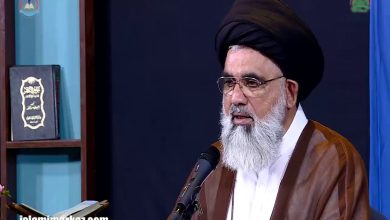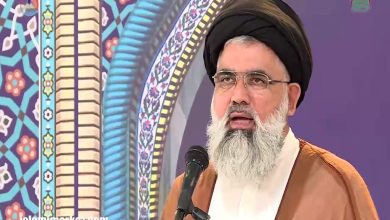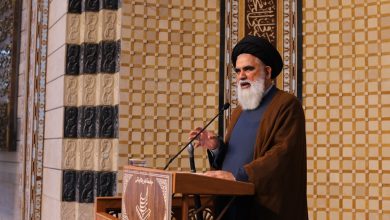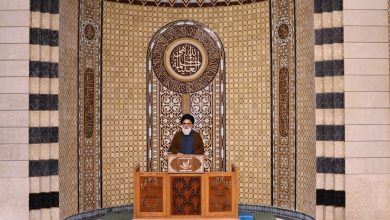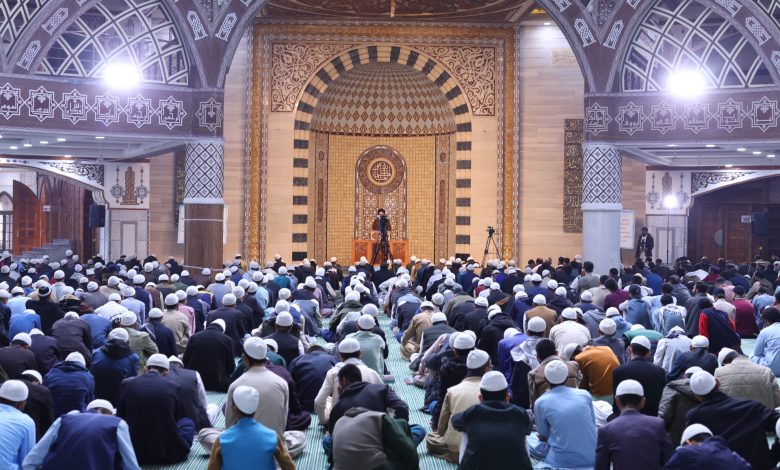
Hujjatul Islam Ustad Syed Jawad Naqvi
(Principal Jamia Orwatul Wuthqa – Lahore)
Delivered at: Masjid Baitul ul Ateeq
Lahore – Pakistan
Friday Sermon 13th Feb – 2026
Sermon 1: From Naas to Ummah: The Qur’anic Project of Unity
Sermon 2: FIR for Jamea in Lahore for protest in Islamabad
SERMON 1
You must become Ummah and you must make Ummah. And for Ummah-making, according to the procedure Allah has set, the Prophets tried to bring human beings out of the initial state of naas and bring them toward Ummah. But at the same time the Qur’an said that the Prophets tried to take naas out of that initial state and give them the form of Ummah, yet some others broke the constructed Ummah, made it into pieces, made its parties, made its organizations, and made its groups and sects. In this way, wherever the noble Prophets succeeded in forming Ummah, those people broke that Ummah and shattered it, breaking it into fragments and scattering it into parts.
This stage is very important, because the foundation of guidance is Ummah-making and Ummah-recognition—Ummah-making and then Ummah-preservation. In Surah al-Mu’minun, in verses 52 and 53, the command is about Ummah-preservation: that after making Ummah it is in danger; there is a danger of it breaking, and various factors break Ummah. Therefore taqwa must be adopted. It was said earlier: this is an Ummah, it has been formed, it has passed through the stage of formation, and now you must protect it.
And for Ummah, the second pillar Allah has stated is Allah’s rububiyyah:
وَأَنَا رَبُّكُمْ فَاتَّقُونِ
“I am your Lord.” Clearly, the necessary pillar for breaking Ummah—the rope by which Ummah is bound, tied, and made one—is the rububiyyah of Allah. And when people are taken out from Allah’s rububiyyah and pushed into the rububiyyah of Allah’s partners or others besides Allah, or people themselves go into the rububiyyah of others, then from here the work of breaking Ummah begins, and the work of tearing Ummah apart starts. Ummah-making too is carried out by the rope of Allah’s rububiyyah, in this same axis. This topic is very prominent in the Qur’an, and likewise the Messenger of Allah (صلی اللہ علیہ وآلہ وسلم) made this topic very prominent and placed it at the top, because this is the headline of guidance. A headline is what is placed at the top; it means the main heading. The great heading—the chief heading—of the Qur’an’s guidance and the Messenger’s guidance is exactly this: to make naas into Ummah, and then to preserve the Ummah.
Likewise, Allah has described the system of Imamah in the Noble Qur’an for the guidance of the Ummah: for Ummah-making and for Ummah-preservation, for guarding the Ummah, for protecting the Ummah—Allah has appointed a systemic Imamah. But in religious understanding, both of these have been lost: Ummah as well as Imamah. The name of Imamah remains, but the spirit of Imamah—because the spirit of Imamah is system; Imamah being a system is the spirit of Imamah—this spirit has been removed from the system of Imamah. Ummah was not presented as a system; rather Imamah was presented as a belief, and as a spiritual office, a ma‘nawi office, and a malakuti office. The spirit of system has been taken out of it. The mention of Ummah has been forgotten from the very beginning; the mention of Imamah remains.
However, we cannot say that among all Muslims and believers and among the readers and teachers of the Qur’an there is the mention of Imamah. There is one school: the Imami Shi‘a school, who kept the title of Imamah alive—kept the name alive, kept the word—but became deprived of the spirit, deprived of the spirit of Imamah. Other people moved away even from the word Imamah; they were given substitute words for Imamah, and they are living with those concepts and those terminologies. Toward the substitute concepts of Imamah, the Imami Shi‘a preserved the word/title Imamah, kept it established, but by taking out the spirit. And the other Shi‘a—(and) the system of Imamah and Ummah—both have forgotten Ummah: they forgot this term too, and its title too, and its content too, and they lost its meaning and concept. Imamah and Ummah—both—while the Qur’an presented both prominently and made them the chief heading of guidance.
Now, in some places the title of Ummah and Imam appears inside a verse, and in some places there is mention of Imamah and Ummah itself, but the terms Imam and Ummah are not used; rather its pillars, its system, its details, or some of its aspects have been stated under other terms. For example, this “sirat al-mustaqeem” and the “sirat al-mustaqeem” of those upon whom You have bestowed favor—there is neither the name of Ummah nor the title of Imam, but the content is the same: it is the content of Imamah and Ummah. Surah al-Fatihah entirely, and likewise other verses of the Qur’an.
Because Ummah-recognition is the first step, Imam-recognition or Imamah-recognition is the first step—its ma‘rifah should be attained. As the Imams of guidance emphasized: those people are ignorant and die the death of ignorance who are not Imam-knowers, not Imamah-knowers, who have no recognition. And a whole generation lives its entire life and dies, living with tyrants, living with worldly people, walking on paths against the Imam or on substitute paths for the Imam, and they assume they are believers because they kept doing acts of worship, kept doing spiritual exercises, and performed other deeds—so they think they are dying a blessed death. Whereas the Imam and the Messenger said: this is the death of ignorance.
“man mata wa lam ya‘rif imam zamanihi mata mitatan jahiliyyah”
Whoever dies and cannot recognize the Imam of his time—recognition does not mean recognizing his name or lineage; recognition does not mean that. If he did not live under his Imamah—by following the system of his Imamah and being obedient under it—if he did not spend life under his wilayah, then this is the death of ignorance. And the outcome of the death of ignorance is not Paradise; it is Hell. A person does not go to Paradise after dying the death of ignorance; he goes to Hell. It is a very frightening end.
On the other side, in the narration it is said: if you want to recognize the Imam, then how will you recognize him? Just as the hadith says: if you want to gain ma‘rifah of Allah, gain it through Allah’s rububiyyah; if you want to gain ma‘rifah of the رسول (Messenger), gain it through the guidance of the Messenger; and if you want to gain ma‘rifah of the Imam—if you want to recognize the Imam of the time—then gain his ma‘rifah through Imamah: through amr bil-ma‘ruf and through his practical system. Recognize who is the Imam of your time.
And this is the precise point that ‘Allama Iqbal translated:
“Tu ne poochhi hai imamat ki haqeeqat mujh se
Haq tujhe meri tarah sahib-e asrar kare
Hai wohi tere zamane ka imam-e barhaq
Jo tujhe hazir-o maujood se bezaar kare”
The Imam-e barhaq is recognized by his performance. Who is the Imam of every generation? What Iqbal understood from the Qur’an and the teachings of the Messenger is this: the Imam-e barhaq is the one who brings a human being out of the present corrupt, unpleasant, and undesirable condition and brings him into Allah’s servitude, Allah’s obedience, and Allah’s rububiyyah—he is the Imam-e barhaq. And the one who makes Muslims worshippers of kings, tyrants, rulers, and oppressors—he is fitnah; his Imamah is fitnah.
For Millat-e Bayzah and the Islamic Ummah—if only all religious scholars had such clear understanding as Iqbal’s clear and transparent understanding. This is an important point for the ‘ulama: the understanding of the ‘ulama is filled with doubts, suspicions, and objections. Their method of teaching is such that even if doubts and suspicions do not arise, they are produced. It is a common method among ‘ulama and fuqaha: in the academic environment it is said, “in qulta, qultu”—if you say this, I will say that; if you say that, I will give this answer. Now that “you” who is not there has been assumed—this “you” is assumed by the religious scholar himself; the objector and the questioner is assumed by himself. If “you object”—that “you” is nowhere; no one has made any objection. They have assumed a twin of their own who objects to them, and they answer him. In this way, religious understanding begins with doubts and suspicions, begins with refutation and denial, then begins with “qultu and in qulta,” and until the end there remains no peace or satisfaction; they do not reach certainty; there is no transparent understanding. From tawhid to ma‘ad, whatever issues you look at, the ‘ulama have difficulties and objections in every issue, and in their minds they also carry the objections and doubts of others. “This is the view of such-and-such knowledge”—their minds are filled with differing sayings, and therefore there is no certainty or confidence.
Iqbal’s mind is free from “in qulta and qultu.” There is the Qur’an and the teachings of the Messenger, therefore there is a completely firm, clear, and transparent understanding. Meaning, regarding Imamah there is no denial in Iqbal’s mind. He says: I know the reality of Imamah; if you want, come to me and I will explain it to you—but in that case it is necessary that you become sahib-e asrar; your being na-rabaz is an obstacle; it is necessary for you to be sahib-e asrar so that I can explain Imamah to you. And Imamah, in clear two words, is this: this is the Imam-e barhaq of your time, and that is fitnah of Millat-e Bayzah. No one has presented such a clear picture of Imamah: this is Imam, and that is not Imam, rather it is fitnah in the name of Imamah.
The Qur’an too has presented the picture of Imamah and of Ummah in the same clear words, without doubts and suspicions, without “in qulta, qultu.” The style of religious understanding has become complicated, and one discipline that has taken responsibility for Imamah is ‘ilm al-kalam—polemical knowledge, meaning the kind in which first a dispute and conflict is raised and then the scholarly talk is done. Without dispute no mutakallim can speak. A philosopher does not need dispute; a philosopher only needs a question: if there is a question on a topic or there is ignorance, he solves it and resolves it. But a mutakallim needs quarrel, needs a rival, an opponent, a denier, so that he can engage with that denier, argue with him, and then overcome him. A mutakallim finds satisfaction when he knocks down his opponent, silences him, shuts his mouth. But a philosopher feels happiness when he discovers the truth—whether someone is opposing him or not—when the truth becomes clear, he becomes very happy.
Like a scientist: when a secret of the universe becomes clear to a scientist, he becomes very happy for a lifetime, and it is written in his name that he discovered this secret. A scientist has no time to quarrel; he is only in pursuit of uncovering reality and the laws of nature. But the مولانا wants an opponent whom he can defeat, silence, give a tooth-breaking answer to—if the opponent has no teeth that can be broken, then they do not like him as an opponent; they want such an opponent who has all thirty-two teeth so that this مولانا can break his mouth with an answer and break all his teeth, then he becomes happy. This is a temperament. Where does a person reach truth in this temperament? If a person is a lover of truth and a seeker of truth, he reaches truth; and if you only have to knock down an opponent, then whether truth comes to hand or not, breaking the opponent’s jaw is necessary—he should surrender, even if the truth becomes clear to no one. These are the afflictions of religious understanding.
And the present generation—if they have an inclination for religious understanding, if they get an opportunity and time—then adopt a clear path. The complicated path of religious understanding will entangle you; in it you will never reach a conclusion. You will start doubting Allah’s existence; the method itself is like that. This religious learning makes even a believer doubting. A person is a believer, has firm faith, but he reads a book, goes to a teacher, and starts doubting everything.
Imamah and Ummah are such clear topics in the Qur’an, in the teachings of the Messenger of Allah (صلی اللہ علیہ وآلہ وسلم), and beyond that—more than all— in the teachings and school of the Ahl al-Bayt (علیهم السلام), they are very clear topics. The Noble Qur’an has stated both topics together: Imam as well as Ummah. As was indicated, there is a relationship and mutual dependence between them. You were also given the example of “tada’uf.” “Tada’uf” refers to those two realities, those two things, which are necessary for each other in existence and also in conception. Meaning, if one thing has to be created and come into existence, then the other must also come into existence; this thing cannot come into existence alone. Something that is “mutada’if” cannot exist alone; it must exist together with the other.
As the example was given of “above-ness” and “below-ness”: when you say “this is above,” the concept of “above” only comes into being when “below” is also present. “Above-ness” cannot exist alone; for “above-ness” to come into existence, “below-ness” is needed, and for “below-ness” to come into existence, “above-ness” is needed. And the same is true for their conception: as soon as you conceive “above,” “below” comes into the mind, and if you conceive “below,” “above” comes into the mind. There are many such realities with which we live, within which this relation of mutual dependence exists. This is an Arabic term; its meaning exists in Urdu and Punjabi as well, and Urdu-Punjabi speakers use it too, but they do not know that this is a term of their own language: that these two mutually-dependent things do not separate—neither in the mind nor in reality, neither on the earth nor in the mind. Both must come into existence together; there is not even a moment’s فاصلہ (gap) between them.
Imamah and Ummah are two such mutually-dependent social and collective concepts: Imamah is a system, and Ummah is a pillar of that system and its collective structure. Ummah without Imam and Imamah without Ummah do not come into existence; they do not even exist in conception. Even in conception, when the concept of Imam comes, Ummah is with it; and when you conceive Ummah, Imamah is with it. Not this distorted Imamah and Ummah that exists in our minds—where by Ummah we mean some river, or we take Ummah in the meaning of قوم (nation), or we call some other faction, party, or organization “Ummah”; and similarly, we give the title of Imam to anyone who is a fitnah for Millat-e Bayzah and say “these are Imam.”
The Qur’anic, real concept of Imamah and Ummah—because the lexical root, the word-root, from which both words are made is one. From the word from which “Imam” came, and from the word from which “Ummah” came—both have one base, one root. In Arabic it is a triliteral root: “imama” (alif-meem-meem). The Arabs, according to their rule, when two identical letters come together in one word, they merge them into each other and read it with tashdid. If you read both meem separately, it is “imama,” and if you merge both meem and read it, it becomes “umma.” “Umma” also has two meem with tashdid—meem merged into meem—and “imama” is read separately. Just as there are many other words that are sometimes read merged, sometimes separately. Like “shadada,” and if you merge dal into dal you read it as “shadda.” There are hundreds of such words in Arabic where a word is formed by repeating a letter.
Ummah and Imam—both—are made from “imama” or “umma.” From this, the word “umm” is also made in Arabic, which is translated as “mother,” whose plural is “ummahat,” and in the Qur’an both forms are used: “umm” and “ummahat.” Umm, Imam, and Ummah—all three have one root; they have a deep lexical relationship. From one lexical root, three words are formed: umm—being mother; imamah—being leader; Ummah—being the social structure, the collective social form that humans or a human settlement or human individuals take.
This word “imama/umma,” from which “umm” is also made, has one meaning. Many things are spread about it, but they have no basis, no reality—just as this has been pointed out many times: that in Arabic every word has seventy meanings. This is a baseless statement. It is not like that. Just as you all have the Qur’an in your hands and you all have in your minds that the Qur’an has 6666 verses—this Qur’an that you are holding itself says that this is wrong; the Qur’an does not have 6666 verses. But it is in your minds. Just as it is in your minds that the earth is made of four elements, whereas the earth itself says: it is a lie; the earth is not made of four things; there are many elements. “Four elements,” meaning water, soil, fire, and air—this is in minds because it is an inherited sacred legacy: elements are four, verses are 6666, and every Arabic word has seventy meanings. These are inculcations—baseless superstitions, you can call them—that have become rooted in our minds.
In Arabic, every word has one meaning. Just as the word is one, the meaning is also one. However, the characteristics of meaning, the attributes of meaning, the states of meaning, and the لازِمات (implications) of meaning exist; with respect to these, another word is also used. For example, there is a sword: basically it has one word, but the sword has different conditions—sometimes it is in its sheath, sometimes out of the sheath, sometimes its edge is sharp, sometimes its edge is blunt, sometimes it is shining in battle, sometimes it is lying on the ground. These are different states of the sword, and for every state there is a separate name. From this it does not follow that every word has seventy meanings, or every meaning has seventy words. One word and one meaning.
So, “umm,” and “imama/umma,” have one meaning in Arabic: that original and foundational thing—lexically—that becomes a center, and with it its similar things, the things that have resemblance and homogeneity with it—things like it. “Mumasal” means “similar”: two things in which you find sameness. Things in which there is no sameness—for example a stone and a plant—there is no sameness. Even among plants, there is not complete sameness; in some aspects there is, but some plants have complete sameness with other plants. The things that have sameness—when they come and attach to that one thing, return to it, or emerge from it, but have their relation with that one thing—when that one becomes the axis, the center, and all similar things become connected to it, attached to it, joined to it, and establish a link with it—then that central thing is called “umm.”
Meaning: the thing that has taken this status of centrality—because all those similar things that have sameness with it have come and joined with it, have gathered around it. This gathering of similar things can happen due to the nature of those similar things—inside them there may be a tendency, an رغبت (inclination), a کشش (pull), that “we, these similar things, should go into this thing or join with it.” Or it is possible that externally, through some external pressure, similar things are gathered and joined to one similar thing. Both are possible: an internal motive becomes the cause, or an external motive becomes the cause. Just as everything on earth is affected by two kinds of factors: an inner factor and an outer factor.
For example: we have gathered for Jum‘ah—an inner factor did not gather us; an outer factor gathered us. دین gathered us; an external divine command gathered us; an external command gathers its followers in one place, makes them stand together. So when similar things—similar in their parts, composition, quality, nature, and disposition—are gathered in one place, and the thing around which they gather, the axis in which they gather, the Arabs call that “umm.”
From this “imama/umma,” “umm” is made—this same word “mother,” which is called “umm.” The mother, the parent from whom children are born, is also called “umm” for this reason: because similar offspring are attached to her; because they are created from her creation, born from her womb; so they are attributed to her, or remain around her axis. The father also plays a role in the birth of children, but children are around the mother. After birth, in nurturing and in the rest of life too, children naturally—internally, constitutionally, physically—have more inclination toward the mother, because the child came from the mother’s body, from the mother’s womb. From the mother’s body itself, a portion separated and became the child. The reality is that it is the mother’s body, and from it a piece separated. Therefore the child is connected to the mother. A second child is born, a third child is born—however many are born, all remain gathered around the axis of that same reality, that same personality. For this reason the mother is called “umm,” meaning the parent who gives birth, who gives children. In lexicon, the Qur’an also accepted it according to lexicon: that this woman from whom children were born is “umm”—she is the center, the foundation, the base. From this the word “Ummah” also came. The word “Ummah” too is in the meaning of “imama/umma” and “umm”—meaning a centrality; but by Ummah is meant that collectivity that gathers around one center. The “umm” is that being or that woman around whom the collectivity gathers.
This center is called “umm.” Her children are gathered around that mother. However, this word is not specific only to the mother who gives birth; rather in Arabic usage the word “umm” is very broad. It is used for humans, for animals, even for inanimate things, even for celestial creations, even among stars. In Arabic literature this word “umm” is used very widely and frequently for different things, and it is used in its real meaning, not metaphorically—truly those things have the status of “umm.”
“Ummah” means a collectivity. “Umm” is that around which the collectivity gathers. And when “Ummah” is formed from it—this collectivity meaning: that collectivity that gathers and comes together; in which there is sameness, homogeneity, resemblance, similar attributes—if such a collectivity gathers around one center, if something gathers them, then that gathered collectivity is called “Ummah” in the lexicon of Arabs. Anything can gather them: a scattered, dispersed collectivity sometimes gathers under an internal motive, and sometimes an external pressure gathers them. It may be a material thing that gathered that dispersed collectivity, and it may be a معنوی (meaningful) thing—like an idea gathered them, a belief gathered them, a purpose gathered them, some need gathered them. Whatever it is: if they gather around some common thing that is present equally among all of them, then in lexicon it will be called Ummah.
And “Imam” is also from the same root. Imam too is from “umm.” Imam is the center, that central point around which this collectivity comes and gathers. That dispersed collectivity—sameness arose within it; that sameness gathered them around one center. The center around which they all gather will be their Imam. Like “umm” is the one around whom offspring gathers, to whom they are attributed, from whom offspring is produced—she is “umm.” If a general collectivity—who may not share lineage but share an idea or something else—gathers around a person or around something else, then that will be understood as their Imam. In lexicon, the words Imam, Ummah, and umm are not exclusive to humans; this is a familiarity formed in our minds that all these words are for humans. Humans are among the examples of these meanings. However, in Qur’anic terminology, these are specific to humans: in the terminology of the Qur’an, all three terms—umm, Ummah, and Imam—have been used for humans. But in lexicon, it is not limited to humans. In lexicon, what is meant is the centrality of that thing—whether it is a human, a material thing, a meaningful thing, a heavenly thing, an earthly thing—anything—collective or individual—can fall under it.
This is the lexical understanding of Ummah, or of Imam, or of lexicon. Since the Qur’an used Arabic words for guidance, and it used those same Arabic words that Arabs used in their everyday speech, the Qur’an reflected those same meanings and those same words to convey Qur’anic meanings, and it preserved the lexical meaning. It is not that in lexicon this word had one meaning and the Qur’an meant another meaning by it—like the meanings translators and commentators often tell us, which are of this sort: as the example of taqwa was given in our discussion, that all commentators, when the word taqwa comes in a verse and they want to interpret it, they translate and explain it like this: “in lexicon the word taqwa means protection”—they mention all this, but then they say: “the Qur’an’s intent is: fear.” Why move away from lexicon? How did “protection” become “fear”? What necessity was there, and whose necessity was it, that a word meant for protection—Allah chose that word used for protection to convey the Qur’an’s meaning, but then it was changed into “fear”? For fear, Arabs also used a word, and the Qur’an also used it. If the purpose was only to make people fear, there was no shortage in Arabic of words to convey fear, and there was no obstacle for the Qur’an and Allah. Allah used “khawf” too: “la takhaf, la takhafuu” — do not fear. Taqwa is not for fear; taqwa is for protection. The meaning intended in lexicon is exactly what the Qur’an intended, and that is why this word was chosen, because its meaning is very beautiful: protection, a protective measure—this is what was needed to convey the Qur’anic concept. The concept of protection cannot be conveyed through the word for fear. But Qur’anic commentators did this: the word whose meaning was protection, they changed it into the meaning of fear; and now it has become common: “taqwa means fear.” From here the foundation changed; the track changed; the switch was changed. When you made protection into fear, then in all the verses where this word is used, you changed the meaning—those became “fear verses”; you made “protective verses” into “fear verses.” Now the point that the Qur’an was making—calling attention to protection and protective measures—you changed its meaning.
In the same way, the word “umm,” the word “Ummah,” and the word “Imam”—their basic meaning in lexicon is what the Qur’an kept in view; that is why the Qur’an chose these words for umm, for Imam, and for Ummah. And this meaning must remain preserved in all Qur’anic terms and usages: its basic meaning musts must remain preserved. If you change it—as commentators have written that the word Ummah somewhere means a book, somewhere means religion, somewhere means a collectivity, somewhere means an angel, somewhere means something else—this is not so. Ummah does not have that many meanings. Ummah has one meaning: a collectivity—such a collectivity that has been gathered by one thing, gathered by one single common thing around one point. In lexicon it is called Ummah. The Qur’an chose this word because it is the best term for describing the Qur’anic rule and the Qur’anic map of human guidance.
Because Allah created humans on one nature, but within humans there are, by nature itself, things that also separate humans from one another and also create dispersion. Humans have inclinations, diverse desires, tendencies internally; and when so many things gather inside one human, then when these inner things appear—desires and inclinations—then in one person one thing becomes stronger, in another person another thing.
For example, we normally see ourselves: within one house there are several brothers. One brother likes self-display: he stands in front of the mirror day and night, goes to the beauty parlor, gets a haircut, and does everything that draws people’s attention toward him, becomes attractive; he will wear clothes in a way that people look at him; he will style his hair so that people pay attention. In reality he wants to display his existence—he is self-displaying. This exists in all brothers, but in the others other things have become dominant, while in him the dominance of self-display has appeared.
There is a second brother: within him the inclination toward wealth is stronger. He does not say that people should pay attention to me; for example, he is not showy; he wears simple clothes—whatever comes, he wears it; he has no sensitivity in dressing. He only desires that his pocket should not be empty; my account should not be empty; I should have a decent amount of money. Clothes—however they are, I wore them. Even if in the whole year he kept only one pair of trousers and it got worn out, no problem—the trouser pocket must not be empty; it must be full. In him, the inclination toward wealth is stronger.
There is a third brother: within him the inclination toward women is stronger. He roams all day after the neighbor woman, in college, in the market; even if you seat him in a shop, he will drive away male customers and seat female customers. This too is an inner human desire.
Three brothers live in one house, and they have one same nature, but when natural matters grow, develop, and emerge, they become different—present in all three, but in one one aspect becomes more prominent, in another the second, in another the third. Now, in one house these three brothers become three tendencies, three inclinations, three personalities, and three kinds of characters. In this way differences arise among humans: despite having one nature, when that nature grows and emerges, its nurturing is not uniform; all its aspects are not trained in one way. Some aspects die and are forgotten; in one person another aspect becomes prominent; in another it is the reverse: what is prominent in him is dormant in the other, and what is dead in him is prominent in the other. In this way, personalities become different and dispersed from one another due to individual characteristics.
Then the biggest thing that, despite one nature, distances humans from one another is interests. Humans are extremely interest-seeking; interest has great dominance over humans. Internally Allah placed this desire of interest or benefit-seeking within humans, but it was placed for another purpose. All the desires inside humans by nature are divine—Allah placed them in creation; Satan did not place them, nor did humans create these things within themselves. Allah placed them—these are Allah’s trusts—but I nurtured them in another direction.
Allah created humans with one nature and with diverse capabilities and potentials, and all of this was placed for one thing: humans have a purpose, the purpose of creation. For that real purpose, all this provision was given: these energies, these desires, these passions, these inclinations, these attractions—these are all batteries Allah placed, because a great target has been set before humans: the purpose of creation. If a human is purpose-aware, purpose-loving, and his eyes are on the purpose, then all these things become one energy.
Like a vehicle: inside it are many capabilities and energies. When a serious person sits at the steering wheel, he uses all the power of the vehicle—the engine power, the battery power, and other capacities—to reach the destination. But when the same vehicle comes into the hands of a reckless youth who does not want to reach anywhere through it, but just wants to play, show off, do wheeling, blow the horn, celebrate basant—then those same energies that were placed for reaching the destination start being used for another goal.
Humans too are a center of diverse energies. Inside humans are many chips, many batteries, many dimensions—extraordinary energy exists: mental, physical, volitional, spiritual, heart-based—different energies. These energies were for the purpose: humans have a purpose, and for that purpose such power is needed from different fields so that humans can reach that purpose. The path is difficult; it is a climb. The purpose has been placed on a peak; humans have been placed at the foot of that peak—at asfal al-safilin—and to climb from there to that peak, this energy has been given: you must do mountain-climbing and rise up. But humans start wasting these energies right there at the foot. The purpose-oriented human becomes interest-oriented; he forgets the purpose and spends all energy for interests.
When interests take the place of purpose, from here dispersion among humans begins, conflict begins. Because everyone has interests; everyone also has a purpose. If all turn toward the purpose, there will not be quarrel even between two people. But when all turn toward interests, then they fight, because interest clashes with interest. Purpose does not clash with purpose. The path that leads to the purpose is sirat al-mustaqeem; it does not clash. The purpose too does not clash. Interest clashes; the path that reaches interest clashes, and the means that reach interest clash. From here a human becomes the enemy of another human; human becomes against human; brother becomes against brother; relative becomes against relative. From here fitnah arises among them and begins due to interest-seeking. Then many things of a human fuel this interest-seeking, and from here dispersion becomes established in humans. And this human, whose nature is one, becomes divided into different groups, parties, factions, and forms.
And the first loss for the human who takes these forms due to interest-seeking is that the purpose becomes distant; the purpose is forgotten. The human was created for the purpose, but interest took him away from the purpose. If he is left to his condition, he will remain entangled in the war of interests and conflicts, die here, kill one another, finish one another—or even if they do not kill, an endless war continues among them: the war of interests and the war of means.
So it is necessary to turn their attention: to make them realize, awaken them, make them aware, tell them: you are not animals, you are not beasts, you are not cows or buffaloes, not sheep or goats—you are humans. You are humans and you have a lofty human purpose. To draw them toward that purpose, it is necessary that there be some centrality around which they gather, and that then makes them one, gathers them.
The first thing that gathers humans is the purpose. The second thing that gathers them is the path to reach the purpose. The third thing that gathers humans is the guide who makes them walk on that path—the guide who shows the purpose and shows the path. This guide gathers them: he gives them awareness, organizes them, unites them, establishes discipline, and turns their direction toward the purpose. The one thing that gathers them is the Imam. And the collectivity that gathers— for the purpose, for the path, and for the leader, or around the leader, around the path, and around the purpose— they are called Ummah.
And since this purpose, path, and guidance have been set by Allah for humans, in Qur’anic terminology the Ummah that Allah has commanded will be those people who gather around Allah’s stated purpose, Allah’s stated path, and Allah’s presented or established leader. That gathered collectivity will be called Ummah. But those who gather around interests or other matters— in lexicon they will be called Ummah, but in Qur’anic terminology they will not be called Ummah.
The Qur’an presented the divine map and structure of human society: that when people gather according to divine دستور, they will become Ummah. When people gather according to the divine manifesto—according to the purpose, according to the path, according to the school and ideology—then they will be called Ummah. But if they do not gather around the divine purpose, then they are not Ummah. Their other titles—like in this very verse the word is used:
وَتْفَتَّقَتَّؤُٓ عَمْرَهُمْ بَيْنَهُمْ زُوْبُرَا
They will become fragments, and they will become parties:
كُلُّ حِزْبٍ بِمَا لَدَيْهِمْ فَرِحُونَ
They will become parties; the Ummah will end; there will be parties, and every party is happy with what it has. They broke the Ummah and made parties, and they are joyful—doing celebration, dance, and dhamaal—upon parties.
So the first stage is Ummah-recognition: what is called Ummah, according to the Qur’anic terminology and exactly according to the lexical meaning. Qur’anic terminology has not moved away from lexicon. The only difference is: in lexicon every axis is called “umm,” and every collectivity that gathers around any axis is called Ummah; but in Qur’anic terminology, only because of دین—when a human collectivity gathers around دین, around the divine purpose and divine path—then it will be called Ummah, and the axis around which it gathers will be called Imam.
Therefore, if there is collectivity but no axis, the collectivity cannot exist; Ummah cannot be formed if there is no Imam. And if there is an axis Imam but there is no collectivity around it, then it is not called Imamah. Like if there is a woman but she has not given birth, she cannot be called “mother.” Many women cannot be called mother because they did not give birth; they are women, not mothers. They will be mothers when from them a collectivity is born—one child, two children—then they will be called mothers. Without having children, calling her mother even feels bad to that woman; rather it becomes a kind of accusation if a virgin woman is called a mother—she is not a mother because the child is not hers.
If there is Imam, then Ummah is needed. Imam means the one around whom Ummah gathers. And Ummah is the collectivity that gathers around Imam, and its path is the same as the Imam’s path—what Allah has set—and its purpose is the same as the purpose Allah has set. If people become one toward that, then this is Ummah. This is the concept of Ummah—this is what the meaning of Ummah becomes in Qur’anic terminology.
Wherever the word Ummah is used in the Qur’an—we will present a few verses—there too the Qur’an used this word in the lexical sense, and also in the sense in which Allah has made the map/design of Ummah for Muslims. Meaning: in some places the Qur’an also called a collectivity gathered upon misguidance “Ummah,” and in some places it called the collectivity gathered around the Messenger or around Ahmad, or gathered upon Allah’s rububiyyah, “Ummah.” So where a collectivity gathered in misguidance is called Ummah, the lexical meaning is intended, because lexicon calls Ummah a collectivity that gathers around an axis, and the one around which they gather is “umm” and Imam.
After this concept, the Qur’an presented the stage of Ummah-making: people are interest-worshippers, passion-worshippers, self-worshippers, followers of lust and desire; therefore this collectivity of naas becomes scattered like a river. To give this scattered river the shape of Ummah again, Allah appointed Imams: you have to make this scattered river into Ummah—this is Ummah-making. When Ummah-making happens and it becomes Ummah, then it is said: this is your Ummah, and you must protect it—Ummah-preservation. That is the later stage. First is Ummah-making, and before that is Ummah-recognition.
May Allah grant us correct understanding of the Qur’an. May Allah grant us the ability. And may Allah grant us the ability to take guidance according to the Qur’an. And may Allah grant us the ability to understand the Qur’anic system—the system of Imamah and Ummah—and to establish it.
SECOND SERMON
O servants of Allah, I counsel all of you and my own self with divine taqwa (تقوى — taqwa). I invite you toward divine taqwa and emphasize that you should live your lives according to taqwa, live your lives under the shade of taqwa, and establish your system of life on the foundation of taqwa. Taqwa is a protective measure from Allah Tabarak wa Ta‘ala for human life; Allah has protected human life through taqwa. For the establishment of taqwa, for the setting up and enforcement of the system of taqwa, Allah Tabarak wa Ta‘ala sent the noble Prophets, revealed the heavenly books, and appointed the scholars. These personalities, in their lives, through their سيرت, implemented the system of taqwa upon their own existence, and in their time, in the establishment of taqwa among the people under their command, and in clarifying the system of taqwa, the conduct of Amir al-Mu’minin (peace be upon him) is very prominent.
Amir al-Mu’minin (peace be upon him) explained taqwa, preached taqwa, taught it, trained people upon taqwa, and fully implemented taqwa in his own life, and he presented many secrets of taqwa. Among them is a wisdom—Amir al-Mu’minin’s wisdom that creates taqwa and that stirs taqwa. In this wisdom, in wisdom number 117, Amir al-Mu’minin says:
حَلَقَ فِي عَرَّجُلَان مُحِبٌ غَالٍ وَمُبْغِزٌ قَال
About me, regarding me, concerning me, two kinds of people will be ruined, and are ruined: one, the lovers who are exaggerators, who exceed limits in love, and the other, those who have بغض and hatred—those who are hostile, nasibi, and enemies. These two are ruined.
This is that point of Amir al-Mu’minin (peace be upon him) by indicating which he stated the formula and rule for the protection of religion as well: that among the major tribulations through which religion ends and religion is trampled are two tribulations—one, the tribulation of ghuluw, of the exaggerators, and the second, the tribulation of the nasibis. And he also said that these two tribulations destroy the Ummah along with religion. They themselves are ruined, but they also become the cause of the ruin of others, and the greatest harm and loss of these two reaches religion and the Ummah.
And as I had said, Amir al-Mu’minin showed sensitivity toward this tribulation, despite the fact that this tribulation was to his benefit—Amir al-Mu’minin had benefit in it. The more ghuluw there is, if you look from a worldly view, from an outward view, then the one whose followers are extremists, whose followers are exaggerators—this پیر benefits greatly. Those who exaggerate the پیر, exaggerate the murshid, exaggerate their leader, and do exaggerations—this does not harm; it benefits the leader. But Amir al-Mu’minin is that unique guide: those who exaggerate about Amir al-Mu’minin, Amir al-Mu’minin punishes them, declares them a tribulation, and also gives them the glad tidings of destruction—that they themselves are ruined and become a means for the ruin of others.
In the same way, the purified Imams (peace be upon them)—every Imam in his era—declared the exaggerators of his time and the nasibis of his time, the people of hatred, as a tribulation, pointed them out, and informed people about their tribulation and evil. And this indicates that in the era of the Imams, among the tribulations there were severe tribulations: the tribulation of ghuluw and the tribulation of nasibi, both. But the Imams warned more, keeping a stronger watch over the tribulation of ghuluw, because through this tribulation Shi‘ism was being destroyed. And this tribulation, after the era of the Imams, continues until today. Until today this tribulation—rather it has become even more severe—and it is in the whole world, but Pakistan is in its cradle, more in its cradle. Pakistan is under a kind of assault of tribulations: political tribulations, religious tribulations. And among religious tribulations are nasibiyyat—meaning people who carry hatred, stubbornness, and enmity toward Amir al-Mu’minin and Ahl al-Bayt—and the other are exaggerators. And both are field-level tribulations. It is not that they are only bookish tribulations, or only propaganda tribulations, or only mental tribulations; rather they have become earthly and field-level tribulations, whose harm is reaching the country, whose harm is reaching the nation, harm is reaching the Shia, and the Sunni also suffers harm, and above all, whose harm is reaching religion—these two tribulations that are presently in occurrence, and people have come under their blow.
“Stop this traffic, set up the نظم of the organizers and students,” and these tribulations at this time have reached their peak. Today is Friday, and throughout the country the Shia community and Shia leaders have announced a day of protest. In Islamabad they are holding a central protest, and across the rest of the country also it is Friday. Now a Friday protest is such that it is of a kind without expense; therefore those leaders who hold leadership but do not have a community with them take advantage of Friday. Some Sunnis also have such leaders who call the entire Muslim Ummah that Friday sermons should be given on this topic. Sermons are going to happen anyway; prayers should be made for the country—those who do Friday pray. Now, especially, even “shahriye” has been added for them; now they make even better prayers. Then they get it written in the next day’s newspapers that on our call prayers were made in Friday, on our call Friday was prayed. This is called: grandmother’s fateha at the sweet-seller’s shop—grandmother’s fateha at the sweet-seller’s shop—because if you do grandmother’s fateha then you have to give some tabarruk, right? So instead of that, you gather people at the sweet-seller’s shop and say, “These sweets are placed in front; recite a fateha for my grandmother.” The sweets you have to buy anyway because you have come there. So this became a proverb: grandmother’s fateha at the sweet-seller’s shop.If you want to arrange a protest, then arrange it properly, and it is a right to arrange it.
As painful as the incident was, as tragic as the incident was—this is the first incident, in my limited knowledge, that received strong condemnation at the global level. All global leaders—European leaders, African leaders, Asian leaders—and even the big governments that often remain silent on big tribulations and big incidents, all of them condemned this incident unanimously. The United Nations’ General Secretary, all European countries individually, all Gulf countries, and inside Pakistan as well, groups, organizations, and personalities condemned it. Some did not, some remained silent, but most condemned it. It is a unique incident in its nature in that sense: they remained silent on Gaza, they remained silent when Iran was attacked, but on the attack of Tarlai, all condemned it unanimously. And this is a very important aspect—its great importance in terms of collectivities and sociology, and in politics—that at such a general level everyone condemned it.
Obviously, this incident was painful for everyone—for all Pakistanis—and especially for the Shia Ummah it was the most heart-breaking incident, especially for the martyrs, their families, and the injured. May Allah grant all of them complete healing—particularly for the injured, the wounded, their families, and for everyone, it was a heart-hurting incident.
Why did this incident occur? Amir al-Mu’minin (peace be upon him) explained it in the same wisdom: that these two groups which Amir al-Mu’minin says are the ruined ones and the ruiners—the exaggerators and the nasibis—these three parties together carried out this massacre, this Shia-killing.
In the Tarlai incident, one party in it are the nasibis and takfiris who carried out this act. The second party, due to whose negligence and laziness this incident occurred, is the government. And the third party are the exaggerators, because this is the same Imam Bargah in which that painful incident from years ago occurred, in which a speaker regarding the sacred figures of Ahl-e-Sunnat—one speaker, one blood-trader—said an incendiary thing in exchange for money, and then the government of that time sent him to England in a secure way, and has kept him secure till now. This incident occurred at the same place. And after that the takfiris made it a document—despite the fact that on that incident the strongest reaction was shown by the Shia. The FIR was filed by the Shia, the protest was done by the Shia, because the Shia knew that this is fitnah. These apparently two factions are in reality one group: nasibi takfiri and exaggerator—sectarian, sect-lover, division-maker zakir and khatib. Inside they are one group, one army, but when they come forward they become two, because both are doing one work, the target of both is one: to spread provocation within the Ummah, to create division, and then to create the ground and field for such incidents, and then new players come into the field—for example, first one goes and says an insulting thing, then the second comes on that insult and starts takfirism, the third takes advantage of the environment made by that takfirism and prepares a suicide bomber, then the fourth takes advantage of the circumstances after that suicide attack. There is a chain between them, and the one behind them who is the motivator is one—like a film director who gives direction. Twenty or thirty actors and actresses are acting in front, but one director sits behind. One person tells every actor: for so many minutes speak this dialogue, do this movement, fight like this, hit like this, do this. One director sits and makes everyone act—making someone dance, making someone cry. That one director—because he has the story—selects actors according to it, and one by one brings every actor, makes him act, and pays him, and says, “Your role is finished, go home safe.” And then at the end of the film there is an “end”; people clap and his purpose is fulfilled.
This is what happens in politics: one director sits behind. He has made different characters of the story, and he has given guidance to each. To one he says: you have to come and give this speech; after the speech your acting, your role in the film, in the story, is finished—go home safe. Then he brings the second: on the speech that has been given, now you must do provocation. He does provocation, his role is performed. You must take out a rally, you must chant slogans of “Shia kafir,” you must do provocation, you must declare all Shias wajib-ul-qatl. Saying this, he takes the money, his role ends, he goes home. Then the third comes: now you must prepare a suicide bomber, because the environment has been made, provocation has been made, flames are blazing, hatred has spread—now bring your suicide bomber and perform the important scene of the action film. He comes. After that the government comes, and the government then stops it—if on the basis of this fitnah it wants to inflame the matter further, then the government takes such steps; and if it wants to suppress the matter and give the direction something else, then the government and media come in between. And in this way, until the next incident, this film continues, and dealings continue over it.
Here the same work has happened: all together they created this environment, and so many innocent lives—most were students, hostel residents—some from Gilgit, some from Parachinar, some from somewhere, from Baltistan, from different cities; some local believers as well—were martyred. They were martyred in the state of prostration, martyred in the state of prayer, martyred in the محراب. They were martyred with such cruelty.
And immediately the government ran a story: that within two to two and a half hours all were caught; his identity card was found; his body was blown to pieces; yet the suicide bomber’s identity card was present intact—nothing happened to it. And it happened exactly like “line eleven”: everything melted at thousands of degrees Fahrenheit and became powder, yet the passport was unaffected—this miracle happened. And immediately they found the responsible ones hidden in Afghanistan within eight hours. And in two and a half hours—our agencies should give more training to the CIA so that they reduce durations. In two and a half hours to do something with the suicide bomber’s identity card, then put him on a bus from Nowshera wearing a jacket, he departs from Nowshera, sits on the bus, drinks tea on the way, and after drinking tea comes straight to the mosque and blasts—while the government is taking strict measures against terrorism. In a country where a terrorist can wear a jacket from home and enter the security zone in Islamabad and carry out a bombing, then in this story it should have been thought: what honor of yours remained? What honor of the director remained in this? If a man can come by sitting on an ordinary bus and do terrorism, then what security is this? Where did your system and your CCTV cameras and your claims go? And then he said that the role the government played afterward is extremely condemnable and shameful.
It is as shameful as the ظلم that the takfiris committed. This criminality is not the first, and it is not the last. But it has been done together. Clearly, exaggerators also had involvement in it, takfiris also, and nasibis also—all placed their part into it.
This exaggerator—look: there was a ban on him in Islamabad. The scholars of Islamabad got a ban imposed that this is fitnah, he spreads sectarianism, this person is doctrinally deviant, a مشرک, and a fitnah, therefore a ban should be placed on him in Islamabad. The Islamabad Commissioner placed the ban. The government had the ban lifted—the government of that time lifted it. In those same areas and in that same Imam Bargah he was made to speak. On 6th Muharram he did that insult, created fitnah, and on 7th Muharram he was delivered to England through a special plane. According to those with him, there was a convoy of vehicles, including government vehicles, large vehicles, a whole convoy of Land Cruisers, escorting him from Islamabad to Faisalabad airport. At the airport a plane was standing in Faisalabad, and from there they took him straight to England, and he is still safe in England.
Only a government can do this. It is not in the ability of a common person to get a visa in one day, arrange a ticket in one day, and reach in one day. Even the current Prime Minister Shehbaz Sharif cannot do this—if he tried to do it for himself, that today the visa is stamped, today the plane is ready, and today they take him—he would also need time. But for this فتنی this arrangement was made. The government of that time and the agents within that government did this. It was done for that day. The one who wrote the story—his purpose was not the insult; this was the purpose that they carried out today. What they carried out last Friday in the Tarlai Khadija-tul-Kubra Mosque—the real aim was to reach here. This was also an intermediate target. Ahead they have to take this work further, and take it further.
It has been a long time; we have openly pointed it out and condemned it: that for the past approximately two to three years takfirism has become unrestrained within Pakistan. In Islamabad, there is record in the media that in these past two or three years takfiri rallies—where only “Shia kafir,” “Shia wajib-ul-qatl,” and hatred against Shia was spread on the streets of Islamabad—were allowed. The Commissioner permitted it; Islamabad police protected these rallies; and they created this environment inside Islamabad, then in other regions, in other cities, one by one in every city.
On one side you created the “Paigham-e-Pakistan” narrative that religious hatred should not be spread. Then what was spread in Islamabad rallies, Multan rallies, Karachi rallies—this is not hatred? This does not fall into the category of religious hatred? This is the same era of Zia-ul-Haq when the environment of “Shia kafir” was made, and clerics were bought and prepared, and prepared to set the country on fire, and all this work happened at government expense, and courts, police, and other departments together lit that fire. And that group still exists. It was declared proscribed on paper, but in practice it still takes out rallies. A proscribed organization takes out rallies, threatens crores of people in the country, declares them wajib-ul-qatl, incites—yet the government takes no action against any one of them: no FIR, no prohibition.
And today the believers in Islamabad have announced they will protest. And for that protest, before coming to Friday I have received a letter from the Islamabad City Magistrate that if today this protest happens in Islamabad, they will register an FIR against me there in Islamabad; that if the protest happens, they will take legal action against me—a student.
Now you have this much سرعت, you are so “swift,” that an FIR for the Islamabad protest will be registered against someone in Lahore? Then what—have you also given warning to any takfiri regarding protest or takfiri provocation? And of course you must have given it to everyone—this is my assumption—that it is not only to me, you must have given it to all.
This is the government’s speed, this is the government’s foolishness. You gave the takfiris an opportunity. You say on one side that khawarij are destroying Pakistan—those khawarij, if they came from the Afghan border then they are khariji; but if a khariji is sitting in Lal Masjid then he is not khariji? Incidentally, the Lal Masjid people belong to the Deoband line, and confirmed Deobandi muftis have said that these Lal Masjid clerics are also khawarij; a government mufti said they are khawarij.
You have read in history who khawarij are: the ones who martyred Ali (peace be upon him). The major identification of a khariji is that he is the enemy of Ali and Ali’s followers; he declares them unbelievers. What has become the capital of these khawarij? What has become the seat of these khawarij? These khawarij have placed Shias under their target. And then when these oppressed families—whose so many people have been martyred—wish to protest, they do not even have the right to cry, nor the right to protest, nor the right to condemn, to gather somewhere; they were not allowed.
Today the believers of Islamabad—various—have announced to pray Jumu‘ah together collectively. This is a very commendable act by them, and a very good step. At such times, they should erase their differences and become united.
And as it seems, more intensely than the era of Zia-ul-Haq they have started this work: first by placing Shias into the “Zainabiyoun” category and beginning arrests, and placing bans on processions, blocking the routes of Parachinar. This was a message, a sign. We said even then: what is happening with Parachinar is not limited to Parachinar; it is a warning to all Shias of Pakistan. This message is being given that we will do to you what was done in Gaza; we will put you under siege; like Shi‘b Abi Talib we will confine you; we will starve you; we will kill you by bullets; we will subject you to torture; takfiris will carry out terror attacks on you; the government will register FIRs against you; and will not even allow you to protest.
Now you yourselves say this is a democratic country; in it protest is the right of every citizen. Then why is the Shia deprived of this right? The takfiri has permission in Islamabad to spread kufr, to declare takfir, to declare Shia wajib-ul-qatl—and the Shia does not even have the right to raise a voice for his oppressed, for his martyr, to shed tears, and to raise a voice for the rights of his wounded, for the rights of his community?
What kind of government is this? Where do you want to take this country? Will the Shia be suppressed by you? Will the Shia be suppressed by the magistrate’s warning? If he was to be suppressed, then Zia-ul-Haq made even greater oppression; he should have been suppressed. You know that sixty thousand Shias have been martyred in Pakistan—sixty thousand before the Tarlai incident—and this killing continues.
An Ahl-e-Sunnat elder scholar, a supporter of unity, told me that it has become an accepted fact in Pakistan that those doing terrorism in the name of Sunni should open their eyes: you have tried killing Shias repeatedly, yet Shias do not end; so why waste your energy on what cannot happen? And similarly, Shias have tried retaliatory actions and seen that they cannot kill Sunnis; so it is better to leave this work.
Whoever does this work—provocation—Shias also do provocation, like these fitnah-spreading exaggerators did. Amir al-Mu’minin had said: they are the ruined ones and the ruiners. They light the fire. And you sit in America and light the fire in Pakistan; you sit in England and light the fire in Pakistan. Stay in your own country. If you are brave, then sit in your own country and do this work; then bear the punishment for it. Its response is obvious: when you do provocation, state your religion freely. The Shia religion, and the difference of Shia religion, is a right.
It is the right of every citizen. Every Sunni has the right to state his sect. The Constitution of Pakistan allows this. I had earlier indicated that for some reason I had long wanted to read the Constitution of Pakistan carefully, but I did not get the opportunity due to busyness. Then in between the Supreme Court asked something from us, so I had to read it. Studying the Constitution of Pakistan became a great خیر, and that is this: the freedom, civic freedom, religious freedom, and religious liberty given in the Constitution of Pakistan—Pakistani Shias are not aware of how much freedom the Constitution gives them. And the Constitution declares that person a criminal who imposes any kind of religious restriction upon someone—in religious practice, religious belief, religious worship, religious expression. That government is criminal, that police is criminal, that judge is criminal who obstructs the freedom of any Pakistani citizen.
You have the right to practice your religion—Shia, Sunni—everyone has the right to express even his religious difference. But you do not have the right to insult; you do not have the right to disrespect; you do not have the right to trample sacred things. This is a crime. The Qur’an declared this crime first; the Constitution of Pakistan declared it later. The Qur’an declared this crime that you must not abuse the false gods of others. The Qur’an stops you. Your argument is that he is false—still false—but you cannot abuse. So religious hatred and hostility is a crime.
Some people did this work: they took money from Peshawar, took fees of dead bodies, and went abroad and lit this fire in Pakistan. The Shia had shown reaction immediately, but the takfiris got an excuse, and takfirism did this provocation, and they are responsible. And the government—even when takfiris take out rallies—protects proscribed groups, does not register FIRs against them, does not allow protest against them, does not allow voices to be raised against them, and puts the case on Afghanistan. The criminal is sitting inside; before the crime he is saying, standing on the road giving speeches: Shia are wajib-ul-qatl and must be finished. They leave him, and they make a story and put it on Afghanistan and elsewhere. Clearly, the government is also responsible.
If the government wants to end terrorism from the country, wants to end “kharijiyyat,” then end the internal bases of khawarij. Catch their roots from here. The mouth of the Shia will not remain shut. The more you try to shut it, the more they will rise.
You do not know the history of Shi‘ism: Shi‘ism was not that strong until Karbala; it became strong from Karbala. Where you tried to finish it, from there it became greater. Until Karbala, Shi‘ism was weak; until Karbala, Shias were in Kufa, and the Kufan Shia were very weak; that was proven even in Karbala. But when you tried to completely wipe out Shias in Karbala by the sword, then look again—look at the history after that—until today how much Shi‘ism has risen.
And today if you are moving to crush Shi‘ism by joining with Trump, then remove this from your mind: bigger than Trump, many Yazids came before to suppress Shias; they were themselves destroyed, but the pure tree of Shi‘ism is still standing and, God willing, will remain standing. Shias are not a people to be suppressed by these things.
Protest is the basic right of Shias. However, sectarianism is a crime, whether a Shia does it or a Sunni does it. All sects are respectable, and we want to live with all sects with tolerance. Those who oppose us—opposition is not a crime. If some people are ideological opponents of Shias, that is fine; it is their right—hold disagreement, present your evidence. Shias have ideological disagreement with them; Shias should promote their own religion, present their own religion. But neither Sunni has the right of insult nor Shia has the right of insult.
And keep this in mind: do not place this in the account of Shia-Sunni. These exaggerators who sit on stages spreading provocation and hatred, and on social media—these are not Shia. The Shia supreme leader Imam Khamenei has said: these are British Shias; these are not Imamiyyah Shias; these are not Shias of Ali; these are Shias of Britain. And thus their actions should not be recorded in the account of Shias, and the actions of exaggerators should not be recorded in the account of Shias. Shias have dignity, culture, and history, and today too they are owners of that same culture.
And similarly, those Sunnis worldwide are not nasibi. This is not Shi‘ism and Sunnism that you see on media. In Pakistan, Shia and Sunni have tolerance, unity, and love. If you go to the market, you see Shia and Sunni together; you see them together in offices; everywhere in Pakistan—in schools, colleges, universities—everywhere. Rather, there are family relations, brotherhood ties; there is trust with one another, cooperation with one another, partnerships. How many Shias have Sunni business partners; how many Sunnis have Shia business partners. Has anyone ever asked at a shop: is this a Shia shop or a Sunni shop? Is this a Shia factory or a Sunni factory? In Pakistan this war does not exist. Shia and Sunni are living their normal life with tolerance.
These are business people who have made organizations, who have made business from pulpits—who have made business from pulpits—who have made business from pulpits. They sit together in offices, together in travel, on buses, trains, planes, in neighborhoods. In Pakistan and in Lahore, look at any neighborhood where Shia and Sunni do not live together—every neighborhood they live together. They are neighbors and have brotherly, friendly, respectful relations. These are Shia and Sunni.
But those who sit on pulpits and those who sit on media—these are not representatives of Sunnis and not representatives of Shias. A takfiri is not Sunni; a takfiri is not Muslim. An exaggerator is not Shia; an exaggerator is not Muslim. The one who hates Ahl al-Bayt is not Muslim. We do not say Sunni is Muslim and takfiri is not Muslim, and exaggerator is not Muslim—this is among the accepted matters on Islamic standards: the basic pillars of Islam are not within them; they do not accept them. And even if, hypothetically, someone is Muslim, but he declares the killing of a Muslim as obligatory, then he also goes out of the circle of Islam.
The foundation of terrorism is the same sectarianism, and the root of sectarianism is takfirism, and the government is patronizing takfirism. These governments, for taking political votes, for taking the vote of hatred, have always committed this vile crime, and today too they are doing it. And Shias too should not get caught in their trap. If somewhere someone does provocation, then do not come into that provocation. You must keep your dignified culture alive, keep your flag raised. Shias are never—because governments do new experiments—so they think that by pressure and intimidation they will suppress—no.
If somewhere you get a statement taken from some helpless person on media that “we will not protest and will not let others protest,” that does not mean he is the spokesperson of the Shia. He is a helpless person; you stand in front of him; in fear and dread he says, “We will not protest and will not let others protest.” Now, you do not want to protest, then do not. But you will not let others protest—who are you to stop people from protesting? A nation has suffered loss, a nation is under pressure, its status has come under question, and you are saying “we will not even let it happen.” These are fitnahs; the government fuels such fitnahs—between Sunni and Shia, and within Shia as well, creating factions.
Alhamdulillah, the Shias of Islamabad and Rawalpindi have set a high example. And hope is—obviously Jumu‘ah would have started—they have laid a practice of one united Jumu‘ah; it is excellent. We fully support this unity, this harmony, this oneness, this sameness, this solidarity. We are with them, God willing. And they should also do peaceful protest; it is their right. And the government, like it is giving state threats to me, should not do this. This is also provocation. Instead of resolving the matter, it can worsen it. And no one is going to come under threats, and no one is going to abandon his right.
When the Constitution of Pakistan gives every Pakistani citizen religious freedom, no magistrate can stop it, no politician can stop it, no government can stop it. Shias of Pakistan are peaceful citizens, dignified citizens, and, God willing, will remain so.
If you insult Shias in Parachinar, humiliate them, that does not mean Shia can accept humiliation. If you put pressure on Shia by getting rallies taken out in Islamabad, the government wants to intimidate Shia through rallies—this is not a nation that comes under intimidation. It is possible some people, for a seat, or due to some compulsion, may come under intimidation. But the one in whom is the Husayni spirit, the Alawi spirit, he will never be intimidated before them.
If you stop the Islamabad protest, then you will have to face protest across all Pakistan—then from Karachi to Parachinar, and from Gilgit to Kohat, the whole Pakistan will become protest. This nation does not accept humiliation.
And this is not a political protest either. This protest is for the rights of their martyrs, their loved ones, their wounded, and for the defense of Shias. In this, we also request the protesters to remain peaceful, but definitely present your right, and do not let it become political, do not let it become commercial. This is purely the protest of Shias, which the Shias of Rawalpindi and Islamabad are doing together. May Allah protect them.
For the martyrs of the Tarlai incident, may Allah gather them with the martyrs of Karbala. May Allah grant the injured complete healing quickly, and grant patience. God willing, may Allah grant the Shia Ummah of Pakistan awareness and consciousness, grant them steadfastness, and grant them unity and agreement.
In the court of Allah we have two prayers: O Lord, protect the Islamic Revolution. Grant the Supreme Leader of the Islamic Revolution long life with health and safety. O Lord, destroy the enemies of the Revolution and the Leader. Help the people of Palestine. Help the oppressed of Gaza. Help the oppressed of Kashmir and Yemen.
O Lord, by the right of Muhammad and the family of Muhammad, protect the state of Pakistan. Protect this country from the evil of internal and external enemies. O Lord, destroy those who spread terrorism, sectarianism, and killing and slaughter within the country, and their supporters and patrons. O Lord, by the right of Muhammad and the family of Muhammad, grant the people of Pakistan awareness and consciousness. O Lord, grant them the ability for unity and agreement. Manifest the appearance, very soon, of Your Wali of truth, Wali Allah al-A‘zam. Grant us the ability to be among the helpers of the noble one.