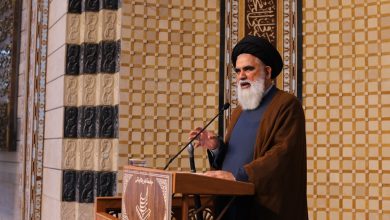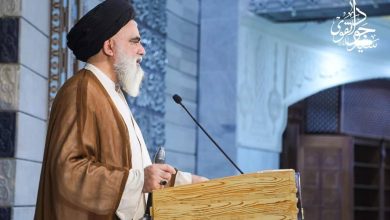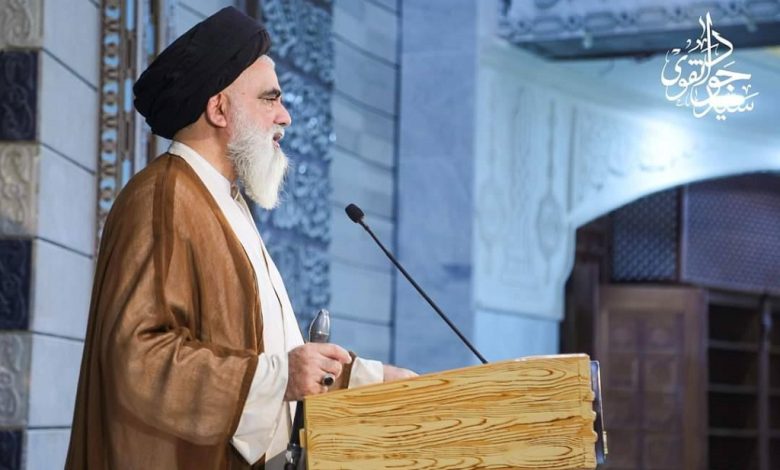
Hujjatul Islam Ustad Syed Jawad Naqvi
(Principal Jamia Orwatul Wuthqa – Lahore)
Delivered at: Masjid Baitul ul Ateeq
Lahore – Pakistan
Friday Sermon 12th December – 2025
Sermon 1: Taqwa in Sexual Affairs (19) – Mata – Comfortable means of life and tranquility in marriage.
Sermon 2: Ghuluw of Ahlulbayt (a) – Business Tool of Orators in Religious industry
The Sexual Dimension of Human Life and Divine Protection
One of the important dimensions of human life is the sexual dimension, for which Allah has made complete arrangements along with mechanisms for protection. If this ability were suppressed, the human race would come to an end. To protect this ability from corruption, Allah has provided the system of marriage (Nikah), Iffat, and Taqwa. Although the actual demand of this ability is fulfilled only through Nikah.
Some religions, such as Hinduism, Buddhism, and Christian priesthood, preach suppressing this desire in order to achieve spirituality. However, this is against human Fitrah. Unfortunately, such ideas have also entered Islam, but they violate two fundamental principles: first, they are against human Fitrah, and second, they are against divine revelation. It is not permitted to completely end any human ability; rather, all abilities must be guided and regulated.
Nikah is an innate and natural desire, irrespective of religion, and it has existed throughout human history. The beginning of creation itself started with the marriage of Adam and Eve. This is also interpreted in another way, where Adam and Eve are not considered two individuals, but rather representations of the entire human gender. Adam is the name of humanity, not just one individual, and all of humanity is guided through this concept. The downfall of Adam was the downfall of the entire humanity, and even today we can see that the entire human race has fallen, particularly in the context of Gaza.
Istimta, Tamattu, and the Means of Life
In marriage (Nikah), one of the conditions that is established is Istimta, because Allah has placed Tamattu within human life. Man is ordained to make arrangements for the means of life that provide comfort. Tamattu is essential for human life.
The word Mata, as explained earlier, was used by Arabs for the means of travel so that hardships of travel are reduced and the journey becomes comfortable. These means help a person reach his destination. Similarly, Allah made means essential for life (Mata-ul-Hayat) so that life can be lived comfortably and humans can reach the purpose and destination of life.
Those who lack essential means of life find living extremely difficult, and life becomes burdensome. After the basic necessities, there are family-related means such as marriage, which provide comfort and help establish family life. Luxuries, however, are not considered essential means, because they are excess. Many people possess excess clothes, shoes, and other items. These fall under Afw, as Allah instructed the Prophet (s) in the Quran to encourage people to spend from their excess (Infaq fi al-Afw).
As mentioned earlier, we should make our Friday congregation fruitful by creating a system of cooperation. Those who lived stressful lives in their early years due to lack of means understand how difficult it is. Poverty makes a person mentally deficient and ineffective. His personality becomes damaged. Some people lived in poverty earlier in life, and their personality became deficient. Even when they later acquired wealth, the complexes formed during poverty remained.
Such individuals often taunt others or express hatred, as they are victims of complexes created by deprivation. They hurt others unintentionally and feel relief by abusing or swearing. This indicates sickness of the soul. When the means of life are ignored, these problems arise. Unfortunately, some ethical scholars preach neglecting the means of life, even though these means were granted by Allah to everyone, including the Prophets.
The Holy Prophet (s) lived a comfortable life in his time. Christian priesthood and Sadhu-style asceticism were never preached by the Prophet (s). In the pursuit of such distorted spirituality, people develop internal complexes.
Earning, Infaq, and Human Comfort
There is no harm in earning more. One should earn as much as possible, even if personal needs are limited. If your need is 1,000, you may earn 10,000 or even 50,000, but spend only what you need on yourself and fulfill the needs of others with the rest. Earning more does not mean hoarding wealth or becoming a billionaire like Elon Musk. Rather, one should become among those who practice Infaq.
A person becomes comfortable when the means of life are fulfilled. When you are thirsty, you need water; spirituality cannot quench thirst. There is no spiritual substitute for food. Some scholars say that when hungry, one should pray two units of prayer. But how can a person pray when he lacks the strength to worship due to hunger?
Excess wealth is that which exceeds one year’s earning. This is also a matter of research, because these laws were established when the annual economic system existed due to agricultural cycles. Today, people earn daily or monthly, yet calculate Khums annually. This system needs reconsideration. If income is monthly, the criteria for excess wealth should also be monthly.
Justice, Balance, and Social Responsibility
Systems of governance and justice are necessary to maintain balance so that everyone’s needs and means of life are fulfilled. It should not happen that one person has four wives while others are still waiting to get married for the first time. The means of life are required by all, according to human nature.
A poor person is not merely one who lacks money, but one who lacks the means of life. We see people with excess means who are still depressed, because the means of life are only one element of a peaceful life. Other dimensions must also be fulfilled for life to be comfortable and peaceful.
For example, a person may have a good house, cars, and food, but if he is unmarried, he remains unsatisfied unless he fulfills his needs through Haram means. Such individuals become victims of sin—some openly, others secretly. Bank balance alone cannot provide comfort in all dimensions of life.
Marriage as a Source of Tranquility
A significant part of Tamattu in life comes through marriage. The Quran clearly states that Allah created spouses so that humans may attain tranquility through them. One of the major purposes of marriage is peace of mind—physical, emotional, and familial.
There are families that are not financially strong, yet after marriage they experience comfort and stability. We mistakenly believe that marriage makes life difficult, but this is because we have made marriage difficult by not following the lifestyle of the Ahlulbayt (a). We have even proven through our actions that we do not want our children to marry the way the Ahlulbayt (a) did, as if—God forbid—their marriages were not correct.
We celebrate marriages in the month of Jamadi-us-Sani, the birth anniversary of Lady Fatima (s), yet we spend millions in her name. Marriage through Nikah is meant to bring peace and tranquility, but many homes have become battlefields.
Many men dislike returning home because they face taunts, shouting, and abusive language. Husband and wife should embrace each other when children are not present. They should communicate and ask about each other’s day. When milk and sugar mix, sweetness is produced.
Sometimes a husband speaks harshly, while the wife may have been trained by her mother to make her husband’s life miserable. Mothers teach daughters to highlight faults and create tension. This is incorrect. The Quran states that husband and wife are garments for one another.
Imam Ali (a), after the Prophet (s), would often return home distressed, and Lady Fatima (s) would console him and heal the pain caused by society. Similarly, Lady Khadija (s) was a source of peace and comfort for the Prophet (s), who faced daily abuse and violence. When he returned home, all his pain vanished. This is how spouses become a source of tranquility for each other.
This is the method of the Ahlulbayt (a), which we must learn. In our culture, women are often suppressed, a mindset taught by mothers, but this is wrong. Women must be treated with respect and honor.
Muta-tun-Nikah, Family Peace, and Divorce
Very few families truly experience Muta-tun-Nikah and its peace. A family becomes Quranic when, after Nikah, it achieves peace and tranquility. Husband and wife should share each other’s burdens.
Mental peace and comfort are the rights of every individual in marriage, and they can either be granted or taken away by spouses. When children are born, they should also provide comfort to parents, and parents should do the same for children. This is Muta-tul-Hayat.
If divorce occurs for any reason, it should be conducted as Muta-tul-Talaq. A woman should be released in a manner that allows her to live comfortably until she settles or remarries. Unfortunately, in our culture, divorce turns into hostility. The man is obligated to provide means at the time of divorce.
Quranic Reference and Temporary Marriage (Mutah)
In Surah Noor, verse 24, reference is made to what many scholars interpret as temporary marriage (Mutah), which is commonly misunderstood in our culture:
وَلْيَسْتَعْفِفِ الَّذِينَ لَا يَجِدُونَ نِكَاحًا حَتَّىٰ يُغْنِيَهُمُ اللَّهُ مِن فَضْلِهِ ۗ وَالَّذِينَ يَبْتَغُونَ الْكِتَابَ مِمَّا مَلَكَتْ أَيْمَانُكُمْ فَكَاتِبُوهُمْ إِنْ عَلِمْتُمْ فِيهِمْ خَيْرًا ۖ وَآتُوهُم مِّن مَّالِ اللَّهِ الَّذِي آتَاكُمْ ۚ وَلَا تُكْرِهُوا فَتَيَاتِكُمْ عَلَى الْبِغَاءِ إِنْ أَرَدْنَ تَحَصُّنًا لِّتَبْتَغُوا عَرَضَ الْحَيَاةِ الدُّنْيَا ۚ وَمَن يُكْرِههُّنَّ فَإِنَّ اللَّهَ مِن بَعْدِ إِكْرَاهِهِنَّ غَفُورٌ رَّحِيمٌ
“And married women, except those whom your right hands possess. It is Allah’s ordinance for you. Lawful to you are all beyond these, provided you seek them with your wealth, in wedlock and not in license. So for whatever you have enjoyed from them, give them their dowries as an obligation, and there is no sin upon you for what you mutually agree upon after the obligation. Indeed Allah is all-knowing, all-wise.”
Some scholars interpret this verse as referring to temporary marriage. An Indian actress once suggested that marriage should have an expiry date, to be renewed later. This statement was published in Pakistani newspapers, yet no one responded that Islam already provides such an option through Mutah.
Mutah is a secondary application of Muta-tul-Hayat. Its purpose is the same as permanent marriage: providing comfort and ease during hardship and stress. Shias and Sunnis often argue over this issue but ignore the broader concept of Muta in other areas of life.
It is necessary to explain and elaborate what Mutah Nikah is, why it exists, and how it functions, so that misunderstandings and doubts can be properly addressed.
SECOND SERMON
O servants of God, I advise all of you, and I advise my own self, to have Taqwa of Allah. I counsel toward the Taqwa of Allah, I invite toward the Taqwa of Allah, and I emphasize that you should spend your lives according to Taqwa, live your lives under the shade of Taqwa, and carry out the affairs of life on the basis of Taqwa.
Taqwa is a measure, from Allah Tabarak wa Ta‘ala, for the protection of human life, and under this measure a person’s worldly life, afterlife, private life, and collective life are safeguarded.
The source of Taqwa is the Noble Qur’an; it is the person and conduct of the Messenger of Allah (صلی اللہ علیہ وآلہ وسلم), and the Sunnah; and the way of life of Ahl al-Bayt (علیہم السلام), and the wisdom and words of Amir al-Mu’minin. Amir al-Mu’minin (علیہ السلام), in Wisdom 117, stated a very rare and unique wisdom for the protection of the believing person, for the protection of his religion:
حَلَقَ فِي الْرَجُلَان مُحِبٌ غَالٍ وَمُبغِدٌ قَال
Amir al-Mu’minin says that regarding me, about me, two types of people have emerged: one, those who love me excessively (ghali), and the other, those who hate me excessively—either nasibi or people of spite and hatred.
In this, especially the part he stated—that even those who love me will become “حَلَق” and will be—this is a very important point. And I had presented that, except for Amir al-Mu’minin, no one else has it within them to speak like this: that even those who love me can become “حَلَق,” because no leader or guide issues such a verdict that my followers can also become “حَلَق.” Everyone says: my followers, however they may be, are saved; and the followers of others, however they may be, are all “حَلَق”-ridden, they are in “حَلَقت.”
Generally, this is the environment; even in our minds it is seated like this: that whoever is a lover of Ali will not go to Hell, and whoever is not among the lovers of Ali will not go to Paradise. Exactly like the Jews and Christians—just as the Jews used to say that besides Jews no one will enter Paradise; the Christians say that besides Christians no one will enter Paradise. And Allah Ta‘ala said that you also have no guarantee that you will enter Paradise, because for entering Paradise, being a Jew, a Christian, a Muslim—this is not the title. Rather, for entering Paradise it is Iman and ‘Amal Salih; and whoever performs Iman and ‘Amal Salih will enter Paradise—whatever school he belongs to, whatever sect he belongs to, whatever religion he belongs to.
But in sectarianism, the measures of Paradise are not Iman and ‘Amal Salih. In the sectarian environment, there are one’s own sects, and that sect has its own sanctities, and its own leaders, and on the basis of personalities, on the basis of lineage and association, on the basis of نسب و نسبت, Paradise and Hell will be distributed. This is the criterion of sects. But the Qur’an’s criterion is that Paradise will be attained on the basis of Iman and ‘Amal Salih.
Amir al-Mu’minin (علیہ السلام) has presented this danger: that those who have love but are extremists—there will be destruction for them; they are destroyed just as the enemies are destroyed; likewise the excessive lovers, those who exaggerate (ghuluw), their end will be the same as the end of the enemies. Meaning: the enemy of Ali, and the extremist who loves Amir al-Mu’minin—both will have the same kind of end.
Now this matter is very important. The A’immah al-At’har (علیہم السلام), in their pure and blessed lives, have confronted on various fronts; among them, one is the confrontation of the fitan that arose within Shi‘ism—among which the fitnah of ghuluw has been the most severe, which, in the very era of the A’immah al-At’har, created cracks within Shi‘ism, divided it, and opened the door of misguidance among the Shi‘ah. Therefore, all the A’immah al-At’har have spoken about it.
Ghuluw is not only about Amir al-Mu’minin (علیہ السلام). The narrations we are reading from Bihar al-Anwar include ghuluw even regarding Imam Ja‘far al-Sadiq (علیہ السلام). There was such ghuluw in the time of Imam al-Sadiq that the ghulat of his era called the Imam Allah, called him ilah, and they would say labbayk in the name of the Imam, and they would attribute all those attributes which belong to Allah Tabarak wa Ta‘ala to Imam al-Sadiq. And in response, instead of praising their praises, Imam al-Sadiq (علیہ السلام) has cursed them—that this is a curse—and he distanced people from them.
There has been ghuluw regarding every Imam and every Ma‘sum. In this chapter we are discussing, its title has been set by the late ‘Allamah Majlisi (رحمت اللہ علیہ): فی نفی الغلوب فی النبی والعائمہ صلوات اللہ علیہ وعليہم—meaning this chapter is about those who commit ghuluw regarding the Prophet (علیہ السلام) and the A’immah al-At’har.
Among the personalities about whom the ghulat have also behaved wrongly, and the enemies and opponents have also behaved wrongly, is that pure and purified Lady, سلام اللہ تعالی علیہہم, about whom ghuluw is still continuing.
Regarding the A’immah al-At’har (علیہم السلام), the unjust treatment that is done: some are enemies—like Banu Umayyah, and takfiri, nasibi—who maintain one kind of prejudice and ظلم. And there are also some believers and supporters, about whom Amir al-Mu’minin said: those who love me will love in such a way that they will be destroyed by love; they will commit ghuluw.
Likewise, regarding the A’immah al-At’har (علیہم السلام), one wrongful conduct that Shi‘ah can do and do is to use the A’immah as a tool—اوزاری استفادہ—meaning to use the A’immah al-At’har for one’s purposes, for one’s misguidances, for one’s personality, for one’s group, for one’s party, for one’s sect, as a tool.
Like political people—commonly prevalent within Pakistan—that for satanic politics, the sanctities of religion are used as tools. For example, if someone is a Sunni religious politician, he brings the Sahabah into politics, that he is doing politics in the name of the Sahabah. Another brings the Messenger of Allah. A third brings Ahl al-Bayt—where are Ahl al-Bayt? By taking the name of Ahl al-Bayt, by taking the name of the Sahabah, by taking the name of the Messenger of Allah, they are going where? They are in parliament. And in that parliament are also irreligious people who neither accept the Messenger of Allah nor accept Ahl al-Bayt. They come by raising the slogan of قومیت; someone comes with some other pretext. Ultimately they mislead people; and people are easily misled. In the name of قومیت, in the name of lie and fraud and deception, in every name people are deceived. Therefore religious people deceived in the name of religion: “Vote for us for the sake of Ahl al-Bayt.” They will take your vote in the name of Ahl al-Bayt—where will you go? Will you implement the system of Ahl al-Bayt? No. You will go into the same place where the irreligious also come, where the sinful and immoral also come. We have to go into the same; we have to become part of this طغیان و طغتیت. But in the name of Ahl al-Bayt, this is instrumental use. This is the greatest insult to Islam and religion.
We have explicitly stated this properly—before government people, and before the public and scholars—that the biggest insult in توہینِ مذہب is to use religion for politics, to use Ahl al-Bayt for politics. But there is not much sensitivity over this insult, therefore it is not counted as an insult—yet it is within the category of insult.
Now see the second class that uses religion and the sanctities of religion as tools: the traders—those who mention Ahl al-Bayt, mention the Sahabah, only to earn money. The commercial market that has been set up in the name of religion is at its peak. Perhaps every day in Pakistan you see: the price of gold is going up then coming down; the rupee’s value is going up; the dollar is going up, then sometimes coming down; everything sometimes goes up, sometimes comes down—but religious trade always goes up; it never comes down. You will not have heard that the religious trade had a slump. There are business people sitting here, traders sitting here. Every day they complain—especially those to whom we say: “Collect your khums in the hawzah”—they say business is in a slump. But you will never have heard any preacher saying that religious trade has had a slump; or a zakir saying that there is a big slump, that they get majalis recited but do not pay fees, or that they do not even get majalis recited. They always get them recited, and their rate always stays ahead of the dollar.
Now this is the second class that benefits from Ahl al-Bayt.
Last week, in an analytical program, I had said that Agha-ye Sistani, Ayatullah Sistani (حافظ اللہ) has given a fatwa—his fresh fatwa—that those who are paid salaries by the government, the imams of congregational prayer, people should not pray behind them. He has said to people that you should not pray behind them. I commented on it; you can watch that. That you should not pray behi