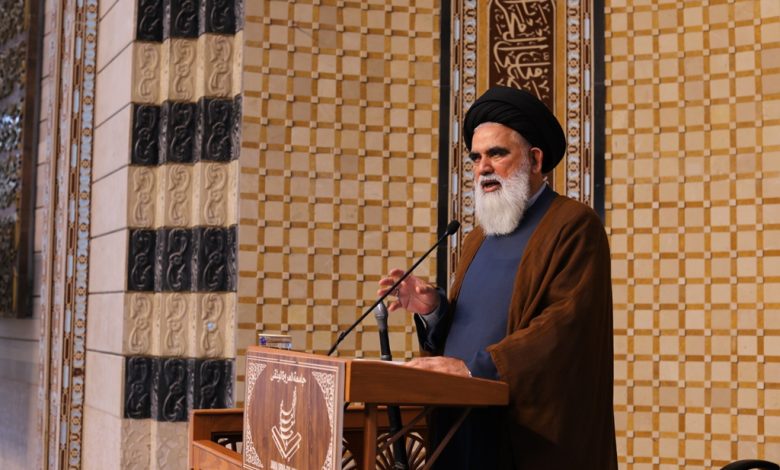
Hujjatul Islam Ustad Syed Jawad Naqvi
(Principal Jamia Orwatul Wuthqa – Lahore)
Delivered at: Masjid Baitul ul Ateeq
Lahore – Pakistan
Friday Sermon 7th November – 2025
Sermon 1: Taqwa in Sexual Affairs (14) – When Men are maintainers of women (wife)
Sermon 2: The danger of exaggeration (Ghuluw)
Human Values and the System of Creation
Whatever exists for a human being is bound with human values; it is placed within the geography of human values. Whatever act it may be — eating and drinking, living, internal desires, or external attractions — all of it has been placed within the system of human values.To understand this, let us consider a term we often hear — though how much we know about it is another matter. We hear that, in the universe, we are part of a system and an order in a constitutional (taqwini) sense. The Earth is a part of the solar system; the solar system itself is an organized system — a whole system in which the sun is the axis, and around it many planets and stars exist, held together by the gravitational attraction of the sun. The Earth too is one of them, and the moons that revolve around the Earth are also part of this solar system.“Manzuma” (system) means a collection of many things joined together to form an order. “Manzuma-e-Shamsi” means the Solar System, a system that has been established around the sun. The sun can never be alone; nor can the Earth exist without being part of a system. The Earth cannot remain stable unless it is part of a manzuma, a system — unless it falls within the solar order. If it were not within that system, it would collide with something and be destroyed — the Earth would perish, and whatever it collides with would perish as well. The order of the world would collapse.Its very existence depends on remaining within that order and that manzuma. In the same way, whatever Allah the Exalted has ordained for human beings has also been set within a system — nothing for man exists in isolation.
Balugh and Rushd — The Foundational Conditions of Marriage
Two conditions have been placed: balugh (puberty/maturity) and rushd (sound understanding). A person may be mature but not sensible — in that case, he is not eligible for marriage. And if he is sensible but not mature, still he is not eligible for marriage. Both balugh and rushd are necessary.
Rushd means intellectual and personal maturity — not sixty or seventy years of worldly experience, which in our common language we call a “seasoned” or “experienced” person. Rather, it means sound understanding, insight, and judgment that come naturally. For example, when we say, “This child has become sensible,” meaning he can now cross the road by himself.
A small child cannot even wear his shoes, close his school bag, or clean his nose — such tasks are beyond him. Soojh-boojh (prudence) means that the understanding appropriate to one’s age has developed within him. So when a person attains the understanding suited to the age of youth or maturity — when he realizes mutual rights, understands personality, respect, and honor — this is called pukhtagi (maturity).
This maturity does not mean he must have business experience, knowledge of engineering or medicine, or political awareness. Even if he lacks those, as long as he understands household matters — what benefits and what harms — that is considered maturity.
The Religious, Social, and Educational Dimension of Marriage
In marriage, the central and pivotal aspect — the reason this bond exists in human nature — is the sexual need of the human being. But this need has been tied and harmonized with other values — so that it is not limited to that alone, but through this bond, other aspects of life are also fulfilled.
For instance, beyond the sexual need, marriage has a social dimension. Marriage belongs to the field of sociology — it is a social affair. Hence, the social aspect has also been kept in view, and social values have been incorporated into it.Likewise, it is a religious act. As stated in traditions, through marriage a person completes two-thirds of his religion. In one narration it says half of one’s faith (nisf al-din), and in another, two-thirds (two-thirds of faith).
The practical implication is that marriage is a highly important, developmental, and educational affair — a moral and nurturing matter — and it has been linked to this dimension as well.
Family Formation and Social Structure
Similarly, when a family is formed, a structure and an order are established within it. A small order emerges — a small kingdom, a small state is formed through marriage, a system between two persons: husband and wife.
In our society, the practice and custom are that marriage is supposedly between two individuals, yet more people are involved in it than those two. The smallest amount of decision-making power rests with the two themselves — the boy and the girl. Ninety-five to ninety-nine percent of the matter of marriage involves people other than the husband and wife.
Because of this, marriage does not take place in the correct direction. The one who should make the decision does not, the one whose consent is required is not the one giving it, and even after marriage, the couple does not have control over their own affairs.
The Holy Qur’an has made this clear — keep in mind that the Qur’an is not designing a system for the society that you currently live in; it is designing the system for a momin (believing) society. Our society is not a momin society. Ours is a mixed society — a hybrid system, a composite one that contains everything: Hindu cultural elements, Western practices, nationalism, regionalism, linguism, individual tastes and preferences — Punjabi, Pashtun, and everything else.
This is what is called kichri (mixture) — a hybrid system, like a dish made of many ingredients. When you cook one thing alone — say only chicken — it gives one flavor. But when you make haleem, you taste a hundred different flavors together. That’s what a hybrid dish is — something formed by mixing many different things.Similarly, today’s Pakistan is a hybrid system. It was so even from the beginning, though people did not admit it then. Now they openly do. Even members of the cabinet say that Pakistan today functions under a hybrid system — a system in which there is democracy, the military, capitalists, the international establishment, and global institutions — everything is mixed together.
Earlier, when we said “military democracy,” people did not accept it. In practice, Pakistan has been living under a military democracy — a system that is both military and democratic. And now they say this is the best possible experiment — of military democracy.In the same way, marriage and the family that forms through it become a composite system — a hybrid structure — because many people become involved in it.
Interference of Relatives in Married Life
When a boy and a girl marry, both sets of parents become involved — and not just parents, their brothers and sisters too. For instance, the girl’s sisters — (sisters-in-law) — all become part of the family for life and they interfere; they have opinions about how their sister’s home should be, how her household should be furnished, and who should or should not visit her home. These are the sisters-in-law and other relatives. Similarly, more distant relatives within the family also get involved. All these relatives end up becoming like a parliament inside the family — and in fact, two parliaments are formed: one in favor of the boy and one in favor of the girl.
Then these two parliaments start passing bills against each other, and the boy and girl — the couple — remain stuck in between, burning like fuel in this fire, while the rest of the family enjoys the spectacle.This, in reality, is an inversion — a wrong system. The method is incorrect. The family was formed by two people; therefore, membership and decision-making authority belong only to those two individuals. The rest are on the margins; they are footnotes. Those in the margins should remain in the margins — they should not enter the main text — so that life can proceed peacefully and properly.
The aspect of married life most negatively affected after marriage is the sexual life of the husband and wife. Interference from others damages this relationship.
Unlawful Interference and Parental Guidance
There are various kinds of interference — one is in matters of clothing, decoration, and the appearance of their home; but there is another, much more severe interference — an unlawful interference — in the sexual relationship between husband and wife.Others interfere in that which is most private, and that is the most unacceptable form of intrusion.
Now, there is a difference between guidance and interference. To guide is not objectionable, but to interfere is wrong.Interference means that you issue orders, that you dictate decisions — telling them “you must do this” or “you must not do that.” That is interference.But giving advice and guidance — that is allowed and even encouraged. Parents should provide guidance to their children in every aspect of life, including sexual matters. Unfortunately, in our society, parents cannot do that. The level of modesty and embarrassment that exists in our culture prevents such open and honest guidance, especially at the time of marriage. Parents hesitate to give proper advice. However, others (trusted individuals, elders) can and should provide guidance — but not interference.
The Joint Family System — From Benefit to Harm
One of the things that disturb and disrupt the sexual life of a couple — that destroy its harmony — is the joint family system.In such a setup, a large family lives together in one house — for example, two or three rooms where six brothers and their families, including the married ones, live together.
This joint family system is often regarded as a symbol of love, unity, and closeness — a beautiful tradition, even a religiously esteemed one — and indeed, in the past, it was a good system. It used to work well when moral, social, and religious values were intact.
At that time, it actually provided help and support, especially to a newly formed family — the young couple would receive protection, assistance, and economic ease. The new family would not bear the full burden of independence and could grow as part of a larger family unit. But today, in the current era, this very system has become one of the most harmful and suffocating forms of living.
The values for which the joint family system once existed are now gone — they have changed — and so the system has lost its foundation. Even logically, if we look at it: after marriage, husband and wife need privacy — they need a time and space for themselves, separate from relatives, friends, and even parents.
If they are granted such privacy — even within the same household — their life becomes tranquil and blessed, light upon light. But if, due to certain necessities, they cannot have complete separation, then within the house there should at least be an atmosphere of peace and security. Married people require aman — security and emotional safety.
In a joint family system, where the house is small — for example, a ten-marla house — and three or four families are living together, such an environment is not suitable even for unmarried individuals, let alone for married ones.
But once a person gets married, it becomes absolutely necessary to provide him and his spouse a separate space.
For instance, if there are seven or eight brothers in a family, and one of them gets married while the others remain single — whether younger or older, studying or working — the newly married brother immediately begins to feel unsafe and uncomfortable in that environment.
He feels that he no longer belongs to the same category as before — his status and rank within the family have changed. This too becomes a source of tension within the household.
These, therefore, are the requirements of marriage which religion has set: that the system of life be organized properly. When a man and a woman become married — a husband and wife — the question arises: who is the manager (mudīr) of this relationship? In Pakistan, everyone knows who the manager is — it is not the husband or the wife, but the husband’s mother or father, or the saas (mother-in-law), or sometimes the wife’s mother. These are considered the real managers.
And you can often hear such conversations — when the time for marriage comes, parents tell their sons, “We have chosen your wife; we will marry you to the one we want.”And the sons reply, “As you wish.”
“As you wish” has become a habit in our culture. When a mother asks, ‘Shall I marry you to such and such girl?’ the boy answers, ‘As you wish.’ But what does “as you wish” mean? It means: “You decide, you choose, but if you find her suitable, and if I also agree, then go ahead.” That would be the correct manner.
However, in practice, parents make all the decisions, and the son merely follows. Recently, a believer told me that an elderly lady complained about one of these sermons — she said: “What topic has Maulana opened up? Ever since that sermon, my young son keeps telling me, ‘Arrange my marriage! Maulana says to marry!’”She said: “My little child keeps asking for marriage every day!”And when I asked his age — the “little child” — he was twenty-seven years old!
A twenty-seven-year-old man, still considered a “small boy” by his mother, asks for marriage, and she complains that the scholar has corrupted his mind! Now, how old will he have to become before his mother thinks he has reached the age of youth? Sixty-five, perhaps — then maybe she will say, “Now he is grown up.” Parents are indeed compassionate and kind, and there is no doubt that they are benefactors — they bore the hardship of raising the child, nurturing him, feeding him, clothing him, and making him what he is.
No doubt, all this is due to the labor and love of the parents. But this does not mean that parents understand everything about their children — nor does it give them the right to exercise total command over every aspect of their child’s life. Parents’ kindness and beneficence do not mean that they are infallible in every matter.
To illustrate: If you were to separate a father from his wife for a while, or forbid them from being together until some condition is met — for example, “until I finish my education, you two may not live together” — then perhaps they would realize how unjust such restrictions are when imposed on their own children.
If the son tells his father, “I will complete my master’s degree or my MPhil, and until then, you may not approach mother,” then they would feel what it means to be deprived of one’s marital rights.
They would then understand that education is not a barrier to marriage, and they would immediately tell their child, “You continue your studies, but let us live our life.” That is exactly the same principle that applies to the children: you may continue your education, but you are also entitled to get married.
Now, the Qur’an places the responsibility of management and leadership within marriage clearly. It says:
الرِّجَالُ قَوَّامُونَ عَلَى النِّسَاءِ
“Men are guardians and maintainers over women…”
This verse uses the words rijāl (men) and nisāʾ (women), but here it specifically refers to husbands and wives, not to all men and all women. The definite article “al” (الـ) in al-rijāl and al-nisāʾ indicates particular men and particular women — meaning husbands and wives.
So, the Qur’an establishes that the husband is qawwām — the maintainer, the guardian, the responsible one — over the wife.Why?
بِمَا فَضَّلَ اللَّهُ بَعْضَهُمْ عَلَى بَعْضٍ
“…because Allah has given some of them advantage over others…”
That is, due to the divine law that Allah has given certain responsibilities and authority to some over others for the sake of maintaining order. This superiority does not refer to moral or spiritual excellence, nor to intellectual perfection, nor to personal value.A woman may be far superior to her husband in knowledge, wisdom, piety, and intellect — as indeed is often the case. Many families have wives who are much more intelligent, understanding, and spiritually mature than their husbands. So this verse does not mean that the man is superior in virtue or character.
It only means that for the sake of organization and order (nizām), someone must have administrative responsibility — just as in a school, all the teachers may be equally qualified, yet one must serve as the principal for the system to function.Similarly, in the household, the Qur’an establishes that this executive responsibility — this management — rests with the husband.
And the verse continues:
وَبِمَا أَنفَقُوا مِنْ أَمْوَالِهِمْ
“…and because they spend of their wealth.”
The second reason is that the financial burden of the household — from beginning to end, from A to Z — rests entirely upon the man.The Qur’an does not assign even one percent of the family’s financial responsibility to the woman.
Neither the dowry (jahez), nor the wedding expenses (walīmah), nor the dishes, utensils, or household items — none of this is her obligation. But look at the system in Pakistan today — it is, frankly, a system of shamelessness and indecency.
A newspaper columnist once wrote, particularly about Punjab — since he himself was Punjabi — that in this culture, when a marriage takes place, the bride arrives with trucks full of goods — sometimes several truckloads — to the husband’s house.
Then the husband’s entire family uses that same furniture and those utensils, and after a while, if there’s any dispute, the same family members threaten the girl, saying, “Don’t you dare misbehave — do you know who we are?”
They threaten her while sitting on her own bed, eating from her own utensils, drinking from her own glasses, living in rooms furnished with the goods she brought, and cooking in her own kitchenware. They use everything she brought into that house — yet they threaten her as if she owns nothing.
What a satirical and shameful situation! The Qur’an, however, has not left the system of family life to human whims; it has specified and defined each person’s responsibility clearly. It is not a matter left to personal or cultural interpretation. The verse establishes two foundations of male responsibility:
1. The divine law of organizational authority (bimā faḍḍalallāhu baʿḍahum ʿalā baʿḍ), and
2. The financial obligation of the man (bimā anfaqū min amwālihim).
Thus, the husband is the qawwām — the responsible and accountable manager of the household. Now, in this same verse, the Qur’an explains the role and duty of the wife within the household:
فَالصَّالِحَاتُ قَانِتَاتٌ حَافِظَاتٌ لِّلْغَيْبِ بِمَا حَفِظَ اللَّهُ
“Therefore, the righteous women are devoutly obedient, guarding in [the husband’s] absence what Allah has made them to guard.”
So when the man becomes qawwām — the one responsible for leadership, the manager of the family — then what is the position of the woman? The Qur’an answers: faṣ-ṣāliḥātu — the righteous women, qānitāt — those who are devoutly obedient, who are ready and willing. The condition set by the Qur’an here is that the family being discussed is a believing family — both man and woman are mu’min. This system is not designed for a “hybrid” society, nor for a culture influenced by Indian or Western values, where men and women have created their own self-made ranks and ideologies.
Rather, this law applies to a believing household where faith governs conduct. Faṣ-ṣāliḥāt qānitāt — that is, the righteous wives are those who are qānitāt, meaning “ready and willing.” Now, qunūt does not mean the “qunūt” that we recite in prayer with raised hands.
The word qunūt here refers to an inner psychological and spiritual readiness — a state of the mind and soul. To be qānit means to be mentally, emotionally, and willingly prepared to perform a duty. Often, we are told to do something but are not mentally ready to do it, and therefore we do not do it — even if outwardly we appear to agree.You may have experienced this — you tell someone to do a task, and he nods and says “yes, yes,” but he does not do it. Why? Because he is not qānit — not mentally ready for that work.
A qānit person is one who is ready in his mind, heart, and body to act — to fulfill the task assigned to him with full willingness. For example, in a classroom: some students come mentally prepared to learn — they are qānitīn (ready). Others come with mental barriers: they think “this subject is too hard,” or “the teacher is not good,” or “this lesson isn’t necessary for me.” Such people are not qānitīn — not ready. The same is true for physical tasks like exercise — those who are mentally ready perform them easily and energetically; those who are not mentally ready do them lazily, half-heartedly, or not at all.
So, qunūt means this inner readiness. Hence, the Qur’an says: faṣ-ṣāliḥātu qānitāt — “The righteous women are those who are ready and willing to accept and cooperate with the management (qawwāmiyyah) of their husbands.”That is, the wife should be qānit — prepared to accept her husband’s authority and cooperate in the running of family life.The husband should be qawwām — responsible and accountable — and the wife should be qānit — ready and supportive. If the roles are reversed — as is common today — where the husband becomes submissive and ready to obey the wife in everything, then the husband becomes qānit and the wife becomes qawwām. This inversion disrupts the order — the system collapses — because both cannot be qawwām, nor can both be qānit.
The Qur’an’s model is balance — one qawwām, one qānit.
And the Qur’an further adds:
حَافِظَاتٌ لِّلْغَيْبِ — “They are guardians of the unseen.”
Meaning, when the husband is absent from the home, the wife safeguards the household — its dignity, property, and sanctity — in his absence.
She protects what Allah has commanded her to protect — bimā ḥafiẓallāh — that is, she fulfills the trust of guardianship placed upon her.
Thus, the Qur’an identifies three qualities for a believing wife:
1. Ṣāliḥah — righteous, upright in character,
2. Qānitah — willing and cooperative with her husband’s leadership,
3. Ḥāfiẓah — protective of her home and her husband’s trust in his absence.
Now, the Qur’an also addresses the opposite type — those women who are not willing, not cooperative. They are called nāshizāt — from nashūz, meaning disobedient, rebellious, or defiant. A nāshizah is a woman who refuses to be qānit — she is unwilling to cooperate, unwilling to fulfill her marital obligations, unwilling to maintain the harmony of the household.
If you fear such rebellion (nushūz) from your wives — that they will not cooperate in family affairs or in marital relations — the Qur’an gives clear guidance:
فَعِظُوهُنَّ — “Then admonish them.”
Advise them, explain gently, remind them of their responsibilities.
If advice does not work:
وَاهْجُرُوهُنَّ فِي الْمَضَاجِعِ — “Then leave them alone in their beds.”
That is, separate the sleeping arrangements — withdraw intimacy, create distance.
And if even that fails:
وَاضْرِبُوهُنَّ — “Then discipline them.”
This does not mean violence or harm; it refers to a symbolic and disciplinary gesture, an act of serious admonition to indicate disapproval — a final step to restore order.
If, after all this, they reform and return to obedience and cooperation, then:
فَإِنْ أَطَعْنَكُمْ فَلَا تَبْغُوا عَلَيْهِنَّ سَبِيلًا
“Then seek not any means against them.”
That is, once harmony is restored, do not continue to mistreat or dominate them.
The verse concludes:
إِنَّ اللَّهَ كَانَ عَلِيًّا كَبِيرًا
“Indeed, Allah is Exalted and Great.”
A reminder that Allah watches over both — that power belongs to Him, not to man, and that this authority must be exercised with justice and humility. This entire verse, therefore, lays down the principle of family order and discipline. Nowhere in the Qur’an does it say that a mother-in-law, a father-in-law, or an elder brother is the qawwām (manager) of the woman. The Qur’an makes it absolutely clear that only the husband is the qawwām — the manager, guardian, and responsible one for his wife.The wife, in turn, shows qunūt — readiness, respect, and cooperation — toward her husband in the matters of their shared life. She must respect the whole family, but the qunūt — the devoted readiness and obedience — is directed specifically toward her husband.
And because the primary purpose of marriage, in truth, is the regulation of human sexual life, the terms qunūt and nushūz (obedience and defiance) in this verse refer primarily to that intimate dimension — to the sexual and emotional harmony between husband and wife.
If the wife refuses intimacy and cooperation (nushūz), then the steps prescribed — advice, separation, and final admonition — apply within that context. If she still remains defiant, then her rights — including maintenance and support — are suspended; and if even that does not bring reconciliation, then divorce is the final option. A nāshizah — a rebellious wife who refuses marital cooperation — is no longer entitled to the privileges of marriage.
For such a woman is not fit to be a partner in marriage, nor to bear the husband’s children, nor to be the mother of his offspring. A woman who cannot fulfill the duties of wifehood (shohardārī) cannot fulfill those of motherhood (bachādārī).
Housekeeping (khāndārī) is only a secondary function; many women are excellent homemakers but completely fail in shohardārī — in the responsibilities of being a wife. If a woman performs household duties well, she is rewarded — but if she fails in marital duty, she is accountable before God. A nāshizah is the one who fails in shohardārī — the one who cannot fulfill the rights of her husband.
SERMON 2
The Command of Taqwa (God-Consciousness)
O servants of Allah, I advise you and myself to observe Taqwa (God-consciousness).
I enjoin upon you piety, I invite you toward Taqwa, and I emphasize that your life should be lived according to Taqwa — under the shade of Taqwa, and that the system of your life should be built upon the foundation of Taqwa.
For some time, the Friday sermon of two parts had been paused due to prevailing circumstances. The subject that was being discussed was a narration from Amir al-Mu’minīn (عليه السلام) in Nahj al-Balāgha, in the section of Hikmah (Wisdoms).
In that narration, Amir al-Mu’minīn (ع) says:
هَلَكَ فِيهِ رَجُلَان مُحِبٌّ غَالٍ وَمُبْغِضٌ قَالٍ
“Two kinds of people will perish concerning me — one who loves me excessively (ghālī), and one who hates me intensely (mubghid).”
The Imam as the Standard of Humanity
Amir al-Mu’minīn (عليه السلام) says that regarding me — about my person, my position, and my being — there are two kinds of people who will be destroyed. One is the one who loves me but commits excess in his love, and the other is the one who bears enmity toward me — who harbors hatred and malice against me.
Amir al-Mu’minīn (ع) is an Imam — and an Imam is the standard (mi‘yār). He is the measure of guidance, the measure of humanity, of justice, and of values. Even linguistically, the word “Imam” carries this very meaning.
In the language of the Arabs, before the revelation of the Qur’an, “Imam” referred to a measuring string used by masons — a string with a weight hanging from it (called shāqūl in Persian and sāhil in Urdu) used to check whether a wall was straight or tilted.A builder would hang this string next to the wall as he built it to ensure that the wall remained upright.This tool — the standard for straightness — was called “Imam.”Over time, the word was extended to any criterion or measure by which something is kept straight and correct.When society is built — when human civilization takes shape — there must be a standard to determine whether that society is straight and rightly established or crooked and deviated.
Thus, Allah (سُبْحَانَهُ وَتَعَالَىٰ) appointed human exemplars — Imams — as the standards of humanity.
When Allah said to Prophet Ibrāhīm (عليه السلام):
إِنِّي جَاعِلُكَ لِلنَّاسِ إِمَامًا
“Indeed, I appoint you as an Imam for mankind.”
It meant that he was to become the measure by which humanity would be evaluated. Whoever’s conduct aligns with the conduct of Ibrāhīm (ع) is rightly guided and human; whoever does not is deviated from humanity.
Ibrāhīm (ع) then prayed that Imamate should continue in his descendants, and Allah replied:
لَا يَنَالُ عَهْدِي الظَّالِمِينَ
“My covenant does not reach the wrongdoers.”
Meaning: among your descendants there will be both righteous and unjust people; Imamate will not be granted to the unjust, but to those who are righteous, like you.
The Divine Effort to Make the Qur’an Accessible to Humanity
One of our esteemed teachers used to say that Allah made tremendous effort to bring the knowledge of Malakūt (the heavenly realm) down to earth for human understanding.
It was not easy to make divine revelation — a celestial, transcendent truth — accessible to earthly minds. It was a great divine undertaking to “reveal” the Qur’an — to bring what was above the reach of man down to his level.However, he said, “The scholars of later times undid that divine effort — they lifted the Qur’an back up from the earth to the heavens!”
Allah had brought the Qur’an down to human understanding, but the scholars — through complex exegesis and philosophical jargon — raised it back up so high that the ordinary believer now feels the Qur’an is beyond comprehension. Thus, through commentaries and discourses, people came to believe that the Qur’an is not for them to understand.
Similarly, Allah sent Imams — heavenly guides brought down to earth for the guidance of human beings. But later, people — again, some scholars and exaggerators — reversed the divine process: they took the Imam, who was meant to be a human exemplar, and elevated him back into the heavens, declaring him divine.Allah had made Amir al-Mu’minīn (ع) an Imam for the people of earth — an exemplar to be followed — but human exaggeration turned him into something unreachable, claiming divinity for him. Thus, just as the Qur’an was removed from human reach, so too was the Imam.
The Unique Nature of Imam ʿAlī’s Imamate
The Imamate of Amir al-Mu’minīn (ع) is a matchless Imamate — one without equal in all of human history. The ḥikmah (wise saying) under discussion is likely number 117 of Nahj al-Balāgha, in which Amir al-Mu’minīn (ع) says:
“Two kinds of people will perish regarding me:
those who love me excessively and go beyond limits (ghulāt),
and those who harbor hatred toward me (mubghidīn).”
This statement could only come from ʿAlī (ع) — no other leader, no other human, could say such a thing. Have you ever heard any worldly leader, religious or political, say: “My supporters, too, can be destroyed”? Leaders normally claim the opposite — that those who follow them are guaranteed success, no matter what they do.
But Imam ʿAlī (ع) declares: “Even my followers may perish if they exceed the limits set by Allah.”This is the mark of divine truthfulness — that even love, if it crosses the bounds of justice and moderation, leads to destruction.
The Danger of Exaggeration (Ghuluw)
Excess and exaggeration — ifrāṭ — in anything leads to destruction, and neglect — tafrīṭ — does the same. Both extremes are ruinous; only balance (iʿtidāl) ensures salvation. In every age, there have been people who committed ghuluw regarding the Ahl al-Bayt (عليهم السلام) — exaggerating their status beyond what Allah decreed.
The ghulāt claimed that the Imams were not human, but divine; that they were creators rather than created beings.Amir al-Mu’minīn (ع) and the other Imams repeatedly warned against this.
ʿAllāmah Majlisī (رحمة الله عليه), in Bihār al-Anwār, volume 25, dedicates an entire chapter to refuting the ghulāt. He documents how every Imam, in his time, confronted this trial.
The first fitnah (trial) of ghuluw began even in the lifetime of the Prophet (ﷺ) and continued through all the Imams — until the time of the final occultation (ghaybah), and even persists today.
The Qur’anic Warning — Those Who Exaggerate Are Among the Lost
ʿAllāmah Majlisī cites the 20th narration under the tenth chapter, explaining the Qur’anic verse:
غَيْرِ الْمَغْضُوبِ عَلَيْهِمْ وَلَا الضَّالِّينَ
“Not the path of those who have incurred [Your] wrath, nor of those who are astray.” (Sūrah al-Fātiḥah, 1:7)
Amir al-Mu’minīn (ع) said:
Allah commanded His servants to ask Him for guidance upon the path of those whom He has favored — the munʿam ʿalayhim — who are, as the Qur’an says elsewhere, the prophets, the truthful, the martyrs, and the righteous.
In contrast, Allah commanded believers to seek refuge from the path of those upon whom is His wrath (maghdūb ʿalayhim) and those who are astray (ḍāllīn).He then explained: among the maghdūb ʿalayhim are the Jews, upon whom Allah said, “Whomever Allah has cursed and upon whom is His wrath.”
And among the ḍāllīn are those who commit ghuluw, about whom Allah said:
قُلْ يَا أَهْلَ الْكِتَابِ لَا تَغْلُوا فِي دِينِكُمْ غَيْرَ الْحَقِّ
“Say: O People of the Book! Do not exaggerate in your religion beyond the truth.” (Sūrah al-Nisā’, 4:171)
Thus, exaggeration in faith — whether by the Christians regarding ʿĪsā (عليه السلام) or by Muslims regarding the Imams — is condemned in the same way.
The Explanation by Imām ʿAlī (ع) and Imām al-Riḍā (ع)
Imām ʿAlī (ع) said: “Whoever disbelieves in Allah, or whoever elevates me beyond the status of servitude (ʿubūdiyyah), he is among the maghdūb ʿalayhim and the ḍāllīn.”
And Imām al-Riḍā (عليه السلام) added:
“Whoever goes beyond in his description of Amir al-Mu’minīn (ع) — raising him beyond servitude into divinity — is among those upon whom is Allah’s wrath and who are astray.”
The Imams said: “Do not take us out of the bounds of servitude. We are the servants of Allah. Describe us as you wish — but preserve our servitude to Allah.”
They warned: “Do not commit ghuluw as the Christians did with ʿĪsā ibn Maryam (عليه السلام). We are innocent of those who exaggerate.”
A Question to Imām al-Riḍā (ع)
A man once stood and asked Imām al-Riḍā (ع):
“O son of the Messenger of Allah, describe for us your Lord — for there are those who oppose us and differ with us in belief.”
The Imām replied:
“Whoever describes his Lord by analogy (qiyās) will always remain in confusion. Whoever imagines Allah in human terms is astray. Whoever limits Allah with form or image has disbelieved.”
He continued:
“I describe Him as He has described Himself — without vision, without form, without limitation.
He is not seen by the eyes, nor confined by space, nor defined by measure.
He is the Creator of all forms, yet He has no form. He is the Giver of all boundaries, yet He Himself has no boundary.”
Conclusion and Supplication (Dua)
The Imām explained that anyone who attributes divine actions or qualities to the Imams commits falsehood and fabrication. Such claims are the beliefs of the ghulāt — the exaggerators — not of the Ahl al-Bayt (عليهم السلام).
The true belief of the Imams is the unity (tawḥīd) of Allah and the servitude (ʿubūdiyyah) of all creation before Him.