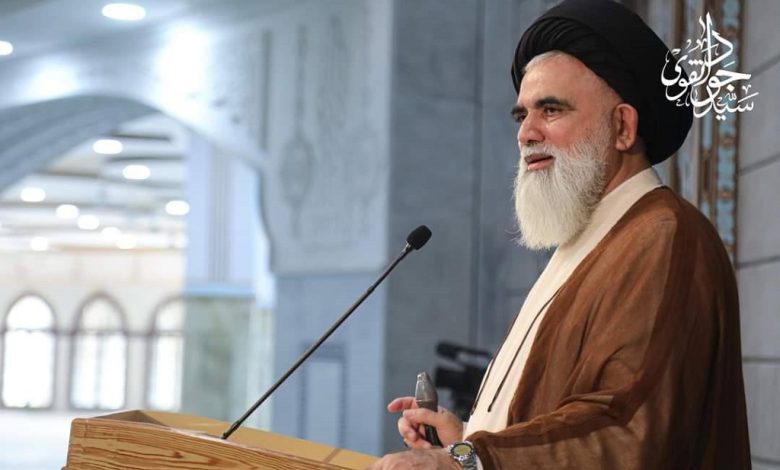
Hujjatul Islam Ustad Syed Jawad Naqvi
(Principal Jamia Orwatul Wuthqa – Lahore)
Delivered at: Masjid Baitul ul Ateeq
Lahore – Pakistan
Friday Sermon 31st October – 2025
Sermon 1: Taqwa in Sexual Affairs (12) – Wife should become beloved of Husband
Sermon 2: Pakistan’s Shift from Neutrality to Complicity
Regulation of Sexual Ability in Human Life
One foundational demand of human life is sexual, and it impacts other affairs of life. In the human system, ideally the intellect should control everything, but mostly other things like desires dominate the intellect. The most powerful such desire is the sexual ability, which mostly controls the intellect instead of being obedient to it. Since it is the most dominating ability, Allah has made greater arrangements for regulating this ability. This management is done through three ways: one is Taqwa—to protect yourself; the second is Iffat (chastity)—to control the inner desire; and the third is marriage (Nikah).
Human beings in all religions—and even those without religion—have had the culture of marriage, and even today this is common. Marriage was natural and common, continuing for the same purpose. Religion has organized this beautifully so that no disturbance takes place in this domain which can affect other parts of human life. The discipline which the Qur’an has given to marriage and sexual affairs is to an extent not seen in other affairs. The marital system has been made the basis, and the axis around which it has been made is the philosophy of satiating, organizing, and gaining benefit from the sexual abilities of man. There are laws for marriage and certain orders given. The first step for regulating sexual affairs is protection of private parts by safeguarding them and closing one’s eyes to the private parts of others. The second step is marriage when you reach the age of maturity, which also has various stages. Two subjects carry high importance here. One is the development of the family—which is close to this topic—but our discussion is around Taqwa to be adopted for controlling sexual affairs. As a reference, Prophet Lut presented the first solution to his sexually corrupt community as marriage and the second as Taqwa. He even presented his daughters to them, which is also interpreted as the daughters of the community to be married and not to engage in homosexuality. The second instruction he gave them was Taqwa. The family system and its etiquettes is different, and we are not discussing that here.
Purpose and Blessings of Marriage
When marriage is done under Islamic principles and etiquettes, then from there the regulation of sexual abilities starts. One purpose of this marriage is to attain tranquility (peace), which is collective in nature—physical, spiritual, emotional, and psychological—and among these, the first tranquility is sexual, while others are the outcome of this satisfaction. Then Allah says that when marriage takes place as per these principles, He grants them love (Mawaddat) and compassion (Rahmat). Mawaddat means that love and orientation which is expressed.
Roles, Equality Narratives, and the Nature of Attraction
A big disturbance created in our lives is the culture of equality whereby it is propagated that both man and woman are equal and they can do each other’s tasks. This is seen in our culture and also in our dramas and films. The relationship between husband and wife should be based on love and compassion, not on hatred, malice, and envy. This love and compassion comes after marriage, not the love which we see in our society before marriage. In this relationship of love, both man and woman are equal. It is an important topic which has been forsaken by all, including religious scholars. Even those who talk about sexual issues also ignore this topic. The status of man and woman in love is not the same. The structure of the woman, in terms of physical, emotional, sentiments, and orientation, is different and is not of Mohib (one who loves) but of Mahboob (beloved). Both man and woman are not going to equally fulfill the demands of this love. The role of man is that of a lover (Mohib) as per the structure of man’s creation. The lover is attracted towards the beloved (Mahboob). The beloved attracts the lover. The woman has to play the role of the beloved, and she has to nurture this capability—both physical and in other domains. For example, a woman should wear such dress that a man likes, and make her physical appearance attractive for her husband. The criterion for a woman’s physical appearance is to attract the man’s love towards her. Love does not get established by contract—such as people setting marital contract terms that a man will not be attracted to or will not marry another woman. The one who truly plays the role of the beloved is the one the man will love. Even if the contract is with one woman, if attraction is created by another, the man will get attracted to her. It is like food: irrespective of the food cooked and placed in front, if it lacks good aroma, you will be drawn to the food that has that aroma. This has become common now—that a man seeks the pleasure of a woman because he gets married to girls from big families and then starts to appease everyone in the woman’s family.
In love, both should dissolve, and this happens when the man plays the role of lover and the wife plays the role of beloved. Love is established by Allah only after marriage. The beloved has a higher and more difficult responsibility because she has to ensure that she keeps her lover attracted all the time. In our society and culture, we prepare the girl as a warrior, and she is nurtured as a “terrorist” by her parents—on how to control her husband and in-laws. They should instead foster girls on how to become beloveds. A woman should transform her husband into a lover and should capture the heart of the man. They are married from different families, but still the woman has a natural ability—and if trained as well, then she can make herself beloved. This does not happen if a woman starts to do all the cleaning of the home or helps her husband in business—which is a different role of responsibility. But the thing by which you make your husband a lover is different. It is possible that one woman takes the best care of the house but does not manage her husband in love, and it could be the other way as well. Taking care of house affairs is a social affair, but the most important is to take care of the husband and fulfill the demands of the husband. This does not mean just fulfilling the sexual demands of the man, but instead, in a collective manner, making her husband attracted towards herself to the extent that the man does not get oriented towards any other woman.
Character, Examples, and the Primacy of Values
In every house this is a problem: the husband is not attracted towards his wife but instead is attracted to other women connected with her. If a man’s attention is towards other women, then this wife does not know the skills of becoming a beloved. For this, a woman does not need to be beautiful. There are some stories made just to explain some concepts and without literal reality. One such story is about Layla and Majnun, which is an imaginary story used by poets to present thoughts in the form of characters. Maulana Rumi also presents this in his Mathnavi. Everyone points to the idea that Majnun was of more physical beauty, while Layla was not even like an ordinary woman and was dark and lacked any striking physical posture—yet Majnun fell in love with Layla. In this imaginary story, one dimension is that a woman can have such spiritual courage and abilities that she can become a Layla even if she does not possess physical beauty. If attraction is physical, then it can change if someone else arrives with better physical attraction.
When I was in Iran, a family came to me with their daughter and her lover. They wanted to get married, but the girl was Shia and the boy was Sunni. The parents came to me and said that the boy is ready to become Shia to marry their daughter, so please make him Shia. I asked the boy: what attraction do you have in Shi‘ism? He said, “I don’t know anything, but I am ready to become Shia for the sake of this girl.” I told the boy: tomorrow, if you fall in love with a Jewish girl, will you become a Jew? The girl said that she is not going to get married because this person is changing religion for her sake and not with recognition.
A woman becomes beloved due to her character and not with cosmetics. This (cosmetic belovedness) happens in films. In real life, belovedness comes with values. Women—wives—should learn the skill of how to become beloveds of their husbands. They cannot become lovers; they have to attract the love of the man towards themselves. A woman should become the most favorite of her husband to the extent that the man should not even think about other women. In this era of media, women are more concerned that their husbands would get attracted to someone else. This is a weakness of the woman—that she could not develop attraction in herself—and that attraction should be with personality and character. At times, a dark-skinned person might have a high personality inside, and a fair-skinned person might have a worse one. The things which tie human beings are esteemed values which develop attraction. If you want to become someone’s beloved, then develop nobility, virtues, and high values inside yourself so that they get attracted to you. If you want to become beloved, then develop values in yourself—and if someone likes you for your values, he will never leave you because he is not after interests.
Practical Conduct at Home, Speech, and Sustaining Affection
What is essential for man and woman are personalities. A woman should become beloved of her husband in terms of personality, and she can ornament her character further—and in this way the relationship of love gets established between them. It is the duty and obligation of the woman to become the beloved of the man. A woman should not taunt or fight with her husband by saying that he gets attracted to other women. A man gets frustrated with such acts. The Qur’an also says that women should decorate themselves for their husbands because men need that physical attraction. In our culture, our women dress up only when they go outside, and when they return home, they will wash their faces, wear smelly dresses, and come in front of their husbands. For those from whom she had to be veiled, she presented herself; and for the one for whom she should beautify herself, she appears in a worse form. With spiritual values, a woman should develop physical attraction as well so that this relationship becomes firm.
Do not frustrate your husband through your tongue. This is the dangerous weapon which women use without any sense. If you want to attract your husband, then remain silent. It is possible that a man uses bad or harsh language, but the point is that this love gets finished with the tongue, which acts like a scissors to cut off this delicate relationship. Many husbands then just live out of agreement because there are children, but he tries to fulfill his needs from outside. The moment he enters home, the woman starts to fire from inside, and the man—out of respect—comes home but does not like to enter home. If it were Europe, he would have entered the house of a neighbor. This is the talent of a woman: even if a man has some deficiencies, do not try to reform him with the tongue. You need love and compassion to reform a man. If a woman uses her tongue less and emotions more, then she can reform the man. The emotions of love, mercy, and compassion would turn a man into a lover of his wife; then he would not turn towards anyone else. A woman should become a beloved in such a manner that when at home, the man leaves everything aside and is attentive towards his wife. A man should throw his mobile the moment he sees his wife—and not the other way around.
Centrality of Sexual Bond, Religious Impact, and Fitrah
This character of love between man and woman is not the same: one has to become beloved to attract, and the other has to become lover. The character of the beloved is difficult because she has to attract the man towards her and make him inattentive to other things. Allah has granted all the abilities to a woman to become beloved. These abilities are extraordinary, but due to the effect of society and environment these abilities get adulterated. If these precise abilities are nurtured, she can make her character that of a beloved. When a man becomes a lover of this beloved wife, then even if some deficiencies are present in the woman, he will ignore those. But our women play the role more of frustrating husbands, and he just—out of social pressure or for children—continues to live with her. The thing that has connected them is the sexual ability, which is the axis and should always be kept in consideration. If only make-up is there and sexual needs are not fulfilled, then nothing will work.
When this relation gets established, then—as per traditions—half and even two-thirds of religion gets preserved. The secret lies only in this: that this relation makes a human being reach the level of tranquility which prepares the ground for Allah’s servitude. They both make the journey of servitude to Allah easy. We can see a boy before marriage coming to Friday prayers and lectures, but after marriage he does not come. This means marriage has drowned his entire religion. This marriage was not on the basis of love but such that it created a disturbance in life due to which a man does not get pleasure in anything, even in worship. A man becomes a victim of strange anxiety and disturbance. People think he got attracted towards his wife, but he is in a different state of mind and is finding ways of salvation from his woman. If marriage is as per religious criteria, then it becomes the basis of secure and successful life. Allah has made the arrangement in our fitrah, and we have to traverse the education and nurturing phase ourselves.
SERMON 2
The Absence of Taqwa and the Betrayal of Palestine
We can see the status of Muslims today without Taqwa. The treachery being committed against Palestine is evident. Three nations—Turkey, Egypt, and Qatar—have played a major role in the genocide of the Palestinian people. They have intervened as so-called mediators but, in reality, acted as stooges of the Jews.
The Prime Minister of Qatar even stated that the ceasefire is being violated by Palestinians, not by Israel. Donald Trump has said that Palestinians will no longer be destroyed by Israel but by powerful Muslim forces. When Trump says “Hamas,” he actually means “Palestinians.”
The three forces to which Trump referred are Turkey, Egypt, and Pakistan. Israel, however, has refused to allow Turkey to enter Palestine—not because Turkey is against Israel, but because of historical reasons. When Israel occupied this land, it was under the Ottoman Empire, ruled by Turkey. At that time, there was an agreement that certain parts of this land would be returned to the Ottoman Empire. Although that agreement no longer holds since the Empire no longer exists, Erdogan still claims that all these lands should be returned to Turkey, insisting that the old agreements should be honored.
Therefore, Israel has objected, stating that if Turkey enters Palestine, those historical agreements could cause complications. As a result, Israel has allowed only Egyptian and Pakistani forces to enter Palestine. These forces, however, will not help the Palestinians—they will go there to suppress them.
Pakistan’s Shift from Neutrality to Complicity
Pakistan has now gone far beyond anyone’s expectations. Historically, Pakistan pursued a cautious policy of remaining neutral in international warfare. It neither supported Palestine nor sided with Israel or America, choosing indifference—a stance that was itself un-Islamic, for remaining neutral while Muslims are oppressed is also a crime.
However, in this situation, Pakistan has abandoned its neutrality and become an active participant in conflict—without seeking permission from Parliament. Regarding the Abraham Accords, Pakistan has been waiting for Saudi Arabia to officially join. In November, Saudi Arabia announced its intention to become part of the Accords, after which Pakistan also plans to join.
Wherever Trump travels, he praises Pakistan’s leadership as “great,” and this is due to the excessive flattery and appeasement shown by the Pakistani Prime Minister. Yet they fail to realize that such appeasement will come at a heavy cost. Pakistan’s government came to power through the votes of its people—so how can it align with the Zionist lobby without consulting the people or Parliament? Is this permissible for Pakistan?
What benefits Pakistan hopes to gain from this remain unclear. Ironically, the previous policy of remaining indifferent was still better than this policy of active betrayal.
Regional Isolation and the Tragic State of Pakistan
The state of Pakistan today is extremely tragic. Recently, there was a war with India, and the situation remains tense. On another border, clashes continue with Afghanistan. Both borders are effectively in a state of war. The third neighbor, Iran, is now being targeted by a sectarian campaign fueled by the media and Takfiri elements—all operating under state supervision. These forces are deliberately attempting to spoil Pakistan’s relations with Iran.
The friendly relations that were developing when Pakistan supported Iran during wartime have now been ruined by these sectarian groups. China, once a strong partner of Pakistan, has also begun to distrust it. China is at odds with America, and Pakistan’s closeness to America naturally threatens that alliance. This is treachery against Pakistan itself, as it is now alienating all four of its neighboring countries.
Historically, Pakistan has always been destabilized by non-state elements operating within the country who manipulate national affairs. Economically, this new policy could deliver a severe blow to Pakistan. The biggest danger, however, is that Trump now likes Pakistan. When Satan begins to like you, it means you are doing something wrong—and that is a grave warning.
Trump’s praise is not a blessing but a bad omen for Pakistan. So far, no tangible benefits from this new alignment have been seen, while various internal groups in Pakistan are further complicating the situation.
Internal Conflicts and Sectarian Targeting
The TTP (Tehreek-e-Taliban Pakistan) remains in conflict with the state. A military operation was recently conducted against TLP (Tehreek-e-Labbaik Pakistan) in Muridke, and now the state is turning its focus towards the Shia community as a so-called “balancing policy.”
What is the fear of these Shias? Throughout Pakistan’s history, the Shias have never engaged in extremism, rebellion, or violence against the state. Yet, they are treated as rebels merely to maintain a false sense of balance.
In Jacobabad, for instance, a journalist was killed by his own tribesmen, but three innocent Shias were arrested. Such policies and diplomatic behavior are disastrous—they destroy Pakistan’s credibility and unity just to gain Trump’s friendship.
During the war with India, Pakistan effectively used Chinese weapons, which has angered Trump, as he wants to break Pakistan’s ties with China. Pakistan must protect its dignity and independence, and aligning with Zionists is deeply dishonorable. Anyone who does this is a traitor to Pakistan, its founders, and its people.
The Religious and Moral Consequences of Betrayal
It was the long-standing policy of Pakistan that it would never recognize the Zionist regime. If Mohammad bin Salman wants to recognize Israel, then let him do so and face the consequences—but Pakistan must not follow that path.
If Pakistan does not have the courage to support Palestine, it should at least refrain from betraying it. To become part of treachery against Palestine is a grave crime, and such an act would never please Allah or His Messenger (peace be upon him).
Those who commit such betrayal should not expect salvation in the Hereafter. This act, both politically and spiritually, will remain a dark stain on the soul of the nation.