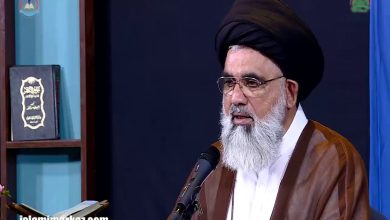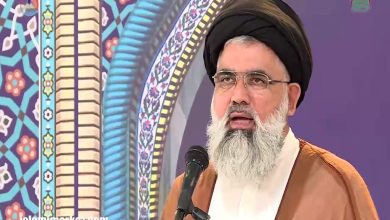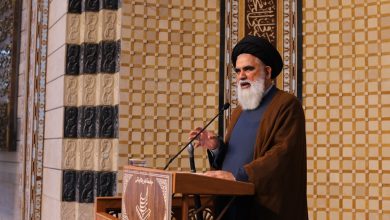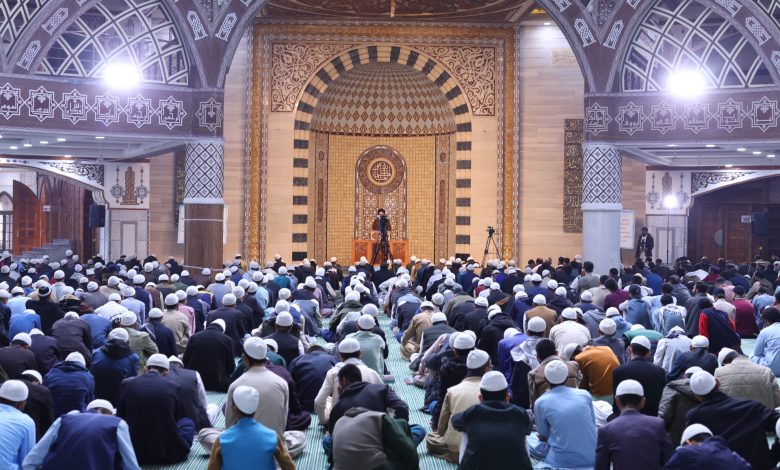
Hujjatul Islam Ustad Syed Jawad Naqvi
(Principal Jamia Orwatul Wuthqa – Lahore)
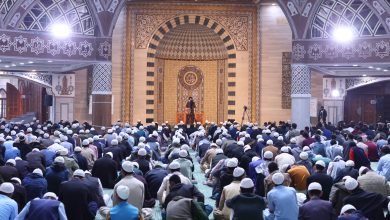
Delivered at: Masjid Baitul ul Ateeq
Lahore – Pakistan
Friday Sermon 16th Jan– 2026
Sermon 1: Taqwa from Shaking of belief during Tests
Sermon 2: Rahbar- Person who has practiced the Character of Imams throughout his life
Taqwa is a protective strategy from Allah, Blessed and Exalted, for human life. Allah, Blessed and Exalted, has granted life to the human being, determined the purpose of this blessing of life, and for reaching that purpose He made a path and a system of guidance, and along with that, in order to protect this life and safeguard it—since human life is caught in various dangers and destructions—He prescribed a protective measure to keep it secure, whose title in the Qur’an is Taqwa.
Since life has different sectors, different aspects, different fields, for every sector and every field and every aspect there is a separate arrangement of guidance according to the requirement of that sector of life, similarly there is guidance for it, and in the same way for every sector of life there is a corresponding and suitable protective measure. Just as a person himself does: he makes protective arrangements for his wealth, he makes a separate arrangement for protecting his house, he makes a different arrangement for protecting his property, he makes a different arrangement for protecting his health, he makes a different arrangement for protecting his status and position, he makes a different arrangement for protecting his faith and belief and religion, he makes a different arrangement for protecting and preserving his relationships and connections, he makes a different arrangement for protecting his family system and his children, he makes a different arrangement for protecting his environment. There is no single arrangement by which everything becomes protected—shoes are protected, environment is protected, wealth is protected, relationships are protected. For every sector a person makes a separate protective arrangement. That is why these things are protected. Those who do not make protective arrangements, their things are not protected. Those who do not arrange protection for shoes, their shoes get lost. Those who do not arrange protection for mobile phones, their mobiles get lost or stolen. Those who do not protect their wealth, their wealth is wasted. Those who do not protect their health, they fall ill.
Allah Almighty has also made such separate protective arrangements for human life. All of that is Taqwa, but it is sector-based Taqwa, topic-based Taqwa, and Taqwa related to different fields. Among these is one Taqwa which is mentioned in the Noble Qur’an: the protective measure given to protect the human being from the earthquake of the Hour, and the command to adopt and choose that protective measure.
In Surah al-Hajj, in the first verse, Allah, Blessed and Exalted, says:
يَا أَيُّهَا النَّاسُ اتَّقُوا رَبَّكُمْ
“O mankind! Be wary of your Lord. Indeed the quake of the Hour is a terrible thing.”
O people! Here the address is not to the believers, nor to the mujahideen; the address is to all people. In whatever form they are, with whatever identity they are, it is necessary for all of them to adopt Taqwa, to adopt a protective measure. From what should you protect yourselves and secure yourselves?
إِنَّ زَلْزَلَةَ السَّاعَةِ شَيْءٌ عَظِيمٌ
“Indeed the quake of the Hour is a terrible thing.”
Because the coming Hour, the coming time, the coming moment, the coming period is extremely great calamity and deadly. The greatest stage that faces human life is the earthquake of the Hour. By Zalzalat al-Sa‘ah, the Resurrection is meant—that the Hour of Resurrection is facing you, and that time is extremely great. Great means its calamity, its severity, its difficulty, its intensity is extremely severe, so much so that not everyone will be able to bear it. Such a severe stage faces humanity. The Resurrection is not for stones, animals, or trees; it is for human beings. Animals will not be presented in the Resurrection, nor resurrected, nor brought forth. Their work ended in this world. Whatever they had to do, whatever they had to become, they became and ended here. The Resurrection is only for human beings.
For human beings, the Resurrection is the name of the conclusion of life. It is not that a separate arrangement will be made for human beings in the Resurrection; rather, whatever life a person lived, that very life reaches an end in order to enter a new stage. Whatever a person carried through life becomes openly manifest before him. Human life opens fully in front of his eyes in the form of his own personality.
In our lives, the respite that has been given to us—of which we are unaware, and whose purpose we do not recognize—we humans, whether religious or non-religious, educated or uneducated, Eastern or Western, can define today’s human being and today’s generation as absolutely heedless of the purpose of life. Why did we come into this world? Why were we sent? This respite, these resources, these blessings, these abilities, these energies—why were all these given to us? And then a time comes when this respite ends. The bell rings: pack your belongings; the journey has ended; time is finished; now you are going to be deprived of the opportunity of this life.
These durations that we have, spanning many years and decades—if we take the average lifespan of a human being today as sixty years (some exceed it, some die before it, accidents occur)—then these sixty years, why were they given? For what were we sent?
Amir al-Mu’minin, peace and blessings be upon him, states that the greatest purpose for human beings is that they have come into the world to find the answers to three questions. These are not verbal answers, not oral examinations; they are practical. Allah sent us to this world for the answers to three questions: From where have I come? Where am I going? And where am I at this moment?
Where have you come from? This is a question whose answer must be searched practically throughout life. It is not merely theory or belief learned from books or teachers. The practical answer is that your connection with your origin must be visible.
Just like households: some women, after marriage, come to their husband’s home but maintain a very strong connection with their parents’ home, and because of this their relationships with the in-laws deteriorate. Some forget their parents’ home entirely. This psychological tendency exists. Amir al-Mu’minin is saying: O human being, you have an in-laws’ home and a parents’ home. Where have you come from? Who sent you? Why were you sent? You must maintain connection with your origin.
Merely reading that Allah sent us is not the answer. The practical answer is that your connection with that origin is strong, continuous, and visible to others.
And where are you going? And where are you now in this journey of life? Just like traveling from Lahore to Karachi, you must know at every moment where you are; otherwise, you may be standing somewhere else while thinking you are progressing.
The final destination of this journey is Qiyamah. Qiyamah is the outcome of this journey. Whatever you did from birth to death will appear openly before you. That stage will be extremely severe.
Allah uses two words here: Zalzalah and Sa‘ah. Sa‘ah means a moment of time. Time does not stop. As soon as it comes, it ends. This fleeting nature of time is why it is called Sa‘ah.
Allah says:
وَمَا أَمْرُنَا إِلَّا وَاحِدَةٌ كَلَمْحٍ بِالْبَصَرِ
“Our command is but one [word], like the twinkling of an eye.”
Zalzalah means the shaking of something that was stable. Qiyamah is called Zalzalah because everything that was firm will be shaken. The greatest shaking will be for humanity, because Qiyamah is for human beings.
This shaking is not limited to the Hereafter. Even before Qiyamah, nations and individuals experience severe jolts. One such jolt is mentioned in Surah al-Ahzab:
وَهُنَالِكَ ابْتُلِيَ الْمُؤْمِنُونَ وَزُلْزِلُوا زِلْزَالًا شَدِيدًا
“There the faithful were tested and were shaken with a severe shaking.”
And Allah describes:
وَإِذْ زَاغَتِ الْأَبْصَارُ وَبَلَغَتِ الْقُلُوبُ الْحَنَاجِرَ
“When the eyes turned aside and the hearts reached the throats…”
And people began to entertain doubts about Allah. This was the moment when the believers were put to trial. It was not the earthquake of the earth; the earth did not shake, the mountains did not shake, Madinah did not shake—the believers shook. The disbelievers did not shake because they were in a position of dominance, in majority, fully prepared for war. The believers experienced an internal earthquake.
This was a severe shaking—hearts trembled, courage collapsed, senses failed, livers rose to the mouth, eyes became fixed and stunned. This is what is called the shaking of hearts.
And in this shaking, many false believers—those who were not truly believers but had disguised themselves as believers—were exposed. One of the biggest problems of the believers is that within their ranks there exists, in large numbers, a group that claims faith but is not truly faithful.
وَمِنَ النَّاسِ مَنْ يَقُولُ آمَنَّا بِاللَّهِ وَبِالْيَوْمِ الْآخِرِ وَمَا هُمْ بِمُؤْمِنِينَ
“Among the people are those who say, ‘We believe in Allah and the Last Day,’ but they are not believers.”
They deceive Allah and those who believe. Allah is not deceived, but believers are deceived by them, thinking they are believers.
During this shaking, during this severity, during this siege:
وَإِذْ يَقُولُ الْمُنَافِقُونَ وَالَّذِينَ فِي قُلُوبِهِمْ مَرَضٌ
“When the hypocrites and those in whose hearts is a sickness said…”
Some scholars say this is explanatory conjunction—that the hypocrites themselves are those whose hearts are diseased. Others say these are two separate groups: hypocrites, and those with weak and sick hearts, full of doubts.
They said:
مَا وَعَدَنَا اللَّهُ وَرَسُولُهُ إِلَّا غُرُورًا
“Allah and His Apostle promised us nothing but delusion.”
They began saying that Allah and His Messenger deceived us.
This shaking is happening today. At this moment, the center of steadfastness, the center of resistance, the center of dignity of Islam, the axis of Islamic honor—the Islamic Republic of Iran, the system of Wilayat-e-Faqih, and the revolutionary camp—are under siege. The entire world stands against them. Not a single country has openly said, “We stand with Iran.” Pakistan has only said that its land will not be used against Iran, because rumors are circulating that attacks will be launched from Pakistan.
At this time, the situation in the Middle East is such that all Arab regimes allied with America are trembling. Their hearts have reached their throats, their eyes have frozen, their senses have failed—because Trump, this madman, this bully, announced that he would attack Iran. Iran declared clearly: if you attack, we will retaliate.
Our missiles may not reach America, but American bases surround us. Every Arab country hosts American military bases. Iran has clearly told these countries: if we are attacked, we will strike wherever American soldiers, bases, or institutions exist. They have already seen in the twelve-day war that this is not empty talk. Iran has missiles, and those missiles have become more powerful over time.
During the twelve-day war, the internal weaknesses of Iran were identified and rectified. Earlier they said Iron Dome would protect Israel—now the Iron Dome has been seen. When Gaza began to resemble devastation, they folded their hands and begged for ceasefire.
Iran has now declared: the glass palaces you have built—Dubai, Doha, Riyadh—where American bases exist—these glass palaces will shatter. America cannot strike Tehran, Mashhad, and Iranian cities and expect immunity for its bases.
Iran has already drawn the battle map. Missile positions are fixed. If attacked, responses are prepared. Neighboring countries have been warned not to complain afterward.
These are the Mujahideen. This is the Leader. Glory be to Allah. Allah is the Greatest.
Reflect: for fifty years, one system has stood against the entire world. Not a small world—against America, Europe, nuclear powers, technological powers, military powers. For fifty years, they have not retreated one inch. Show me in history such people, such leadership, such firmness, such upbringing—what school produced them?
Hamas took inspiration from this school. Hamas showed extraordinary steadfastness. Hezbollah did the same. Those trained in this school reached the peak of resistance. They were martyred. Their cities were destroyed. Their lives were ruined—but not one inch of retreat. Why? Because in this system, martyrdom exists, beheading exists, bowing does not exist. This is the Husayni school. This is the Alawi school. This is the path of the Conqueror of Khaybar. There is no compromise in it.
On the other side, the Qur’an shows the scene of the Battle of the Trench: all disbelief gathered, and against them stood Ali ibn Abi Talib alone. This is leadership. A single individual with a sword defeats an entire army.
Today’s Battle of the Trench is more important for us.
In that battle, Ali decided—and the battle became a source of honor for Islam. The backbone of disbelief was broken.
When Ali went forward, someone remarked that his gait seemed proud. The Prophet ﷺ responded:
“Today, all of disbelief has gathered, and all of faith has gathered in Ali.”
This is the same scene today.
They thought that after martyrdom of Qasem Soleimani, they could subdue the sons of Haydar. They did not know that the One who creates Soleimanis is still alive. The pressure is immense. Threats are constant. Media screams war. Leaders tremble.
The Qur’an says: Madinah also trembled. Hypocrites existed there too. Iran is filled with hypocrites today as well. From the first day of the revolution, hypocrites emerged—Bani Sadr, others. Hypocrites reproduce hypocrites.
But Allah’s law is this: when earthquakes come, believers are tested—not to destroy them, but to separate hypocrites from believers
Allah says:
فَأَرْسَلْنَا عَلَيْهِمْ رِيحًا وَجُنُودًا لَمْ تَرَوْهَا
“So We sent against them a wind and hosts that you did not see.”
Invisible armies exist. Today, visible Ali-like figures stand firm, and invisible armies are also prepared.
Has Allah’s power diminished? Have Allah’s armies ended? Have the followers of Ali finished? Look at this ninety-year-old leader—standing firm while the world threatens him.
Allah raises such servants to anchor nations during earthquakes.
Just as Ali anchored the Ummah in the Prophet’s time, today too anchors exist.
The result of this Battle of the Trench will be the same: disbelief humiliated, faith victorious.
Allah has promised:
لَأَغْلِبَنَّ أَنَا وَرُسُلِي
“I will surely prevail, I and My apostles.”
Take care not to become hypocrites. Guard your hearts. Outcomes may resemble Karbala or Khandaq—but in Karbala, Husayn stood; in Khandaq, Ali stood.
Necks may be cut—but they will not bow.
This war is a school, a training ground. Learn where you stand. Choose your side.
Our prayer is that just as Allah humiliated the Confederates in the first Battle of the Trench, He will humiliate today’s confederates—Trump, Netanyahu, and their allies.
SECOND SERMON
O servants of God, I advise all of you and my own self to divine Taqwa; I counsel divine Taqwa; I invite toward divine Taqwa; and I emphasize that you should spend your lives according to Taqwa, live life under the shade of Taqwa, and carry out the affairs of life on the basis of Taqwa. Taqwa is a protective measure from Allah, Blessed and Exalted, for the safeguarding of human life. In order to put this protective measure into practice, Allah, Blessed and Exalted, has granted the human being the means: the heavenly books, the noble prophets, the pure Imams (peace be upon them), and especially the person, personality, conduct, and wisdom of Amir al-Mu’minin (peace be upon him), which is the practical embodied model of Taqwa. Amir al-Mu’minin (peace be upon him) says in Nahj al-Balaghah, Hikmah 117: حَالَكَ فِيَّ رَجُلَانِ مُحِبٌّ غَالٍ وَمُبْغِضٌ قَالٍ: about me, two kinds of people will be destroyed—one is the extremist (ghali) who loves me, who exaggerates, and the other is the one who hates me, the Nasibi, the hater (qali). Amir al-Mu’minin said that love for me, if it remains within limits as Allah has set the limit, is a means of salvation; love of Ali is a means of salvation. But if you exaggerate in Ali’s love, if you cross the limits, if you pass beyond the limits, then it becomes a means of destruction—and exaggeration (ghuluw) is the name for crossing that limit.
To protect the religion of God and to protect the Shia, the pure Imams (peace be upon them) not only rose, fought, and struggled against oppressive rulers, but they also confronted the dangers that arose from within the Shia themselves. Three kinds of dangers have faced the Shia from the time of Amir al-Mu’minin (peace be upon him) until today: one from oppressive tyrannical governments and taghuts; the second from opposing religions and sects, and from the harsh and fanatical scholars of opposing religions—history books are filled with this hatred, this fanaticism, and this severity; and the third danger to the Shia is from within. The Imams confronted the oppressive governments; they confronted the opponents and the attacks that came upon the Shia from other sects and religions; and likewise, the internal danger was given greater importance by the pure Imams (peace be upon them), because external dangers do cause harm, but they are not as significant as internal danger. One should not close one’s eyes to the external danger, nor to the internal danger; but if you compare them, internal dangers are more dangerous. Just as if it is raining, rain is falling on your house from above, and inside there is termite infestation—what will destroy your house quickly? The external rain, you may be able to protect yourself from it; but if you do not control the internal termites, they will ruin and destroy it. This exaggeration (ghuluw) is the termite that infected the Shia from within, and the pure Imams diagnosed it in time and confronted it, and commanded confronting it, and alerted us to its danger.
Exaggeration has existed in every era, and it is more appropriate to examine it by eras. It has been my wish for a long time that the history of Islam, the Shia, and the Imams be presented with analysis—an analytical history, not merely نقلِ اقوال (transmission of statements) as histories are usually written; rather, by analyzing history with its logic, by examining it in the light of the logic of sociology, then we can take lessons and guidance from it. According to this history, the pure Imams (peace be upon them) confronted the dangers that arose in every era—internal and external. The era of Amir al-Mu’minin, then after that the era of Imam Hasan (peace be upon him)—I mean the era of Imamate; the lifetimes of some personalities are long, but their era of Imamate is not long. The era of Imamate of Imam Hasan, the era of Imamate of Imam Husayn, similarly the fourth Imam—these eras must be reviewed, that what kind of conditions each Imam had to face and how each fulfilled the duty of Imamate, how each performed the role of Imamate. Generally, the information we have leaves aside Imamate entirely, and only keeping معنویت, spirituality, and the spiritual aspect in view, it is presented to the believers—scholars too have only that much awareness that they give to the public: regarding the pure Imams (peace be upon them), a few hadiths, a few texts, and the life circumstances of the Imams. Look at the life circumstances of Imam Musa al-Kazim (peace be upon him) from the internet or in printed books—generally, the life of one Imam ends within ten or twelve pages: first the Imam’s introduction is written—name, birth—then a few narrations about نص (designation) to the Imamate, a few hadiths, then a few karamat are mentioned, then the Imam’s children, then martyrdom and a few causes of martyrdom, and the story ends there. This is how books have been written from old times; scholars write like this, and everyone has only this much information. Rather, the zakirs have even less information than this; the believers have more information about the pure Imams, but zakirs have even less.
It is said that there was a gathering about Imam Ali al-Naqi (peace be upon him), near Lahore, somewhere around Sheikhupura; there was a large gathering in which dozens of zakirs and speakers were gathered, a جلسہ. The organizer said that someone should recite something about Imam Naqi (peace be upon him) too, because whoever came recited virtues of Mawla Ali and recited مصائب of Imam Husayn and left, and they recited the same kinds of topics. The organizer’s حسرت was—apparently he was a Naqvi Sayyid—that someone should also tell something about Imam Ali al-Naqi, about our forefather, whose day of martyrdom it is. So whichever zakir or speaker he asked, he would say the next one will recite; they kept pushing it until the last zakir. When the last zakir was to recite, he said: now there is no one else, so you recite a little. He said: tell me, this Imam Naqi—was he martyred by poison or by the sword? He did not know. So he said: if you confirm that, the rest of my topic is ready—if he was martyred by the sword, that topic is ready; if he was martyred by poison, that topic is ready; just confirm for me how he was martyred. This is the knowledge of speakers and zakirs; then the public has only a little knowledge. But we who have study—our knowledge too is only this much within books: the books about the Imams’ life circumstances contain only this much—some hadiths, some karamat, and a few incidents—individual incidents.
If you especially want to know about Imamate and the Imams in these days of martyrdom of Imam Musa al-Kazim (peace be upon him), then the book of the Supreme Leader (may his shadow be extended), “Two-Hundred-and-Fifty-Year-Old Human,” is the best source. In it the Supreme Leader has compiled the discussion of Imamate in a very excellent and beautiful way: the lives of the pure Imams (peace be upon them), such that the total span of the Imams (peace be upon them) amounts to 250 years—from Imam Ali (peace be upon him) until the time of Imam Mahdi’s (peace be upon him) occultation is 250 years—so he has compiled it in such a way that it is as though this is one human being: twelve personalities, twelve roles—like one person. But the excellence is not that he has proven twelve personalities as one personality; rather, the excellence of this book is that Imamate has been presented as a system. Imamate has not been presented only as a belief; Imamate has been presented as a system. And then in the implementation of this system, in putting this system into practice, the era of every Imam has been mentioned by analysis and examination. This should be a textbook, a curriculum book for the Shia. And I will request my dear friends that they teach this in different ways—teach the entire nation this book. At minimum, from this book the Shia understanding of Imamate will become clear—what has become confused, what ignorant and حرفه ور (professional) zakirs have confused and ruined minds about Imamate—through this book, Qur’anic Imamate and true Imamate that Allah, Blessed and Exalted, has made for human guidance, you will gain its correct understanding.
The Imamate of Imam Musa al-Kazim (peace be upon him) is especially very important. In the night majlis of عزاداری I also pointed to this point. Today, the situation of the Shia at the global level, and especially in Pakistan—in it the model of Imamate that is necessary for the Shia is the method and style of Imam Musa al-Kazim’s era, the method the Imam adopted for the guidance and leadership of the Shia, and to keep the Shia organized. It is a great tragedy that the Shia—especially I am speaking of Pakistan, not the global, though it exists in the rest of the world too—like in Iraq, the Iraqi Shia have withdrawn; they have lifted their hands, “raf‘ al-yadayn,” meaning lifting hands: that this is not ours. This is what Iraqi Shia have always done throughout history. Especially now, their behavior in the current era has become very regretful: when they got the opportunity, when the oppressive tyrant Hajjaj ibn Yusuf of today—Saddam—was destroyed and dispatched to Hell, and they got the opportunity that as the majority of the country they could come and guide their system and take it, they openly, voluntarily—not under American pressure—voluntarily said: we do not want the نظامِ فقی; we do not want the system of Imamate; we want democracy. Rather, they committed such ظلم that when it came to naming the state—Pakistan’s name is “Islamic Republic of Pakistan,” this is the constitutional name, written in Pakistan’s constitution. When in Iraq this discussion came that what should we name the state, one suggestion was “Islamic Republic of Iraq,” but they refused—especially the religious people refused—that no, even Islam’s name should not come with Iraq. What name did they keep? “al-jumhuriyyah al-‘arabiyyah al-‘iraqiyyah”—the Arab Republic of Iraq. They did not even like the name “Islamic Republic.” They have withdrawn.
In Pakistan too, the Shia certainly have devotion; their passion for Imamate is very elevated; the passion of Pakistanis is extraordinary and unparalleled. I pointed to this in the night majlis—perhaps some heard—that behind عزاداری there is a very great passion at work; truly it is unparalleled in the world. I am not exaggerating; it is a reality: the passion within Pakistani Shia is such that you will not find in any nation in the entire world. Even among Pakistan’s Ahl al-Sunnah there is not as much passion as there is among Pakistan’s Shia. Behind عزاداری there is great sincerity and passion as the motivating force, and ahead of it there is trade and business; the one who has taken the reins of عزاداری, who has held its control, is business and professionals—meaning they sell all this passion, they cash it, these traders. If this passion were in the hands of righteous leadership, this passion today would have shown that the system of Wilayat-e-Faqih is not alone. Today Trump would not be so insolent if this passion were in the hands of righteous leadership, if the leadership of this passion were done by righteous leadership, Shia leadership, Husayni leadership—then this passion would have been a very great power even for Pakistan. This passion would have been so strong, like Hizbullah was a limited Shia group, but Israel could not look at Lebanon with an evil eye. Similarly, if there were righteous leadership of the Shia and not “passion-sellers,” then India would not have the courage to look at Pakistan with an evil eye.
But this passion was sold; it was cashed; its price was collected; therefore the result that should have emerged did not. Imam Musa (peace be upon him) in his era—Imam Musa’s era was the most turbulent era: on one side the most tyrannical sultans of Banu Abbas—four caliphs: Mansur, Mahdi, Hadi, and Harun—these four were the most tyrannical, most corrupt, most ruthless caliphs and rulers; on one side they were, and on the other side was Imam Musa (peace be upon him). Because the Imam (peace be upon him) was born in the second century Hijri, and the station of Imamate began in the second century Hijri after the martyrdom of Imam Ja‘far al-Sadiq (peace be upon him), this century in reality was the century of sect-making. In it, the work of creating sects was happening. Banu Umayyah had ended, Banu Abbas came, and Banu Abbas began making sects in their favor. And Banu Abbas had this sensitivity that the Ahl al-Bayt be completely pushed out of the social and political arena, because this is the name by which any government can be threatened, just as Banu Umayyah had to be removed from government for this reason: because they had oppressed the Ahl al-Bayt, and that became a movement, and Banu Umayyah ended—by the hands of the Shia, by the hands of Abu Muslim Khurasani—the same Abu Muslim Khurasani who went and sold the Shia passion at the feet of Banu Abbas. Haruni Shia, Mansuri Shia—wherever you throw your passion, you become the Shia of that one. Like today in Pakistan there are “Imrani Shia”—they take all the Shia passion and throw it at the feet of a corrupt man; the same thing happened within that movement.
In the time of Imam Musa al-Kazim (peace be upon him), this ruthless government that was intent on completely eliminating the Ahl al-Bayt, by every excuse and trick did this: against Imam Musa al-Kazim, within the Shia—rather within an even more limited circle than the Shia—within the family of the Ahl al-Bayt, within the family of Imam Musa al-Kazim, approximately six or eight sects were manufactured from within the Imam’s family, whose leadership was being done by the Imam’s brother, or the Imam’s nephew, or the Imam’s relative, or a cousin—fitnahs were raised within the Shia from within the Imam’s family. Now on one side is the tyrannical government that is not ready to give the Imam freedom even for a moment; on the other side sect-making is at its peak, religion-making, and it is happening under the leadership of Banu Abbas; they are putting major “imams” into the میدان; and in that too they have completely sidelined the Ahl al-Bayt; and from here, within the Shia, sects and fitnahs that had been continuing from before—among which ghuluw was the greatest and most severe fitnah.
Now pay attention: an Imam who is confined, in jail, in prison, not free, under surveillance—how did Imam (peace be upon him) keep the Shia organized? There is no power, no government, and there is no conception even remotely that the Imam will become a ruler; but even so, the Imam safeguarded both Shi‘ism and the Shia. The Imam safeguarded both: the Shia as a community, and Shi‘ism as a school. The Imam kept the school of Shi‘ism organized and also organized the Shia community, and made such an excellent beautiful system that the entire Shia community that existed in the surrounding regions was all connected through a network, through a system of communication, and many works the Imam performed—this book “Two-Hundred-and-Fifty-Year-Old Human” contains this detail; for every Imam’s era you can find it. And this is that method of Imamate that is needed today.
Today, Pakistan’s Shia are so scattered—look how many groups have formed: as many villages as there are, as many clerics as there are, as many leaders as there are, as many zakirs as there are, that many sects are here. How will they be organized? And among them there are also ghulat who have risen for destruction. The approach of Imamate of Imam Musa al-Kazim (peace be upon him) and the measures of Imamate of Imam Musa al-Kazim can be useful for Pakistan’s Shia today—but if, by analysis and examination, those lessons are extracted that the Supreme Leader has presented of this system of Imamate. And let me also say: read the view of Imamate of other scholars and jurists—historical and contemporary—and read the view of Imamate of the Supreme Leader, then you will also realize the level of knowledge: whose understanding of religion is stronger, whose understanding is deeper, who is the faqih of religion who understands by going to the roots, and who is someone with only a superficial understanding. This too you will realize by reading this book: how much mastery there is over the issues of religion, how clear the resources of religion are, and above all how clearly, purely, transparently the Supreme Leader has explained the system of Imamate. For today’s Shia, he has solved all difficulties and presented an entire railway track like a train-track: the 250-year era of the Imams’ conduct, character, and statements, and in it he has shown that Shia is one system; Imamate is a system for the Shia; and Shi‘ism is the name of the vehicle, the name of the community, the name of the collective, that runs on the track of Imamate. If Shi‘ism comes onto the approach of Imamate, then neither Trump, nor Modi, nor Netanyahu, nor any ruthless tyrant—whether Harun or Ma’mun or Hajjaj ibn Yusuf or Banu Umayyah—no ruthless man of the world can shake the foundation of Shi‘ism.
You have seen that the Supreme Leader has read and presented Imamate, and how firmly he stands on that Imamate; how this personality stands like a pillar of steadfastness; the entire world—Trump is applying pressure that somehow he uproot and throw away the system of Wilayat-e-Faqih, but the more measures he takes, the more disappointed he becomes, and the more unsuccessful and deprived he becomes. And Allah, Blessed and Exalted, God willing, has to keep this system established and enduring until the revolution of Imam Mahdi, God willing. And our prayer in the court of Allah, Blessed and Exalted, is: O Lord, grant the Supreme Leader long life, grant him health and safety, and increase him in steadfastness and perseverance. O God, by the right of Muhammad and the family of Muhammad, these fitnahs that have risen against the revolution—O Lord, annihilate all these fitnahs, make these فتنه گر (fitnah-makers) fail; and the enemies—Trump, Netanyahu, Arabs, non-Arabs—O Lord, turn all their plans, their evil plans, back upon themselves. O Lord, by the right of Muhammad and the family of Muhammad, protect the state of Pakistan; protect this country from the evil of internal and external enemies; establish peace and security within this country; grant this country deliverance from fitnahs; O Lord, grant the nation of Pakistan awakening and awareness; grant them the ability for unity and agreement.