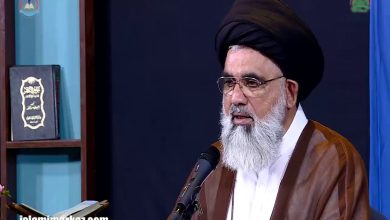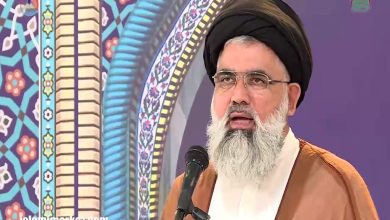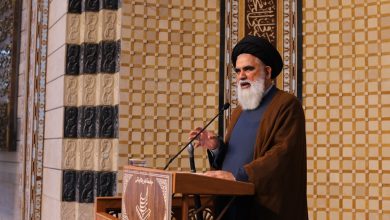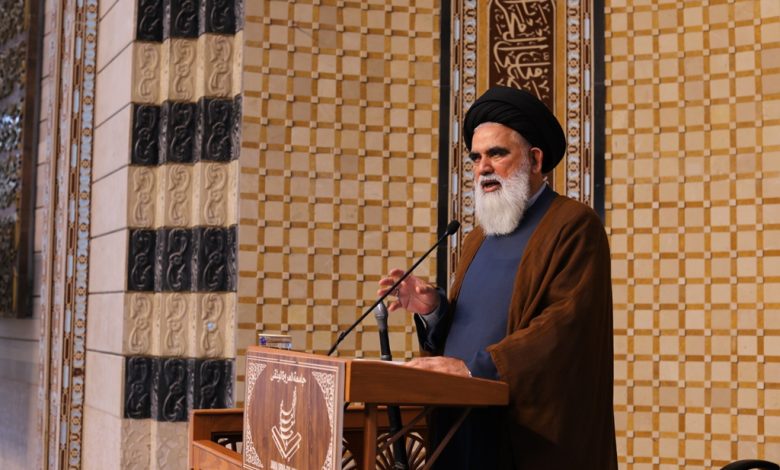
Hujjatul Islam Ustad Syed Jawad Naqvi
(Principal Jamia Orwatul Wuthqa – Lahore)
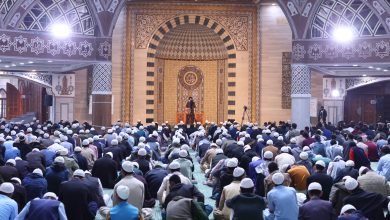
Delivered at: Masjid Baitul ul Ateeq
Lahore – Pakistan
Friday Sermon 9th Jan– 2026
Sermon 1: Taqwa for protection from big shaking on Qayamat
Sermon 2: Ghuluw: The Internal Fitnah More Dangerous Than Tyranny
One misconception that exists among us and even among our scholars is the belief that we can attain salvation even while living our lives within a corrupt society. This is similar to living in the midst of an epidemic. In Surah al-Hajj, the first verse states:
يَـٰٓأَيُّهَا ٱلنَّاسُ ٱتَّقُوا۟ رَبَّكُمْ ۚ إِنَّ زَلْزَلَةَ ٱلسَّاعَةِ شَىْءٌ عَظِيمٌ
O people! Guard against (the punishment from) your Lord; surely the violence of the Hour is a grievous thing.
يَوْمَ تَرَوْنَهَا تَذْهَلُ كُلُّ مُرْضِعَةٍ عَمَّآ أَرْضَعَتْ وَتَضَعُ كُلُّ ذَاتِ حَمْلٍ حَمْلَهَا وَتَرَى ٱلنَّاسَ سُكَـٰرَىٰ وَمَا هُم بِسُكَـٰرَىٰ وَلَـٰكِنَّ عَذَابَ ٱللَّهِ شَدِيدٌ
On the day when you shall see it, every woman giving suck shall quit in confusion what she suckled, and every pregnant woman shall lay down her burden, and you shall see men intoxicated, and they shall not be intoxicated, but the chastisement of Allah will be severe.
There is a warning here of a great threat that is advancing towards humanity. That danger is the immense earthquake of Doom (Qayamat), which is for all people and not only for believers. Human beings must begin making arrangements for their protection from now. Even the earthquakes that occur in this world cause massive destruction, but that earthquake will be so severe that mothers will abandon their suckling children and flee. This is mentioned specifically because a mother normally prioritizes the protection of her infant, yet the shock of Qayamat will be such that she will forsake even her child and become concerned only for herself. Pregnant women will miscarry due to this shock. People will appear to be intoxicated, meaning that the wrath will be so overwhelming that human beings will lose their senses, and thus it is described as a state of intoxication.
Qayamat is destined to come, but if one makes protective arrangements in this world by adopting a secure and righteous lifestyle, one can remain protected on that Day. The address in these verses is directed towards all humanity, so if people adopt protective means and walk the right path, they can remain safeguarded.
Society is like a mother, which a human being needs both before birth and after birth. As a child grows, his needs continue to increase, but when he becomes mature and grown, the mother alone cannot fulfill all his needs. At that stage, society assumes the role of a mother. If the things provided by society did not exist, we would not survive even after birth. Many people are involved in the formation and functioning of society. When we sit in a madrassah in a peaceful environment to study, we should be grateful and realize how many categories of people were involved in creating this infrastructure. In the universe, we can see how many forces are actively engaged in providing for us. With every morsel of food that we eat, we should be aware of how many systems and efforts are involved in its provision. Sheikh Sa‘di says that this process begins from the solar system, so that we do not consume even a single morsel negligently. There is a cosmic system behind this, created by Allah, and then there is the Tashree‘i system, formed according to laws through human beings. Since human beings are social by nature and Allah has placed them within a society, their growth and guidance will also occur within society.
Imam Hussain (a) presented how many means and arrangements Allah had made for his birth. He expressed gratitude for everything created by Allah, and for the sending of the Prophets, all of which became means for his existence. Imamat and religion remove human beings from negligence and enable them to perceive all of this around them. Today, however, we are living in negligence, and when the earthquake of Qayamat arrives, it will force us to abandon everything. Pregnant women will miscarry their children. If one acquires Taqwa, this will not happen, because such a person has not spent life in negligence, but in a state of protection.
Imam Ali (a), in his will, says not to leave his testament neglected and thrown into a corner. He instructs that this will should be made the path of one’s life and not discarded. We have pushed these teachings aside. If even one percent of the Friday sermons we have listened to had become part of our lives, we would have been transformed. Our teacher used to say that if we adopted even one percent of seminary teachings, we could be considered saints of Allah. We listen habitually and then leave everything behind in the mosque. We exit the mosque with empty minds and do not carry religion outside its walls. We should analyze ourselves and ask whether we have avoided disobedience between two Fridays, and how much Taqwa we have acquired from one Friday to the next.
Two terms are used in these verses regarding Qayamat. One is “Qayamat as-Sa‘aat,” and the other refers to the earthquake of Qayamat. We often assume that it is the earth that will shake, whereas in reality it is the human being who will be shaken. When a person suffers a business loss or a relationship breaks down, he is shaken and his life is disturbed. This is not merely a physical earthquake. The shaking of the earth is only one reference. The quake of Qayamat will be far more intense and will shake all of humanity. It cannot be compared to earthly earthquakes. Zalzala means that something is moved from its original place and displaced elsewhere. It is like slipping, where sometimes a person slips physically, and at other times such slips occur that an entire society deviates from its course. If a scholar or a ruler slips, the whole society slips. People are connected to religious scholars, so when a scholar slips, everyone slips. If a Marja‘-e-Taqleed slips in his path or character, all his followers slip with him. History shows how people have been destroyed due to the slippage of scholars. Many people did not stand with Imam Hussain (a) because of the slippage of their scholars. We often do not concern ourselves with these deserters, considering them part of ourselves, yet the Imams (a.s) supplicated that just as they isolated us, Allah should isolate them as well. Those who abandon the path of Allah and do not support or contribute their share are also isolated by Allah. We do not complain about those who refuse to support religion; rather, they are the greatest criminals. In Palestine, the slaughter that was carried out made the entire world complicit in that crime.
When this earthquake arrives, immense destruction will occur, so one must acquire Taqwa. When a scholar slips, the impact of that slippage is immense, and society often does not return to its original state. Iqbal pleaded for the Ummah to return to the state of the Prophet Muhammad (s), who led people towards monotheism, Imamat, and the right path. The reason people drift away from religion is the slippage of either a scholar or a ruler, a fact confirmed by history. People generally follow scholars, rulers, and elites. We can observe how content the Shia appear to be without Imamat, and how little concern there is for the system of Imamat. If one generation realizes that it cannot live without Imamat, the next generation may find peace and return to the right path. Unfortunately, when we slip, we begin to settle comfortably in that state of deviation. When Imamat is taken away from us, we say it does not matter and choose to remain wherever we have fallen. The Qur’an instructs us to cling to those who cannot slip. We cling to the Infallibles because it is impossible for them to slip. Those who did not hold on to them grasped others instead and continued to slip. We do not see even the slightest deviation in the lives of the Imams. An infallible is one who cannot slip. They were appointed as Imams of the Ummah so that people would not slip, yet people abandoned them and followed those who were destined to slip.
Zalzala is the quake that displaces something from its position. The quake of the human being is far greater than the earthquake of the earth. Some people, when they acquire wealth, abandon their values and become blind. Why Qayamat is called Sa‘aat will be discussed later.
SECOND SERMON
O servants of God, I exhort you and I exhort my own self to taqwa; I counsel toward taqwa, I invite toward taqwa, and I emphasize that life must be lived according to taqwa, under the shelter of taqwa, and that the system of life must be established upon the foundation of taqwa. Taqwa is protection—protection against dangers, calamities, destructive forces, and afflictions that threaten human life, that annihilate and destroy. Protection from every such danger is called taqwa.
For taqwa, Allah, the Exalted, has provided means for human beings, has prescribed resources, and has established a system. He sent the noble Prophets and the Imams, peace be upon them, and revealed the heavenly books so that the strategy of taqwa might be taught to humanity and implemented and enforced within their lives. Amir al-Mu’minin, peace be upon him, explained the field of taqwa in the most excellent manner, lived his life within the field of taqwa, and clarified for the believers the places where a believer may be destroyed or ruined.
Among those destructive dangers, Amir al-Mu’minin mentioned a strange and grave danger for the believers. In Wisdom 117, Amir al-Mu’minin, peace be upon him, states: “Two groups will be destroyed concerning me: the extremist lover and the hateful enemy.” One is an excessive, extremist lover, and the other is one filled with hatred and enmity toward me—both will be destroyed. Among the dangers, especially for the believer, that Amir al-Mu’minin identified, the danger of ghuluw (exaggeration) is a great danger. Not only Amir al-Mu’minin, peace be upon him, but all the pure Imams, peace be upon them, sensed the danger of ghuluw and guided the believers in order to protect them from it. In that guidance, they explained multiple dimensions of ghuluw.
During the eras of the pure Imams, the Shi‘a were under many forms of pressure and danger. Tyrannical, oppressive governments such as the Umayyads and the Abbasids ruled—governments that had not the slightest mercy, neither for the Ahl al-Bayt nor for their followers, the Shi‘a. Yet despite this oppression and tyranny, the Imams lived within that environment and guided the Shi‘a. However, in their guidance of the Shi‘a, they placed greater emphasis on the danger of ghuluw.
Who were the ghulat (extremists)? They were not the Umayyads, nor the Abbasids, nor those whom today we call Ahl al-Sunnah, nor the ideological opponents. Ghuluw arose from a group that emerged from within the Shi‘a themselves. In the name of love for the Imams, in the name of love for ‘Ali, they created a danger for the Shi‘a greater than oppression and tyranny. From the manner in which the Imams confronted them, it becomes evident who the greater danger was in their view. Tyranny and oppression can never create inner inclination in the heart of a Shi‘a—neither toward the Abbasids nor toward the Umayyads. This is impossible. A Shi‘a—and even a Muslim—should never incline toward them. Others were deceived regarding the Umayyads, but that group is such that washing them does not cleanse them; rather, the water itself becomes impure. If the entire ocean were used to wash the Umayyads, the ocean would become filthy, and not a single Umayyad would become pure. The same is the case with the Abbasids.
No matter how much pressure or oppression they exert, the greater danger for the Shi‘a is not that they can kill or subjugate them physically; rather, it is that they can never unite the Shi‘a heart with themselves. The danger of ghuluw is greater because it diverts the Shi‘a from the path of the Imams, alters the Shi‘a mind, changes the Shi‘a heart, and corrupts their allegiance. Thus, in history, no Shi‘a is seen supporting the Umayyads or the Abbasids, but many are seen connected with the ghulat. This is because the ghulat are like termites, attaching themselves internally to the body and foundations of Shi‘ism and hollowing it out from within. For this reason, the Imams confronted them with great severity, and that struggle is recorded in our books.
From Bihar al-Anwar, volume twenty-five, chapter ten, which addresses the negation of ghuluw, several narrations were presented. Among them is a narration that discusses a well-known extremist of that era. One of them was Abu al-Khattab, also referred to as Abu Mikhlaas. In narration twenty-five, there is mention of Hamzah, who was also an extremist, about whom the Imam asked Zurarah. In narration twenty-six, it is reported from Imam Ja‘far al-Sadiq, peace be upon him, transmitted by Sa‘d ibn ‘Abdullah ibn ‘Ali ibn ‘Amir, without a chain. Allamah Majlisi, may Allah have mercy upon him, records this narration.
It must be noted that throughout history, and even today, there have been scholars who themselves do not commit ghuluw but show sympathy toward the ghulat, defend them, or soften their stance toward them. Among scholars as well, historically, there have been two groups. Some realized that if ghuluw continued to grow and spread, Shi‘ism would be destroyed. This is no exaggeration: if anything can damage or derail Shi‘ism, it is ghuluw alone. Nothing else can. Every other force tried its weapons—Karbala occurred, the Abbasids came, organizations were formed, terrorists and takfiris emerged—but Shi‘ism did not end. It is like a tree: cut one branch, ten more grow. Look at Pakistan—despite massacres and genocide, have Shi‘a decreased or increased? They have increased. Shi‘ism does not end through these means. But ghuluw can destroy it.
For this reason, the Imams fought it, and among the scholars, some great figures recognized the danger of ghuluw and confronted the extremists with courage. Among them was the late al-Kashshi, one of the great scholars whose book remains a foundational reference for ijtihad. Without the references of his book, no one can truly perform ijtihad. He was the teacher of Shaykh al-Tusi. Shaykh al-Tusi refined and abridged his book, which is now known as Rijal al-Kashshi. Al-Kashshi did not merely warn people verbally to beware of extremists; he identified and exposed the leaders—those who had infiltrated the Shi‘a, gained recognition, taken control of education and guidance, and acted as supposed representatives of the Imams. He seized them by the wrist and declared: these are not Shi‘a; they are extremists.
Even those whose narrations were respected and transmitted by Shi‘a scholars were exposed by al-Kashshi as being deceived. Thus, al-Kashshi and Ibn al-Ghada’iri are among the scholars who rendered an immense service to Shi‘ism by identifying those who had infiltrated its ranks and clarifying that they were not Shi‘a. Their beliefs were polytheistic; they believed in the divinity of the Imams and attributed divine qualities to them.
Among them was Abu al-Khattab, mentioned in narration twenty-six. He initially established relationships with the Imams, gained trust, and people saw him coming and going from the Imams’ gatherings. This visibility generated respect and credibility. Gradually, he exploited that trust. This pattern is common: a person takes time to build trust, then uses it to strike from within—like a snake hidden in the sleeve.
Abu al-Khattab claimed to his followers that the Imam was God—God forbid—and that he himself was the Prophet sent by Him. Instead of rejecting him immediately, ignorant minds accepted whatever was spoken from the pulpit without reflection. Had they used reason, they would have realized this was blatant disbelief: declaring an Imam to be God and claiming prophethood. Instead, they were impressed and said, “We have met a prophet.” He even propagated that wherever he was, God’s shadow was over him—by which he meant Imam Ja‘far al-Sadiq, peace be upon him.
This matter reached the Imam. Abu al-Khattab and his group were eventually killed by the Abbasids in Kufa for political reasons, not at the Imam’s command. Yet Imam Ja‘far al-Sadiq, peace be upon him, said: “May Allah curse Abu al-Khattab and all those who were killed with him. They were a misguided sect.” He expressed relief at their death, sensing that a great fitnah within Shi‘ism had ended.
During battle, Abu al-Khattab told his companions that he was a prophet and that God—meaning Imam Ja‘far al-Sadiq—was supporting them. He claimed to see God sitting atop the mosque or the city wall, encouraging him. When this reached the Imam, he said: “By Allah, it was Satan who appeared to Abu al-Khattab.” Satan stood upon the wall of Kufa or atop the mosque, urging him to fight on, promising victory, angels, and divine help. Abu al-Khattab mistook Satan for God and imagined he was receiving divine visions.
Another extremist leader of that era was Abu Mansur al-‘Ijli, mentioned in narration twenty-seven, also reported by al-Kashshi. In a gathering with Imam Ja‘far al-Sadiq, peace be upon him, someone reported that Abu Mansur claimed the Imam was God and that he himself was a prophet. He even claimed that the angel Jibril took him to God, who placed His hand on his head and spoke to him in Persian, calling him “O son.”
In response, Imam Ja‘far al-Sadiq, peace be upon him, narrated from his father Imam al-Baqir, peace be upon him, who narrated from the Messenger of Allah, peace be upon him and his family, that Satan has established a throne between the heavens and the earth and has helpers equal in number to the angels. When he summons someone, they bring that person before him. Abu Mansur, the Imam said, was taken to Satan, not to God. He is a messenger of Satan, a satanic prophet. The Imam cursed Abu Mansur three times, declaring him misled and misleading others.
Another important narration is narration twenty-eight from Zurarah, one of the most eminent companions of the Imams, whose reliability, justice, and trustworthiness are unanimously agreed upon. He preserved the authentic teachings of the Imams. Zurarah reported that Imam al-Baqir, peace be upon him, asked him how many Shi‘a narrations he possessed. Zurarah replied that he had many and preserved whatever he heard. He confessed that he had often thought of burning many of them because they were fabricated and harmful, and he did not want them transmitted further.
The Imam asked why, and Zurarah presented some examples. The Imam responded by referencing the angels’ objection when Allah intended to create Adam. Their understanding was incomplete. From this, scholars differed in interpretation: some understood that Zurarah might be mistaken, while others held that those narrations, like the angels’ assumptions, were false projections about the Imams’ divinity.
The Imams themselves said: “We are servants of Allah; do not raise us above servitude. Describe our virtues as you wish, but do not divinize us.” Ghuluw is misguidance, corruption, and destruction, and the Imams actively eradicated it.
Time is limited. Ghuluw is the fitnah that destroys Shi‘ism. For this reason, the Imams showed severity against it. Scholars must convey the stance of the Imams clearly. The public must use reason and awareness, not applause for fabricated claims. May Allah protect the Shi‘a, safeguard the school of Ahl al-Bayt from every evil and fitnah, protect it from ghuluw, sectarianism, takfirism, and hostility, and preserve this blessed tree.
O Allah, deliver the Muslim Ummah from oppression; annihilate the oppressors with their oppression; bring an end to America and Israel; aid the oppressed of Palestine and Gaza, Kashmir, Lebanon, Syria, Iraq, and Yemen; protect them. Protect the Islamic Revolution, grant long life to its Supreme Leader, safeguard it from internal and external plots, connect it to the revolution of Imam al-Zaman, protect Pakistan, deliver it from internal and external trials and enemies, and disgrace those who betray the country.