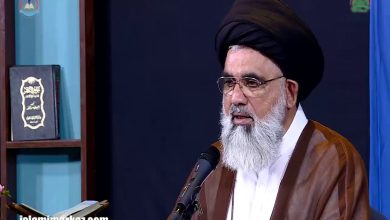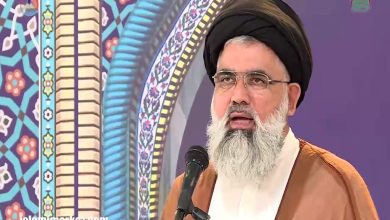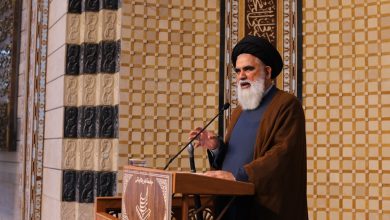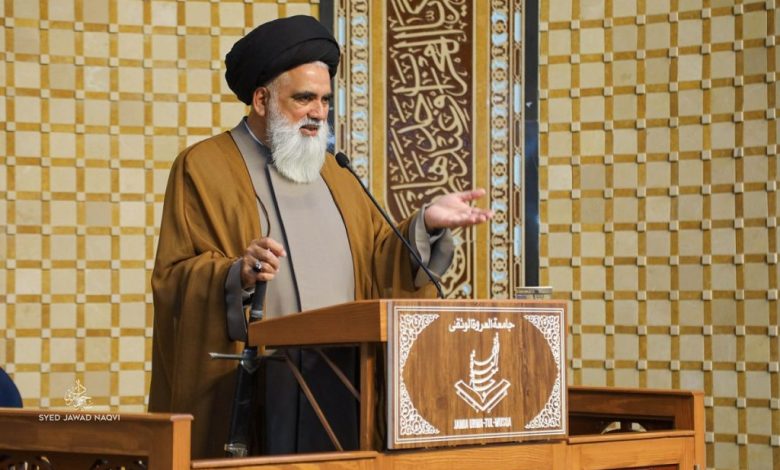
Hujjatul Islam Ustad Syed Jawad Naqvi
(Principal Jamia Orwatul Wuthqa – Lahore)
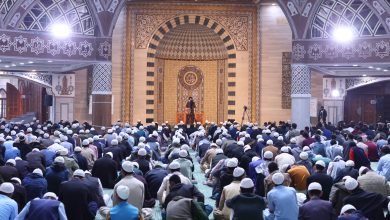
Delivered at: Masjid Baitul ul Ateeq
Lahore – Pakistan
Friday Sermon 26th December – 2026
Sermon 1: Taqwa in safeguarding Ilaah (servitude)
Sermon 2: Sectarianism and the loss of Shia Narrative in Pakistan
Marriage as ‘Aqd’ and the Meaning of ‘Aqeeda’
Marriage is an “Aqd”, which means a strong knot. It does not open easily, just as Nikah is an Aqd and cannot be untied without Talaq. Similarly, “Aqeeda” is not mere information; it consists of certain truths that become absorbed within a person and form the foundation of their thinking.
Taallum and Taabud in Society
In our culture, people generally fall into two categories: “Taallum” and “Taabud.”
Those in Taabud blindly do something when instructed, without thinking or verifying. Those in Taallum know what should be done but do not act upon it. When belief (Aqeeda) is discussed, Taallum is often mistakenly treated as belief. For example, knowing that Allah is omnipotent is Taallum, not Aqeeda. When a person truly accepts this reality and does not obey the commands of anyone other than Allah, that becomes Aqeeda.
Belief and Taqwa in Surah An-Nahl
In Surah An-Nahl, belief is directly linked with Taqwa.
أَتَىٰ أَمْرُ اللَّهِ فَلَا تَسْتَعْجِلُوهُ ۚ سُبْحَانَهُ وَتَعَالَىٰ عَمَّا يُشْرِكُونَ
Allah’s command has come, so do not seek to hasten it. Immaculate is He and exalted above what they ascribe [to Him].
يُنَزِّلُ الْمَلَائِكَةَ بِالرُّوحِ مِنْ أَمْرِهِ عَلَىٰ مَن يَشَاءُ مِنْ عِبَادِهِ أَنْ أَنذِرُوا أَنَّهُ لَا إِلَـٰهَ إِلَّا أَنَا فَاتَّقُونِ
He sends down the angels with the Spirit, by His command, to whomever He wishes of His servants: “Warn that there is no god except Me; so acquire safeguarding of Me.”
Role of Prophets and the Warning (Inzaar)
The angels descend with the Spirit upon those whom Allah chooses, meaning the Prophets and the saints of Allah. After receiving this divine command, their responsibility is to warn people that there is no Ilaah other than Allah and to acquire protection from Allah.
This warning is necessary because there is a severe danger of humans becoming Ilaah themselves or accepting others as Ilaah. If a person takes someone else as Ilaah, the destruction continues indefinitely. Once this belief enters a person’s foundation—that Allah is an Ilaah but others are also Ilaah because their commands are obeyed—then no science can provide salvation. For this reason, Allah raised Prophets to help humanity recognize the true Ilaah and remain in servitude to Allah alone.
Misinterpretation of the Term ‘Ilaah’
There is a serious misunderstanding of the word “Ilaah.” It is commonly translated as someone who is worshipped, and worship is understood as a ritual act, similar to “Pooja” in Hinduism. Terminologically, both Hindu temple worship and Muslim prayers can appear similar as rituals. However, Ilaah actually means a supreme ruler with absolute sovereignty, whose commands are above all.
Uloohiyat refers to giving commands, and Uboodiyat refers to obeying those commands. In Arabic, Abd means something that has been prepared, such as a road being prepared or a camel being trained to obey. Being prepared to listen to commands is Abdiyat, and expressing it is Ibadat. When we perform Salah, it means we are preparing ourselves to carry out Allah’s commands. If Ibadat is reduced to a ritual like Pooja, then it becomes merely an expression of respect. True Abdiyat means readiness to uproot Taghoot and establish the rule of Allah. The mosque is a place of preparation, but the real field of servitude lies outside.
Revelation, Servitude, and Historical Examples
Allah sent books and revelations to the Prophets to prepare people for servitude. Bani Israel were not ready to obey Allah and instead followed Saamri. If today’s generations are compared with Bani Israel, they have surpassed them in deviation, having a Saamri at every level and position. This was the mission given to the Prophets: to prepare human beings for obedience.
We succeeded in producing engineers, doctors, professionals, scholars, and orators, but failed to produce true Abd. Imam Ali (a) had many followers, yet most were not ready to obey. He told Kumail that he possessed an ocean of knowledge in his heart but could not find anyone capable of bearing it. Some people would take support from the public treasury, yet when called for jihad they would make excuses—complaining of cold in winter and heat in summer. Imam Ali (a) said that if they feared cold and heat, how would they face striking swords? He declared them unfit and unprepared.
False Worship and the Reality of Abdiyat
Just as some Hindus worship cows or monkeys, Muslims also fall into worshipping graves, horses, and sages. This is not Abdiyat. Ilaah means only one thing: supreme rulership. In this domain of Ilaah, Taqwa is required. If Taqwa cannot be achieved here, it cannot be achieved in any other field. Failure in this leads to becoming a victim of divine wrath.
People ask where this wrath is, but they are already living under it. The dominance of Taghoot rulers is itself divine wrath. A writer once stated that it feels as though Qiyamat has arrived and many people are already living a life of hell. As the verse says, this is something that should not be hastened.
Taqwa as the Core Message of Verse 2
Verse 2 is specifically about Taqwa. Scholars became entangled in discussions about the Spirit and missed the core message. The verse states that angels descend with the Spirit so that the Prophets may warn people not to accept any Ilaah other than Allah and to acquire Taqwa from Him. Protection must be maintained in this domain to avoid accepting any other Ilaah.
Multiple ‘Ilaah’ in Daily Life
We can analyze how many Ilaah exist in practice. Parents are often treated as Ilaah, but the Qur’an clearly states that obedience belongs to Allah, the Messenger, and Ulool Amr, and all three forms of obedience are actually obedience to Allah, because the Messenger and Ulool Amr are appointed by Allah. Other relationships are based on rights, not obedience. Parents and children have mutual rights, primarily respect and not causing harm.
Similarly, an employer is treated as an Ilaah when whatever he says is obeyed. Employment is based on an agreement of work and payment, not obedience. Scholars and jurists are to be followed only when they convey Allah’s commands. Anyone who makes others obey his own self cannot be obeyed.
Foundation of Taqwa and the Creation with Truth
This is the fundamental level of Taqwa: not associating anyone else with Allah. After this, Allah declares that He created the heavens and the earth with truth, yet the polytheists refuse to accept it.
SECOND SERMON
Below is a direct, faithful English translation, organized under sub-topic headings, written in continuous paragraphs (no bullet points), without inserting phrases like “the speaker says”, and without omitting any sentence or idea. The wording remains as close as possible to the original while being understandable in English. Arabic terms are retained with brief meanings in brackets where needed.
The Misunderstood Concept of Taqwa and the Qur’anic Meaning of Protection
There are people who do not call evil “evil” at all, who completely withdraw from society, remain distant from people, and stay absorbed only in their own remembrance, thought, and worship. Such a person is called a muttaqi (one who possesses Taqwa – God-conscious protection). Even if such a person is foolish, even if there is stupidity and lack of understanding in him, he is still regarded as a great saint (Wali Allah), someone spiritually elevated. But this is not Qur’anic Taqwa. Qur’anic Taqwa means protection. Sacredness is a different matter; protection is another. A protected human being, a protected society, a protected class, a protected nation, a protected life—this is Taqwa. This is the Taqwa that Amir al-Mu’minin (عليه الصلاة والسلام) adopted, practiced, and taught as a system and a strategy, and he also educated his followers and believers upon it. This is extremely important.
The Milad of Amir al-Mu’minin (عليه السلام) and the Blessing Bestowed upon Pakistan
Because these are the days of the Milad of Amir al-Mu’minin (عليه الصلاة والسلام), tomorrow is the 13th of Rajab, the day of the birth of Amir al-Mu’minin (عليه الصلاة والسلام), and it is also a day of impact and significance. Allah the Exalted granted the Pakistani nation a special blessing in the form of Jamia Orwat-ul-Wuthqa. This blessing was given on the 13th of Rajab, meaning its beginning and inauguration took place on this day. Construction had already started earlier, but its opening and formal beginning occurred on this day, and this is a great honor. Tomorrow, insha’Allah, there is a conference related to this, and believers should attend themselves and also bring their friends and acquaintances with them. Some say that they will watch it online. This is not a film that you can just watch online.
Religious Duties Cannot Be Replaced by Online Viewing
For example, when you are invited to a wedding feast (walima), do you say that you will watch it online? The walima is broadcast online, isn’t it? You could just look at its pictures online. Then why do you go there in person, taking your entire family, reaching two hours early? Things that are meant to be watched online can be watched online—news can be watched online, rumors can be watched online, and all other such matters can be done online. But duties (fara’id and wajibat – obligatory acts) must be performed on the ground. Saying that you will watch Friday prayer online or that you will watch such-and-such religious matter online is like saying that you will not even get married and will just watch someone else’s wedding online and be happy. Obligatory acts must be performed. Likewise, these gatherings are not merely about attendance; they carry great benefits. On another occasion, it will be explained what benefits these gatherings and assemblies have, what effect they have on the individual himself, what message they send to others, and what the effects are of not attending them. This will be explained in detail, insha’Allah.
The Hadith “Ana wa ‘Ali” and the Fatherhood of the Ummah
As a brief point, because tomorrow there will be a detailed speech and there will be little time for practical emphasis, it is mentioned that the Messenger of Allah (ﷺ) said a short hadith which can be memorized: “Ana wa ‘Ali abawa hadhihil ummah” (I and Ali are the fathers of this Ummah). This is a hadith of the Messenger of Allah stating that the Prophet is the father of the Ummah and Ali is also the father of the Ummah. Tomorrow is the birth day of the father of the Ummah.
13 Rajab as the Day of Honoring the Father
On this basis, elders of religion and revolution have guided that the 13th of Rajab is a day of honoring the father (Yawm-e-Takreem-e-Walid). Just as the 20th of Jumada al-Thani is observed as the Day of the Mother (Yawm-e-Takreem-e-Madar) due to the birth of Lady Fatima (عليها السلام), similarly, the 13th of Rajab is also the Day of the Father and the Day of honoring fathers. Those who have this blessing, whose parents are alive—may Allah keep them safe—should honor them. Those whose parents are not alive should definitely pray for them tomorrow and seek forgiveness for them. Those whose parents are alive should honor and respect them. Honoring and respecting can also be done for deceased parents by fulfilling their unfulfilled wishes and continuing their righteous deeds. However, those whose fathers are alive should definitely perform a visible, practical act of honor specifically on the 13th of Rajab. Present a bouquet, give a gift, or do something that visibly shows respect. Even a respectful greeting can be a form of honor.
Cultural Respect for Parents and Reviving a Lost Tradition
It is repeatedly emphasized that in the subcontinent there was a beautiful culture which media has largely erased: touching and kissing the feet of parents. This is less common in other nations; even in Iran it is not very widespread, though some special people do it. Among Arabs, respect exists, though it is often expressed by kissing the hand. But in the subcontinent, it was common that when someone met an elder, he would touch or kiss their feet. This is a form of respect and it is extremely noble, especially for parents. Whenever you meet your parents, meet them in this manner, touch and kiss their feet, especially on occasions like Eid or other special days. This too is a method of honoring them.
Those whose parents are upset with them should apologize tomorrow and seek forgiveness properly, making a firm commitment. Because it is the Milad of Amir al-Mu’minin, make your father pleased with you, especially your father. Do not give a gift by taking money from the father himself and then giving it back to him; give something from your own side. Do some good deed, complete a task that your father had instructed, and present its result to him so that he becomes happy. The pleasure of parents shapes both this world and the Hereafter for a person, especially when it is connected to the path of Allah.
Those who have living parents should specifically perform this act on the 13th of Rajab. Either give the gift before attending the conference or after returning from it. The best option is to bring your father to the conference so that he is also honored and respected. Make this a culture. This is the civilization of Ahl al-Bayt which should be present within us. Parents should be respected every day, but tomorrow should be observed symbolically and practically. Parents who endure immense hardships for their children deserve at least one dedicated day of honor. Whether simply or according to one’s means, it should be done. May Allah grant all parents righteous children and protect their children from every evil and calamity.
The Two Groups That Are Destroyed Regarding Amir al-Mu’minin
Amir al-Mu’minin (عليه السلام) said that two types of people will be destroyed regarding him: one is the extremist (ghali), and the other is the one who harbors hatred (nasibi). This discussion is ongoing, and the important point today is that these two groups are doomed. However, there are also those who are saved through Amir al-Mu’minin, and they are the Shi‘a. As the Messenger of Allah (ﷺ) said: “Anta wa shi‘atuka hum al-fa’izun, hum al-muflihun” (You and your Shi‘a are the successful and the saved). Numerous narrations confirm this. Thus, the Shi‘a of Ali are saved, while the extremist and the hateful are destroyed. This destruction is certain and unquestionable.
Distinguishing Shi‘ism from Extremism and Hatred
However, the Shi‘a who are saved must clearly separate their path from that of the extremists and the haters. Shi‘ism is a completely separate path with no overlap with either of these misguided routes. There is no joint, no relationship, no shared point between Shi‘ism and extremism or hatred. Extremists and haters form one stream, while the Shi‘a are an entirely separate stream.
Now attention must be paid to this reality: when a nation, a community, or a group has a leader like Amir al-Mu’minin (عليه السلام), where should it be standing today? Leaving history aside, looking only at the present generation, those who claim to be followers of Amir al-Mu’minin must assess where they should be standing today by following his path, discipline, and personality. This assessment is extremely necessary.
Comparing Followers of Different Schools and Leaders
Look at others as well. Among Muslims, apart from the followers of Amir al-Mu’minin, there are followers of the companions, followers of the caliphs, followers of Banu Umayyah, and they are increasing rapidly in Pakistan. This is a very strange reality in Pakistan, where religious deviation is spreading rapidly. People make noise about atheism spreading, but in reality atheism is less widespread; religious misguidance is spreading more. Hatred and extremism are increasing. Atheism is outright denial of Allah, the Messenger, and the Qur’an, and those people are few. Religious deviation is spreading much more.
In such circumstances, one must analyze where the followers of other leaders stand today by following their leaders. The followers of Banu Umayyah, for example, are ruling in Syria. Look at others similarly in different countries. Then examine the Shi‘a branches that exist today: Ithna ‘Ashari, Ismaili, and Zaidi. Many other Shi‘a branches disappeared historically, but these remain. Observe where the Ismailis stand globally today, where the Zaidis stand, and where the Ithna ‘Ashari stand—especially in Pakistan. This analysis is extremely important for understanding the current condition of the Shi‘a.
The Example of the Plant and the Crisis of Shi‘a Growth
On a previous 13 Rajab program held in this same mosque when it was incomplete, it was said that Shi‘ism must assess where it stands today and where it should have been. An example was given from Jamia, where plants were planted hastily. Some were planted properly, while others were planted with their plastic bags still on. Years passed and those plants did not grow at all. When one plant was removed, it was discovered that the plastic bag prevented contact with soil, nutrients, moisture, and fertilizer. As a result, it did not grow even one centimeter in three years, which is a massive decline for a plant. When the bags were removed and the plants were replanted properly, they grew into strong trees.
This example was used to explain that Shi‘ism in Pakistan has also been buried in “plastic bags,” preventing growth. Despite having leaders like Imam Ali, Imam Husayn, and Imam Mahdi (عليهم السلام), the community has not grown as it should have.
Sectarianism and the Loss of the Shi‘a Narrative
One of the biggest reasons for this stagnation is sectarianism. Shi‘a energy—of scholars, speakers, institutions, and gatherings—is consumed in countering attacks, allegations, and polemics. Entire generations of scholars have been occupied with this defensive struggle. Another major issue is that a nation needs a manifesto, a constitution, a central subject of dialogue. Shi‘a did not choose their own subject; extremists and haters imposed subjects upon them. As a result, Shi‘a energy is spent discussing topics created by others, such as whether Ali is superior to Abu Bakr or exaggerated claims about Ali’s divinity. These were never Shi‘a subjects.
The Shi‘a subject was Imamate, leadership of the world, justice, the system of Wilayah and Imamate, the uprising of Imam Husayn (عليه السلام), and the global justice to be established by Imam Mahdi (عليه السلام). This was the Shi‘a dialogue. But Shi‘a never got the chance to present it.
Reviving the True Shi‘a Dialogue
When Imam Khomeini revived the discourse of Wilayah and Imamate, Shi‘a were surprised because they had been trapped in polemics for decades. Imam Ja‘far al-Sadiq (عليه السلام) condemned extremists, protected Shi‘ism, defined its manifesto, and built its narrative. That is why Shi‘ism survives today.
Shi‘a must establish their own identity, ideology, and dialogue. Following democracy, dictatorship, parties, or personalities at the cost of Imamate leads to humiliation. A humiliated Shi‘a does not represent Ali, Husayn, or the Imam of the Age. The true Shi‘a are those who impose their dialogue upon the world, like Sayyid Hasan Nasrallah, Hizbullah, Sayyid Ali Khamenei, and the martyrs of resistance.
The real Shi‘a dialogue is Imamate and Wilayah as a system, supported by Qur’an, reason, Sunnah, and consensus. Shi‘a must stop promoting the dialogues of extremists and haters and present their own. Imam al-Sadiq (عليه السلام) said: present our words as they are, without adding spice; the world will listen. And it did.
Final Supplication
May Allah, by the blessing of Raj