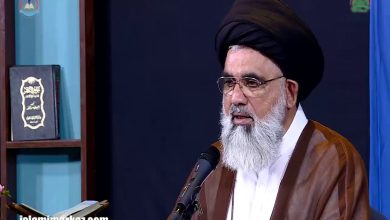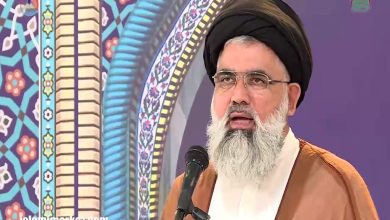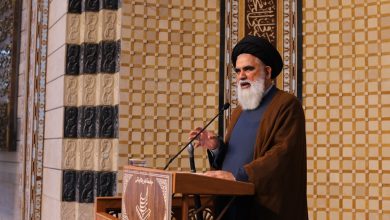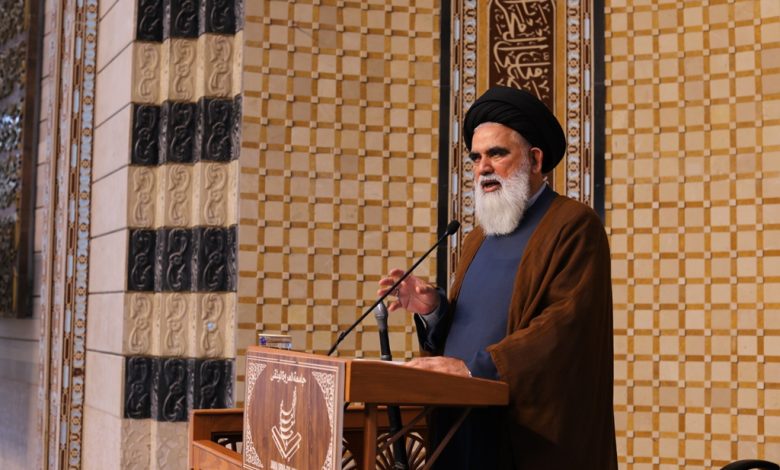
Hujjatul Islam Ustad Syed Jawad Naqvi
(Principal Jamia Orwatul Wuthqa – Lahore)
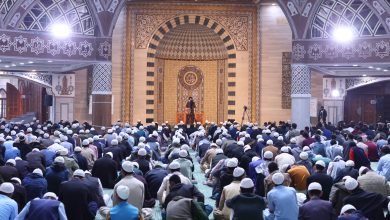
Delivered at: Masjid Baitul ul Ateeq
Lahore – Pakistan
Friday Sermon 26th December – 2025
Sermon 1: Taqwa in Sexual Affairs (21) – Destruction of Community Lut is a sign for all societies
Sermon 2: Ahle Sunnah should protect their sect from Nasibiyat.
SERMON 1
Divine Protection and Human Free Will
Allah created everything and also protected it, but for the human being Allah gave free will; therefore, He also gave a system of protection which man has to follow in order to remain protected. Man faces threats from both outside and inside. From inside, there are abilities which Allah has placed within man for various purposes of living, but when these abilities cross limits and deviate, they result in great threats and destruction for man.
Sexual Ability and the Need for Regulation
One such ability is the sexual instinct, which, when nurtured improperly, takes complete control of a person. We mentioned the incident of Prophet Lut, how when guests came to him, the people of his community rushed to indulge in acts of homosexuality. Prophet Lut advised them to acquire Taqwa and to marry women, and he even offered his own daughters (or the daughters of the community). The protection mechanism is always according to the thing that needs protection. Every ability, even the tongue and the eyes, becomes dangerous when not regulated. The Prophet (s) says that a Muslim is one from whose tongue and hands other Muslims remain protected. Similarly, the sexual ability must be controlled—where it should be used and where it should not.
Spread of Sexual Deviation and the Islamic Protection System
This disease was once limited to a specific community, but today homosexuality and lesbianism have spread across the globe. At the very least, this should not have existed among Muslims, because Allah has given them a beautiful system of protection from sexual deviation: acquiring Taqwa through Iffat (chastity) and Nikah (marriage). In our society, people try to become Muttaqi without Nikah and delay marriage. This ability dominates every aspect of a human being and puts such pressure on a person that he cannot remain Muttaqi.
Consequences of Illegitimate Sexual Practices
In some people, this ability is damaged due to diseases or practices like masturbation, which weaken or destroy it, so that when the time of marriage comes, the person is almost impotent. Across Pakistan, we see advertisements of local sages offering treatments for sexual weakness. Nikah does not weaken any ability; rather, it builds and stabilizes life. Without marriage, when one adopts illegitimate means of pleasure, there are side effects in every affair of life.
Purity Laws and the Impact on the Human Being
A young man once asked me: when we pass urine or use the toilet, a lot of impurity comes out, yet we only need to perform Wudhu, but when semen is discharged, which is very little in quantity, we must perform Ghusl—why is that? I asked him about his state of mind while using the toilet, and he said it is normal. But when semen is discharged, the mind and the entire existence are involved in the act; therefore, everything needs to be washed. In the toilet, only a specific part needs cleaning, but here the entire body must be washed. The side effects of illegitimate sexual pleasure are many—mental, spiritual, and social—and one major effect is physical, where this ability itself is eventually destroyed.
The Second Quranic Account of Prophet Lut
The incident of Lut appears in the Quran on two occasions. The other instance is in Surah Hijr, when the Angels came to Prophet Ibrahim and said that they had come to punish a criminal community. Since that community was under your representative, they said, we have come to inform you. We will destroy everyone except Lut and his followers who acted upon his guidance, except the wife of Lut. It was decided and commanded that she would be among those who would remain behind (Ghabireen), despite being under the Nikah of a Prophet, because she did not follow his path.
Divine Warning, Doubt, and Certainty
When the Angels came to Lut, he did not recognize them. They explained that they were not humans and had come to remove the doubts of his community. The people doubted Lut’s warnings of destruction, as man often doubts the consequences of his own sins. The Angels came not only with words but with reality, so that the people would witness divine punishment with their own eyes.
Discipline, Obedience, and Salvation
The Angels instructed Lut to leave the town at night with his family and followers, quietly, and not to look back. They showed them the path and the way out. The followers of Lut obeyed with discipline, even when they heard massive blasts behind them. A similar test of discipline occurred with the army of Talut, where only a small, obedient group succeeded against Jalut. This highlights the importance of discipline and organization in divine obedience.
Destruction of the Criminal Community
The Quran describes how the people of the town rejoiced when the guests arrived, intending further sin. Lut pleaded with them to acquire Taqwa and not disgrace him before his guests. When they persisted, he directed them toward lawful marriage. At dawn, a tremendous blast (Saihaa) struck, overturning the town, followed by a rain of stones. The entire community was destroyed, while the purified were saved.
Lessons for People of Intellect
Allah states that in this incident are signs for those who possess intellect, insight, and understanding. Social crimes of this nature become the means of societal destruction, and divine punishment descends upon such communities, while only those who remain pure are granted salvation. The ruins of this town were left on a main route as a lasting sign.
Nikah as a Means of Taqwa
Nikah is a means of protection, and one who avoids marriage cannot truly become Muttaqi. Marriage is not a burden but a safeguard. Delaying marriage due to social status, wealth, or false standards leads to corruption and injustice, and parents who impose such criteria often destroy the futures of their children.
The Model Marriage of Imam Ali and Lady Fatima
The criteria set by Ahlulbayt (a) made marriage simple and dignified. The marriage of Imam Ali (a) and Lady Fatima (s) is the perfect example. The Prophet (s) facilitated this marriage personally, focusing on character and faith rather than wealth or status. Imam Ali (a) later described Lady Fatima (s) as the best companion in the servitude of Allah.
Concluding Reflection
Our discussion began with the community of Prophet Lut and the issue of homosexuality. There are further dimensions to this topic, particularly regarding the family system, which may require separate discussion.
SECOND SERMON
Servants of God, I advise all of you and my own self to adopt Taqwa (God-consciousness). I counsel towards Taqwa, I invite towards Taqwa, and I strongly emphasize that you should spend your lives according to Taqwa, live life under the shade of Taqwa, and establish your entire system of life on the foundation of Taqwa. Taqwa is a protective measure from Allah, the Exalted and the Most High, for human life, which a human being must apply and enforce upon his life.
For the establishment of Taqwa and for the measures of Taqwa, Allah, the Exalted and the Most High, has provided every necessary means to mankind and has made complete arrangements. Whatever was necessary, possible, and required for a human being at any time to establish the system of Taqwa—within his own being and within his household—Allah has provided it. Among these, the most important are the Divine Books, the lives and characters of the Noble Prophets and the Pure Imams (peace be upon them), and especially the pure life, blessed conduct, and wisdom of Amir al-Mu’minin Ali (peace be upon him).
Amir al-Mu’minin (peace be upon him) says in Wisdom 117:
“Two kinds of people will be destroyed because of me: an extremist lover and a hateful enemy.”
Regarding me and in relation to me, two servants will be destroyed. One is the one who loves me but commits Ghuluw (exaggeration)—he is an extremist, exceeds limits, raises me to the rank of Allah, and attributes divine qualities to me. Such a person is destroyed, ruined, and doomed. The second is the one who hates me, harbors enmity and hostility; he too will be destroyed. Both the extremist lover and the extremist hater will be destroyed.
These two dangers exist today in their most severe form, especially within our country and land of Pakistan. Within this nation, both of these tribulations have become living, powerful, and deeply rooted trials, and our nation and community are caught in their grip. As a result, the wisdom of Amir al-Mu’minin is clearly manifest today, as this destruction has engulfed Pakistan: the trial of Ghuluw and the trial of Nasibiyyat—hatred toward the Ahl al-Bayt and exaggeration regarding the Ahl al-Bayt—are both in competition with one another, each trying to surpass the other, and the outcome of both is destruction.
For believers in general, and especially for the Shi‘a, the trial of Ghuluw is the most dangerous and severe tribulation. The trial of Nasibiyyat is dragging the Ahl al-Sunnah toward destruction, and we are witnessing that in Pakistan, Nasibiyyat is rapidly spreading. If we reflect, this is truly among the most dangerous phenomena.
Until a few years ago—ten years ago—the intensity of hatred toward the Ahl al-Bayt among Nasibis was not so severe. They existed, but they were few. Today, they are far more numerous. Twenty years ago, Nasibiyyat existed but not to the extent it did ten years ago, and if you continue going further back, it was even less. I remember from our youth and childhood that Shi‘a commonly used to say that every Sunni harbors hatred toward the Ahl al-Bayt, but this was incorrect. Not every Sunni hates the Ahl al-Bayt. They love them, even if they do not share the Shi‘a belief regarding Imamate and intercession. Love certainly exists, and the majority of Ahl al-Sunnah—both scholars and common people—possess this love.
At that time, real Nasibis—those who truly carried hatred for the Ahl al-Bayt in their hearts—were very rare, sometimes not even one in an entire neighborhood or city. Occasionally, one would appear in a city and then spread mischief. Such Nasibis became known; some wrote books, others displayed their hatred through debates. This tribulation is destroying Ahl al-Sunnah by engulfing them.
Today in Pakistan, this tribulation has spread widely. Among the three major Sunni groups—Ahl al-Hadith, Deobandis, and Barelvis—Nasibiyyat is spreading intensely. Ahl al-Hadith are the fewest, Deobandis are more numerous, and Barelvis are the largest in Pakistan, and within all three, Nasibiyyat is spreading. It first appeared among Deobandis, then among Ahl al-Hadith and Salafis, and now Barelvi Sunnism is heavily afflicted, with intense manifestations. Today, many Barelvis openly express hatred toward the Ahl al-Bayt.
One method of expressing hatred toward the Ahl al-Bayt is openly mentioning their names with hostility, but a more common method is praising the enemies of the Ahl al-Bayt. A person does not praise the enemy of someone he loves. One who loves the Messenger of Allah ﷺ will never praise his enemies. One who loves Allah will never praise Allah’s enemies. One who loves the Ahl al-Bayt will never praise their enemies.
Today in Pakistan, all three Sunni streams are affected by this, and it is the responsibility of Ahl al-Sunnah to protect their religion from Nasibiyyat. If Nasibiyyat spreads, Shi‘a will be affected, but only by its smoke; the burning will occur among Ahl al-Sunnah. Fire burns where it ignites; smoke reaches the neighbor. Therefore, Shi‘a will suffer smoke, but Ahl al-Sunnah will suffer the burning. Hence, they must consciously stand against Nasibiyyat, as some senior scholars and researchers are doing—though they are few.
If one does not even sympathize with the Ahl al-Bayt, at least one should love Sunnism and protect it. As for the Shi‘a, if they wish to survive, the tribulation that is devouring Shi‘ism like a monster is Ghuluw—the extremist group. Shi‘ism will never be destroyed by Nasibis, but it can be destroyed by Ghuluw. This is why throughout history, the Imams (peace be upon them) fiercely opposed Ghuluw. They confronted Banu Umayyah, Banu Abbas, and other enemies, but the intensity of their opposition to Ghuluw exceeded that shown toward any other enemy. The Ahl al-Bayt regarded Ghuluw as the greatest tribulation.
They knew that Yazidism and Banu Umayyah could kill them, imprison them, torture them, but they could not stop the path of the Messenger of Allah—and this indeed happened. However, Ghuluw could destroy Shi‘ism, Islam, and the religion itself. Therefore, all the Imams, from Imam Ali (peace be upon him) to Imam Askari (peace be upon him), fought Ghuluw unanimously.
There were many famous extremists during the era of the Imams; some scholars mention seven, others ten. Their influences still exist in Shi‘a books and teachings. I had pointed out that in the fourth Hijri century, when Ghuluw intensified, those opposing it also adopted strong measures. Although Ghuluw had already become prevalent in the second Hijri century, Shi‘a scholars in the fourth century strongly confronted it.
Among them were two renowned figures: al-Kashshi and Ibn al-Ghada’iri. Common people may not know them, but scholars—especially those trained in hadith and rijal—do. Their names are not commonly mentioned in Pakistani seminaries due to the level of curriculum. Al-Kashshi authored Ikhtiyar Ma‘rifat al-Rijal (known as Rijal al-Kashshi), later summarized by Shaykh al-Tusi, who was his student. Ibn al-Ghada’iri also authored an independent work on rijal. These two scholars clearly identified extremist figures, exposed their deviation, and warned the jurists and scholars who had unknowingly fallen under their influence.
Al-Kashshi narrates a tradition (no. 25), later explained by Allama Majlisi in Bihar al-Anwar, volume 25, in Kitab al-Imamah, chapter ten, “Refutation of Ghuluw regarding the Prophet and the Imams.” Imam Ja‘far al-Sadiq (peace be upon him) asked his companion Zurara about Hamza, who claimed that Imam Muhammad al-Baqir (peace be upon him) appeared to him. Zurara confirmed that Hamza spread such claims. Imam Sadiq declared him a liar and stated that what appeared to him was not Imam al-Baqir but a devil created by Iblis, named Mutakawwin, which takes various forms but can never assume the form of an infallible Imam.
This method of extremists exists even today. In Pakistan—Karachi, Lahore, Faisalabad, Rawalpindi—such centers exist where people claim direct contact with Imam al-Mahdi. I have personally witnessed a magician who pretended to convey people’s requests to Imam al-Mahdi, accepting money to approve them. Similar incidents occurred in Rawalpindi, Faisalabad, Lahore, and elsewhere. Fake miracles, fabricated signs, and staged visions are common tools. These individuals exploit emotionally devoted but intellectually weak believers, as Imam Hasan al-Askari (peace be upon him) warned.
In Layyah, a man even announced a specific date for the appearance of Imam al-Mahdi, arranged a gathering, and later claimed the land was now endowed in the Imam’s name. Such centers still exist.All this is deception. Just as artificial intelligence today can fabricate realistic images and voices, Satan fabricated “appearances” in earlier times. Imam Sadiq explained that Satan can imitate anything except the image of an infallible Imam. Whoever claims to see such visions is seeing satanic illusions.
This narration shows the methods used by extremists—methods used in the era of the Imams and still used today. The challenge remains the same. If Shi‘ism in Pakistan is to be protected, it must be safeguarded from Ghuluw, and extremists must be kept away from it. Only then will the door of divine guidance opened through the Ahl al-Bayt remain until the Day of Judgment. Otherwise, extremists are like termites, destroying from within.
May Allah, the Exalted, protect us all from every tribulation. May He protect all Muslims from trials, and especially protect Pakistan from religious, national, and political tribulations. May He protect Shi‘a, help the oppressed of Gaza and Palestine, free all oppressed people of the world from oppression, destroy the oppressors, protect Pakistan from internal and external enemies, grant awareness to its people, disgrace the traitors, hasten the reappearance of His representative, Imam al-Mahdi (may Allah hasten his noble reappearance), and grant us the honor of being among his helpers.
The believers are informed that today, after Friday prayers, the funeral prayer of the wife of respected teacher of the Jamia, Mr. Aghir Sikandar Sultani, will be offered here. Those who are not in a hurry are requested to participate. We offer our condolences to Mr. A
ghir Sultani and his family. May Allah forgive the deceased.