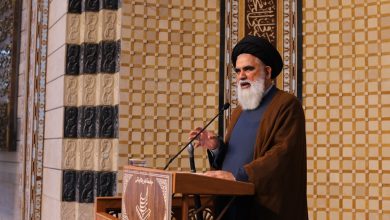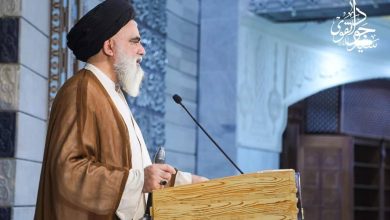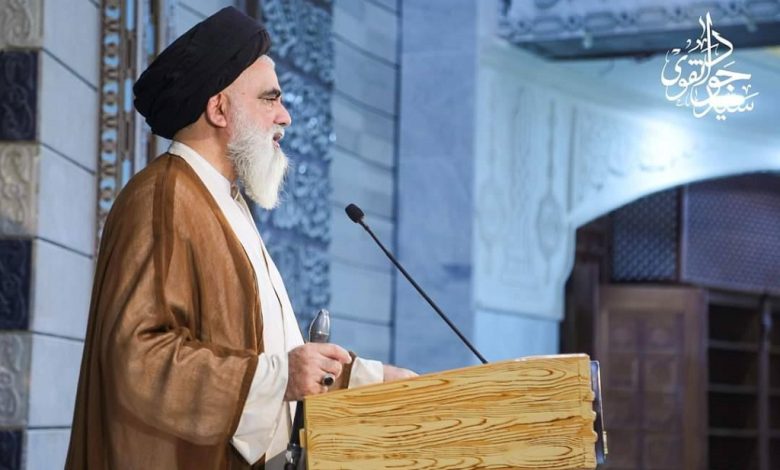
Hujjatul Islam Ustad Syed Jawad Naqvi
(Principal Jamia Orwatul Wuthqa – Lahore)
Delivered at: Masjid Baitul ul Ateeq
Lahore – Pakistan
Friday Sermon 15th August – 2025
Sermon 1: Imam Hussain (a) – From Uprising to Movement
1. The Disgrace of Society and Imam Hussain’s Stand
Imam Hussain (a) witnessed a society that had fallen into moral and spiritual disgrace from every perspective. He did not remain a passive observer but took active steps to lift the people from this degradation. In sermons, particularly the Sermon of Mina, he directly addressed the elites of the time, confronting them about their complacency and warning them of the corruption in which they lived while the state acted unjustly. People had abandoned Amr bil Ma‘roof (enjoining good) and Nahy ‘anil Munkar (forbidding evil) to such an extent that Yazid—an openly immoral and sinful man—was accepted as ruler. While Muawiya had gained power through deception, Yazid’s transgression was public, yet both the masses and the elites either submitted to him or remained silent. Imam Hussain (a) began preparing to rise against him even before Muawiya appointed him as successor. Imam Ali (a) had warned that Muawiya relied on cunning while he himself acted upon Taqwa (piety). History has shown that the same pattern repeated over time—masses deceived by shrewd individuals, abandoning support for the righteous.
2. The Role of Corrupt Scholars in Silencing the Ummah
Imam Hussain (a) strongly condemned scholars who altered religion to suit the desires of rulers. In the Sermon of Mina, he addressed them directly, accusing them of refusing to stand against evil for fear that their stipends and privileges from tyrants would be cut off. These scholars drained the spirit of religion from the people, making the Ummah senseless and inactive. Their influence silenced the masses by convincing them they were weak, or that in the absence of an infallible Imam, resistance was unnecessary. This mindset laid the groundwork for every form of tyranny, just as it did in Karbala. In Kufa, eighteen thousand armed men pledged allegiance to Imam Hussain (a), but fear tactics by Ubaidullah ibn Ziyad and manipulation by local elites led them to abandon their pledge. They were told to protect their lives, dignity, families, and property or face total destruction by Banu Umayyah. Those same leaders who once encouraged allegiance now instructed the people to stay indoors. The masses did not act on independent understanding; their reins were in the hands of elites, rising or retreating at their command.
3. Betrayal in Kufa and Indifference in Hejaz
The Kufans’ behavior was particularly disgraceful because they not only withdrew support but also confronted Imam Hussain (a). In Hejaz, despite the presence of elderly personalities and even some companions of the Prophet (s), people refused his invitation and instead tried to dissuade him. Imam Hussain (a) rejected their advice because his path was firmly grounded in truth, while the elites had created false, alternative paths that he refused to follow. When he reached Kufa, he found the situation worse than in Hejaz—the same people who had invited him and pledged allegiance committed treachery. Yet Imam Hussain (a) remained steadfast in his mission. Even when stopped by Hurr, he clearly stated that he could not accept Yazid’s rule. Umar ibn Saad, after arriving in Karbala on the 4th of Muharram, repeatedly tried to negotiate, but Imam Hussain (a) held firm until his martyrdom on Ashura.
4. Continuing the Mission After Karbala
After the tragedy, the captives—led by Imam Sajjad (a) and Lady Zainab (a)—were taken through courts, prisons, and markets before returning to Medina. They continued the struggle through speeches and guidance, turning the tragedy into a living movement. Imam Baqir (a) and Imam Sadiq (a) later institutionalized this mission, ensuring that Karbala was not merely remembered as a historical event but preserved as an ongoing movement to awaken and mobilize the Ummah. Without their efforts, Karbala would have been reduced to a distant memory.
5. From Movement to Ritualistic Blind Faith
In many regions, the movement’s spirit was replaced by blind, ritualistic belief. In the Indian subcontinent, an emotional, uncritical attachment to anything labeled “sacred” emerged—a trait rooted in pre-Islamic traditions. People began venerating stones, celestial bodies, or self-proclaimed saints without questioning their authenticity. Even educated individuals bowed before false sages. This blind faith turned the revolutionary force of Karbala into a set of rituals that only tranquilized the conscience. For example, some burn tents because Imam Hussain’s tents were burned, or wear shackles because they were once placed on the captives. Orators and religious traders molded these passionate believers into tools for their own agendas. Such people do not see Azadari (mourning rituals) as a call to action against oppression; instead, they reduce it to symbolic gestures.
6. The Problem of Discipleship and Ritualism
In places like Qom and Najaf, there are more disciples than students—people who blindly follow scholars without benefiting from their knowledge. Discipleship, driven by affection and devotion, teaches one only to praise and honor, not to act constructively. Cultural rituals—burning candles, distributing food, crawling toward shrines—become ways to satisfy personal feelings of devotion rather than fulfill the divine covenant. For instance, some Pakistanis began calling themselves “dogs of the Prophet” and even barked together to express loyalty—acts that have no basis in Shariah but fulfill emotional satisfaction. Such people claim that Shariah is one thing and Aqeedat (belief) another, using belief as justification for anything that soothes their conscience.
7. Revival of the True Movement
The Imams intended Azadari to be a movement that stands against oppression, not a ritual that ignores tyranny. In Iran, maintaining the connection between Azadari and activism helped topple tyrants and establish a divine system. Elsewhere, the focus remained on symbolic acts, detaching the practice from its revolutionary roots. As Martyr Murtadha Mutahhari explains, a movement must aim to uproot oppressive systems; rituals without purpose cannot bring change, even if they continue for centuries. The Arbaeen walk, though massive, has yet to fully adopt the mission of Karbala. True movements require sacrifice, resources, and commitment—not just emotional displays.
8. Karbala as the Complete Model of Struggle
In the world today, there are two kinds of large enterprises—those like Bill Gates and Elon Musk in the field of technology, and those religious traders who amass wealth by selling religion. A genuine movement demands the opposite—it requires sacrifice, not profit. Karbala stands as the most beautiful and complete example of such a movement, one that demands that believers rise against tyranny, remain steadfast in truth, and carry the mission forward with sincerity and action.
Sermon 2: Arbaeen without raising voice for oppressed is an Entertainment journey
1. Life Without Taqwa and the Purpose of Karbala
We are living as foremost examples of life without Taqwa, where our lives are insecure and others are unsafe from our actions. Our religion, system, family, and country have all become insecure because we have distanced ourselves from Taqwa. Karbala is the movement that brings people back into the field of Taqwa. Imam Hussain (a) stood against Yazid for the sake of an Ummah that had become insecure under tyrannical rule, a rule the people themselves had accepted. His mission was to awaken this insecure nation, and the Imams (a.s) transformed his uprising into an eternal movement to secure humanity forever. Imam Hussain (a) declared that he was rising for the reformation of the Ummah and to revive divine customs. This movement has continued for centuries, and in our time, the day of Arbaeen is a key reminder of that mission.
2. Arbaeen: From Saddam’s Era to Today
During Saddam’s time, visiting Karbala for Arbaeen was heavily restricted. I personally recorded scenes from that period with a handycam, creating a historical documentary that shows the stark difference between then and now. Today, millions attend Arbaeen. The tradition of walking from Najaf to Karbala, known in Arabic as Mashya, was long ago established by the scholars of Najaf. Initially, it was simply a journey of belief for personal spiritual comfort, with some walking barefoot for a greater sense of contentment. The numbers were small, but after Saddam’s fall, it expanded into a massive international pilgrimage. In this walk, pilgrims are generously served by Iraqis and others—provided with food, massages, and every kind of hospitality.
3. The Absence of Real Movement in Today’s Arbaeen
In recent years, millions have attended Arbaeen out of deep devotion. Yet, if we examine the reality of the movement, it is absent. At the same time as this pilgrimage, tyranny and oppression rage in Gaza, where children are starving to death and bombs fall upon the hungry. Karbala and Arbaeen are meant to embody the stand against oppression. But in today’s Arbaeen, there are no slogans, no steps taken for the oppressed, and no condemnation of oppressors. Billions are spent on food for pilgrims, yet the starving Palestinians are forgotten. Serving food and water on the path to Karbala is rooted in historical symbolism, but when modern Karbalas exist—like Gaza—our presence and resources should be directed there. Imam Hussain (a) himself left Hajj when the reality demanded that he rise to defend sanctities.
4. The Qur’anic Standard of Priority
The Qur’an addresses this very question in Surah At-Tawbah (9:19–20):
Verse 19:
أَجَعَلْتُمْ سِقَايَةَ الْحَاجِّ وَعِمَارَةَ الْمَسْجِدِ الْحَرَامِ كَمَنْ آمَنَ بِاللَّهِ وَالْيَوْمِ الْآخِرِ وَجَاهَدَ فِي سَبِيلِ اللَّهِ ۚ لَا يَسْتَوُونَ عِنْدَ اللَّهِ ۗ وَاللَّهُ لَا يَهْدِي الْقَوْمَ الظَّالِمِينَ
“What! Do you make the giving of drink to the pilgrims and the guarding of the Sacred Mosque like him who believes in Allah and the Last Day and strives hard in Allah’s way? They are not equal with Allah; and Allah does not guide the unjust people.”
Verse 20:
الَّذِينَ آمَنُوا وَهَاجَرُوا وَجَاهَدُوا فِي سَبِيلِ اللَّهِ بِأَمْوَالِهِمْ وَأَنْفُسِهِمْ أَعْظَمُ دَرَجَةً عِندَ اللَّهِ ۚ وَأُو۟لَٰٓئِكَ هُمُ ٱلْفَآئِزُونَ
“Those who believed and fled (their homes), and strove hard in Allah’s way with their property and their souls, are much higher in rank with Allah; and those are they who are the achievers.”
At the time of revelation, some in Mecca compared the merit of serving pilgrims with the merit of those engaged in struggle (jihad) for Allah. Those serving pilgrims claimed superiority, but Allah made it clear—they are not equal. It is oppression to consider them equal, and Allah esteems those who sacrifice wealth and life in His way above all others.
5. Serving the Satiated While Ignoring the Starving
If there were no ongoing jihad or starvation in Palestine, then serving pilgrims would indeed be among the best acts. But most Arbaeen pilgrims are well-fed, financially capable individuals. Serving them while keeping Palestinians hungry—and without even raising a voice for them—is against the spirit of Karbala. When Arbaeen becomes merely a means of personal spiritual satisfaction, it loses its revolutionary essence. The Qur’an grants the highest rewards to those who actively support the struggle against oppression, not to those who only serve fellow believers in times of comfort.
6. The Silence on Oppression
Karbala is the Qiblah of awareness; it should guide our sense of direction. Ziarat to Imam Hussain (a) is meant as a pilgrimage of movement, not merely belief. The true reward lies in supporting the oppressed—in this time, the Palestinians—because tyranny is destroying them daily. Even at Hajj, oppressive regimes like the Saudi authorities silence voices against tyranny, but in Karbala and Najaf, who is stopping us? The shadow of American influence on Iraq is visible, from allowing Israeli use of Iraqi land against Iran to disarming the Hashd al-Shaabi. This could even be why no voice is raised during Arbaeen.
7. When Pilgrimage Becomes Entertainment
A Hajj without disavowal of tyranny is not a true Hajj in the eyes of the Qur’an. Similarly, visiting Imam Hussain (a) merely to enjoy barbeque, fruit, shoe polishing, and massages—without raising a voice for Palestine—turns the pilgrimage into an entertainment trip. The reward, in Allah’s eyes, is for those who are present in the Karbala of today, standing with the crusaders against oppression. A single Hajj or Arbaeen, if directed with unity toward stopping the war in Gaza, could end the suffering.
8. The Call to Action
Imagine if all Arbaeen pilgrims simply sat in Karbala in protest until oppression in Gaza ended—this would mirror the uprising of Imam Hussain (a). Instead, many feel content serving free kebabs to wealthy pilgrims while ignoring the starving. The real place to direct our abilities and resources is toward those oppressed in modern Karbalas. May Allah grant victory and salvation to the oppressed, especially the people of Gaza, through the efforts of all who truly stand in the way of Allah.