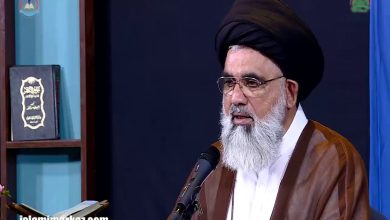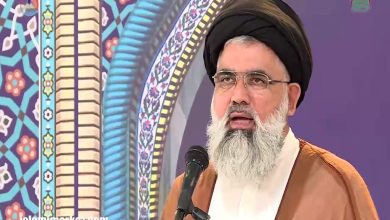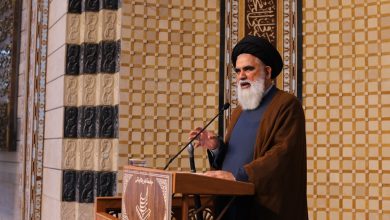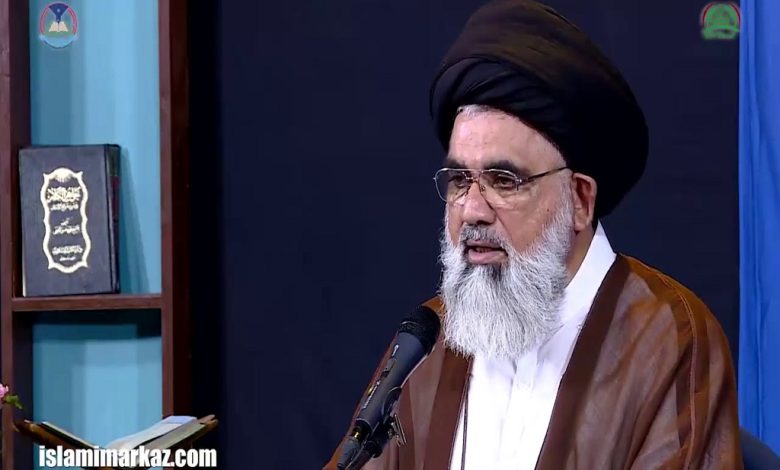
Hujjatul Islam Ustad Syed Jawad Naqvi
(Principal Jamia Orwatul Wuthqa – Lahore)
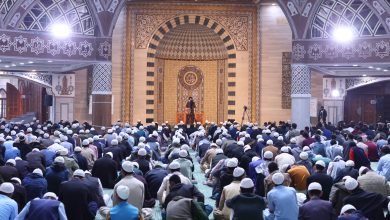
Delivered at: Masjid Baitul ul Ateeq
Lahore – Pakistan
Friday Sermon 2nd May – 2025
Sermon 1 : Recognition of Fitnah needs sense (Aql) and Imam
Sermon 2: Total disconnection from accursed Ghaali’s as instructed by Imam Raza (a)
Fitnah (Sedition) is something that cannot be avoided in society. When people live together, conflicts arise due to competing interests and desires. The consequence is a situation in which people lose clarity and become confused.
The era of Amirul Momineen (a) was one of intense sedition, and he provided guidance both for his own time and for the future. One of the challenges during times of Fitnah is that people often fail to identify the true issue. They become fixated on what they see in front of them and cannot distinguish whether what they are witnessing is sedition or a genuine obligation—thus, they may participate in Fitnah, mistaking it for a duty.
To confront Fitnah, a person needs intellect (Shaoor), not just physical faculties. This intellect develops slowly and much later in life compared to the physical senses, which mature quickly. At times, a person may face trials so severe that they lose their sense of discernment.
Shaoor refers to fine, precise awareness. The word is derived from the same root as “hair,” implying something extremely subtle. Just as it is difficult to find a strand of hair in dust or hay, recognizing the fine and hidden truths during Fitnah requires refined awareness. Fitnahs are similarly subtle, concealed, and not easily detected by everyone.
Allah has created an entire universe within man, and at the center of this internal universe is the Imam. According to traditions, the Imam in a society holds the status of Aql (intellect) and Shaoor (sense). This was the teaching of Imam Sadiq (a) to his student Hisham, who once confronted a scholar from Kufa who was confusing people about the concept of Imamat. Hisham explained that the Imam is like the heart in the body, essential for the functioning of the whole. Upon hearing this, the scholar recognized that Hisham was a student of Imam Sadiq (a). The Imam praised Hisham and urged others to be like him. In this tradition, the Imam is described as the center through which the Ummah receives true understanding.
Unfortunately, the perception of the Imam among some Shiites has been distorted by theological and mystical (Sufi) disciplines. These two schools present opposing views to the Quranic understanding. In their views, the Imam is only a spiritual figure, detached from societal leadership. In contrast, the Quranic Imam is someone granted authority over the affairs of the people, tasked with organizing and guiding them. The Quranic Imam is present in every era. He may be directly appointed by name, like the Prophets or their successors or representatives. The absence of Prophets does not negate the need for an Imam—just as the human intellect is needed in every era. It is against divine wisdom for Allah to leave people without an Imam.
During times of Fitnah, every individual must use their sense and intellect to identify seditions. Today, many believers view certain issues as Fitnah, but ironically, they become involved in actual seditions thinking they are fulfilling religious obligations.
The period of Amirul Momineen (a) was particularly complex. The caliphate came to him amid chaos following the assassination of the third Caliph. The group responsible—Banu Umayyah—engineered the assassination in a way that plunged the Ummah into Fitnah. People turned to Ali (a) for leadership, which was his divine right, yet he did not actively seek power. Though rulership came to his doorstep multiple times, he rejected it because it was not coming through the right means.
He (a) stated that people came to him not because they were righteous, but because all had turned to him, and thus the proof (Hujjah) was established. He was obliged to accept leadership. One of his immediate actions was to recover public wealth held unjustly by elites. Another major step was dismissing corrupt governors, including Muawiyah, who governed Syria. This move sparked Fitnah. Later, the Khawarij emerged. Alongside these major events, many smaller yet significant seditions occurred.
One such case was the dismissal of Abu Musa Ashari, the governor of Kufa. He was widely regarded as a pious and respected religious figure. Despite advice to delay his removal, Ali (a) proceeded. Later, evidence proved that Ashari was indeed unfit to govern, and even Ali (a)’s advisors acknowledged this.
During the Battle of Jamal, Basra became the battleground. The opposing army came from Mecca (Hijaz), while Ali (a) was in Medina. The battle could have taken place elsewhere, but circumstances led it to Basra, where the local governor was appointed by Ali (a), though the majority of Basra’s people supported the opposition.
Ali (a) sent a delegation to Abu Musa Ashari in Kufa, asking him to raise a battalion to support him. Ashari refused, delivered a sermon in Kufa’s mosque, and told people not to participate, calling it Fitnah. Eloquently, he said: “In times of Fitnah, the best person is one who is asleep, better than the one sitting, better than the one standing, and better than the one who mounts a horse.” Ironically, this same Ashari was later appointed as Ali’s (a) representative in arbitration against Amr ibn Aas, where he failed miserably. People then realized Ashari’s true nature. His piety did not help him recognize Fitnah—because it is not sanctity but sense and insight that is required in such times.
Another example from the Battle of Jamal: a companion approached Ali (a) and said, “Do you think we will support you when on the other side are the elites and Ummul Momineen (Aisha)?” Ali (a) responded with unmatched wisdom: “Your mind is narrow. You are judging truth based on personalities. You should first identify the truth (Haqq), then see who stands with it. It is not necessary that elders or famous personalities are always aligned with the truth.”
Even today, people follow personalities rather than truth. Even when those personalities deviate, their followers remain loyal. For instance, Shi’ism has been presented as a sect—but it is not. The followers of Maraje’ Taqleed have become divided into factions, blindly following different scholars. As a result, Maraje’ themselves have differences, and their followers remain divided. By definition, these become sects—where whatever an elder says is blindly followed. But in religion, the foundation must be evidence and reason. If a scholar lacks evidence for a position, you must follow the truth, not the personality.
This has occurred in every era. The Jews followed their rabbis instead of Musa (a) and the Torah. When Christianity emerged, people followed pastors instead of the Bible. During the time of the Prophet (s), everything he conveyed was from the Quran, and the Quran itself warned him: “O Prophet, if you fabricate anything and attribute it to Us, We will not tolerate it.”
During Fitnah, man needs insight, which comes from Aql (intellect)—provided it has been nurtured into a sound intellect (Aql-e-Saleem). This is the source of sense. If you can recognize the truth in complex times, be grateful—you have matured intellect. The second source for recognizing truth in Fitnah is the Imam, but understood from the Quranic perspective, not the Sufi or theological view of the Imam as merely a spiritual being. The Quranic Imam is Allah’s appointed authority on earth, responsible for leading and organizing the people.
SERMON 2
Imam Ali presented the threat from Fitnah’s of Kuluw and Ghuluw.
.وَ قَالَ عليه السلام: هَلَكَ فِيَّ رَجُلَانِ مُحِبٌّ غَالٍ وَ مُبْغِضٌ قَالٍ
Two categories of persons will face ruin on account of me: he who loves me with exaggeration, and he who hates me
Ali (a), in his guidance regarding Taqwa (God-consciousness), taught that sometimes man is destroyed not only by things that are inherently dangerous, but also by things that seem harmless in essence but ultimately lead to destruction. In Saying 117, he explains that two types of people will be destroyed: the Ghaali (those who exaggerate in their love for Ali) and the Qaali (those who harbor hatred towards him).
The Prophet (s) declared that Ali (a) is the means of salvation for the Ummah. However, this very source of salvation also became a cause of destruction for some due to their misguided understanding of him. These two groups—those who exaggerate and those who vilify—existed during the lifetime of Ali (a), throughout the eras of the other Imams (a), and continue to exist today. While in the past such groups would occasionally emerge and then be suppressed, today they have become powerful sources of fitnah (sedition), posing significant threats to the Muslim Ummah.
Pakistan, in particular, has become a highly fertile ground for fitnah. It takes very little effort to create sedition in this land because people’s minds are already prepared to accept such confusion. Consequently, these fitnahs have been welcomed and entrenched deeply.
Although we will also address the issue of the Nasibi (those who hate the Ahlulbayt), here we focus on the sayings related to ghuluw (exaggeration).
Imam Raza (a) on Ghuluw
In Volume 25 of Bihar al-Anwar, Allama Majlisi narrates several traditions from the Imams regarding the Ghaalis. During their lifetimes, the Imams not only resisted the tyrants of their era, such as the Banu Umayyah and Banu Abbas, but also confronted the internal threat posed by the sedition of ghuluw.
In Tradition 17, Chapter 10, Imam Raza (a) narrates a conversation with Mamoon. Mamoon once said to him, “I have received reports that people exaggerate in their beliefs about you and your forefathers.” Imam Raza (a) responded by narrating a tradition from a chain of infallibles—his father Imam Musa al-Kazim (a), from Imam Ja’far al-Sadiq (a), from Imam Muhammad al-Baqir (a), from Imam Ali ibn Husayn (a), from Imam Husayn (a), from Imam Ali (a), and finally from the Prophet (s). This is known as the Golden Chain of narration.
The Prophet (s) said:
“Do not speak about me beyond my station of prophethood. Before Allah appointed me as a Prophet, He chose me to be His servant.”
It is well known that the Prophet (s) preferred to be called “Abdullah” (servant of Allah). He said that Allah revealed the following verses from Surah Ale-Imran:
“It is not for a person to whom Allah has given the Book, wisdom, and prophethood to say to people, ‘Be my servants rather than Allah’s.’ Rather, he must say, ‘Be servants of the Lord because of what you know and teach of the Book.'”
Imam Raza (a) continued:
“Ali (a) used to say that two groups related to me will be destroyed—and I disown both: those who go to extremes in love for me, and those who harbor hatred and reduce me from my rightful status of Wilayah and Imamat.”
Imam Raza (a) told Mamoon:
“We, the Ahlulbayt (a), disassociate ourselves from anyone who elevates our status from the position of servants of Allah to divinity—just as Prophet Isa (a) disassociated from those who claimed he was the son of God.”
Allah asked Isa (a):
“Did you tell people to take you and your mother as gods beside Allah?”
Isa (a) replied:
“Glory be to You! I could never say what I had no right to say. You know what is within me, while I do not know what is within You. I only told them what You commanded me: ‘Worship Allah, my Lord and your Lord.’ I was a witness over them while I was among them. When You took me, You became the Watcher over them. You are a Witness over all things.”
The Messiah was proud to be a servant of Allah, and even the angels never denied this status. Allah says:
“Messiah was only a messenger of Allah. Before him too, messengers passed away. They both ate food.”
Imam Raza (a) explained this verse by saying it affirms the human nature of the Prophets—they ate food and digested it like other people.
Then he added:
“Anyone who believes in the divinity of the Prophets or Imams—we disown such a person both in this world and the hereafter.”
Despite this, today many speakers, orators, and Zakir individuals propagate ghuluw from pulpits—and they do so because there is a market for it. People buy into it.
Further Traditions Condemning Ghuluw
In Tradition 18, Imam Raza (a) says:
“Anyone who believes in hulool (incarnation of divine spirit) is an infidel. May Allah curse the Ghaalis. They believe in predestination. They are like the Magians, the Christians, and the Murji’ah. They are also akin to the Harooris (Khawarij). Do not sit with them, do not testify for them, do not befriend them—stay away from them.”
This refers to the belief that the soul of an Imam or the spirit of Allah enters the Imam—a belief strongly condemned by the Imam. He cursed those who held such beliefs, yet many people today admire them and follow them.
The Murji’ah was a sect born during the time of the Banu Umayyah after the Battle of Siffin. They believed that as long as someone professed the Kalima, no one had the right to criticize their actions, regardless of corruption or sin. Their affairs, they claimed, were entirely in Allah’s hands, and they might be forgiven after death. According to them, no one should interfere in another’s deeds—each person should mind their own business.
Imam Raza (a) also linked the Ghaalis to the Harooris (Khawarij).
In Tradition 19, Imam Raza (a) was asked about the Ghaali and the Mufawwidhah. The Mufawwidhah are those who claim that although Allah exists, He delegated all His power and authority to the Imams after creation. This belief is known as Tafwidh (delegation of divine authority).
Imam Raza (a) responded by stating that the Ghaali are kuffar (disbelievers), and the Mufawwidhah are mushrik (polytheists). He then issued a grave warning: anyone who maintains any kind of relationship with the Ghaalis—whether by associating with them, engaging in transactions with them, eating with them, marrying into their families, giving their daughters to them in marriage, showing them leniency, entrusting them with anything, affirming their statements, or even cooperating with them by as little as a single word—such a person exits the Wilayah (guardianship) of Allah, the Prophet (s), and the Ahlulbayt (a).
Imam Raza (a) is highlighting how dangerous and devastating the fitnah (sedition) of ghuluw truly is. He knew that while the Shia might be able to survive the oppression of the Abbasid regime, they could be internally destroyed by the Ghaalis. Even if Shiism today were to be protected from external enemies such as Israel, America, and the Nasibis (those who hate the Ahlulbayt), it could still be ruined from within by the Ghaalis.
The Imam, being the ‘Aql (intellect) of the Ummah and the center of reason, understood that this form of internal corruption acts like a termite, silently devouring the structure from the inside. This ghuluw has deeply penetrated the community.
Since many people are unaware of the authentic teachings of the Ahlulbayt (a), they accept whatever is preached from the pulpit as genuine Shi’i doctrine. This gives the Ghaalis—those who fabricate lies and attribute them to the Ahlulbayt (a)—an open platform. The result is that others develop animosity toward the Shia due to the distorted image presented by these exaggerators.
The tragic irony is that while the Imams themselves declared such Ghaalis as their enemies, today they are praised and admired by some within the Shia community. Some orators, even if they do not personally believe in ghuluw, resort to it because otherwise they would not receive financial support or invitations to speak. To preserve their income and audience, they choose to exaggerate and deviate.
This is a group from whom true believers must publicly and clearly disassociate. The curse of Allah, His Messenger, and the Imams is upon them—and it is upon anyone who knowingly associates with them.