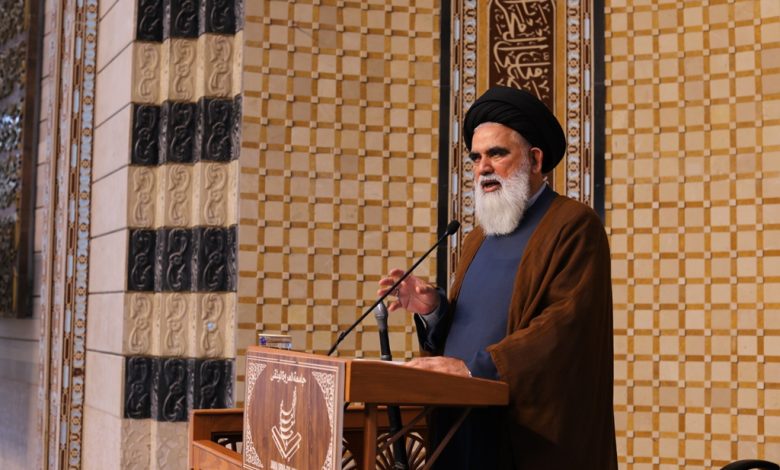
Hujjatul Islam Ustad Syed Jawad Naqvi
(Principal Jamia Orwatul Wuthqa – Lahore)
Delivered at: Masjid Baitul ul Ateeq
Lahore – Pakistan
Friday Sermon 5th December – 2025
1. The Purpose of Life and the Central Role of Sexual Discipline
This limited life is an opportunity granted to us to nurture our potential and abilities so that we may reach perfection and attain union with Allah (Liqaullah). Among the various affairs of human life, the sexual dimension is one of the most significant, yet man behaves ignorantly in this area and adopts whatever comes before him without proper understanding. Allah has ordained Ahkam (laws) to organize human life, and this organization forms the primary philosophy of religion. If life in this world is not structured according to divine principles, then even what follows in the hereafter will not truly benefit from religion. For sexual affairs, Allah has prescribed a specific form of Taqwa. After Taqwa comes ‘Iffat (chastity), and then Nikah (marriage) as the primary means for managing sexual life. If Nikah is not possible for genuine reasons, then ‘Iffat must be adopted. Unfortunately, we have removed Nikah from our religious curriculum and surrendered it entirely to culture. In the chapter of Nikah, whose primary purpose is fulfilling sexual needs, there is also the institution of Tamatto‘ (Mataa). Without Tamatto‘ in life, a person becomes disturbed, distressed, and emotionally drained. In Fiqh, Tamatto‘ has been restricted to a specific technical subject, whereas Tamattu‘ in reality has a much broader meaning. Therefore, it is necessary to first understand the term Tamattu‘ (Mataa) linguistically and terminologically. The Qur’an has used this term in relation to life, Nikah, divorce, and travel—all contexts in which human beings benefit from certain means.
2. The Historical Meaning of Mataa and the Misapplication of Jurisprudence
In Arabic terminology, Mataa was used particularly for matters of travel. In earlier times, economic life depended on herding livestock such as camels and sheep. Roads were not paved, and pathways changed due to sandstorms and dunes. Water sources were scarce, so travelers had to make extensive arrangements to face these hardships. They needed a ride, then water, and then food. Even small journeys, in terms of distance, took several days. The jurisprudential laws regarding shortening prayers (Qasr) were established in that era based on how long travel by camel would take. However, our jurists today apply the technology and standards of the camel era in the age of rockets, giving verdicts according to outdated measurements. Many scholars lack the courage to analyze issues according to the contemporary era. For example, some still refuse to allow moonsighting through technological means, a confusion that should be eliminated through research. Banu Umayyah prohibited Ijtihad after the period of the four jurists of Ahl al-Sunnah. Although the Shia continued research, in many cases the outcomes still resemble those reached without Ijtihad, which suggests that both approaches are producing similar results. Allama Iqbal emphasized the importance of research so that Shariah laws can be applied according to the needs of the time rather than outdated circumstances.
3. Mataa as Ease and Comfort in Human Life
Returning to the meaning of Mataa, when the Arabs traveled, they needed tents, water skins, and other supplies that made the journey easier and reduced hardship. Mataa refers to these comforts—anything that removes difficulty and pressure. These items were easily available at home but not during travel, so travelers had to gather and arrange them beforehand. Mataa thus refers to the means that make travel easy. More broadly, Mataa means to take benefit from things. In our homes today, nearly eighty percent of items—including clothing and kitchenware—remain unused. These unused or extra items are termed ‘Afw. When the Prophet was asked what should be given in the way of Allah, the answer was: give whatever is extra. Believers, however, hesitate to sacrifice anything unless everything is pre-organized and convenient. For example, regarding Friday prayers, we attempt to form committees instead of fulfilling the real purpose. Ideally, we should register the names, contacts, professions, available time, needs, and hardships of those attending Friday prayers. Everyone carries the burden of his own life, but Friday prayer is meant to gather people so they may cooperate in resolving one another’s difficulties. If they begin by solving internal issues such as sickness, unemployment, and marriage needs, they can then extend support to others. If this system begins at the level of a single community, it can eventually reach the national level. People could even bring extra household items to Jamea in an organized manner to be provided to those in need.
4. Tamatto‘ in Daily Life and the Qur’anic Command of Mataa
Just as a traveler needs Mataa to reach his destination without hardship, a person also needs Mataa at home to complete the journey of life. Tamatto‘ means benefiting from the available means to make life easy, whereas its opposite is hardship. Wearing warm clothing in winter to protect oneself from the cold is also a form of Tamatto‘. The first Mut‘ah (benefit) ordained by the Qur’an relates to life itself. Allah says in Surah al-Baqarah (2:36):
فَأَزَلَّهُمَا الشَّيْطَانُ عَنْهَا فَأَخْرَجَهُمَا مِمَّا كَانَا فِيهِ ۖ وَقُلْنَا اهْبِطُوا بَعْضُكُمْ لِبَعْضٍ عَدُوٌّ ۖ وَلَكُمْ فِي الْأَرْضِ مُسْتَقَرٌّ وَمَتَاعٌ إِلَىٰ حِينٍ
“Then Satan caused them to stumble therefrom, and he brought them out from what they had been in. And We said, ‘Get down, being enemies of one another! On the earth shall be your abode and sustenance for a time.’”
Adam and Hawwa were placed in a location with complete facilities and were prohibited from approaching one tree. When Satan deceived them, they were removed from that blessed environment. Allah commanded them to descend to the earth, a place of hardship, declaring that the earth would be their residence and that therein would be their means of life (Mataa). Acquiring the means of life present on earth is Mata‘ ul-Arz. Although everyone does this, modern man does so excessively and wastefully. He extracts unnecessary quantities of oil, gas, and minerals. The earth, which Allah created for all generations, should not be exploited by one generation at the expense of others; using more than what is needed is a form of injustice.
Another Qur’anic reference appears in Surah al-Baqarah (2:241):
وَلِلْمُطَلَّقَاتِ مَتَاعٌۢ بِٱلْمَعْرُوفِ ۖ حَقًّا عَلَى ٱلْمُتَّقِينَ
“For the divorced women there shall be a provision, in accordance with honourable norms—an obligation on the Godwary.”
This means that divorce must also be accompanied by Mut‘ah. At separation, the husband must give his wife sufficient means so that she may settle into her new life without hardship. If she lacks resources and her parents cannot support her, the husband is not allowed to divorce her empty-handed.
There is also Mataa that can be used for negative purposes. For instance, a mobile phone is a necessary and beneficial means of communication, but many youth and women misuse it for immoral purposes. This is termed Mata‘ ul-Ghurur. The Qur’an says:
زُيِّنَ لِلنَّاسِ حُبُّ الشَّهَوَاتِ مِنَ النِّسَاءِ وَالْبَنِينَ وَالْقَنَاطِيرِ الْمُقَنطَرَةِ مِنَ الذَّهَبِ وَالْفِضَّةِ وَالْخَيْلِ الْمُسَوَّمَةِ وَالْأَنْعَامِ وَالْحَرْثِ ۗ ذَٰلِكَ مَتَاعُ الْحَيَاةِ الدُّنْيَا ۖ وَاللَّهُ عِندَهُ حُسْنُ الْمَآبِ
“The love of [worldly] desires, such as women and children, heaped-up treasures of gold and silver, branded horses, cattle and farms, has been made décor for mankind. That is the wares of the life of this world, but the best refuge is with Allah.”
The foremost desire on which human life depends is the attraction towards women; no one can deny this natural inclination. Shahwah refers to strong desires. The love of desires for women has been made an adornment for people. The second attraction is towards one’s children. Then comes man’s love for accumulating piles of gold and silver, which today signifies currency and wealth. After that come horses—now represented by cars—followed by livestock and farmland. These are all Mataa of worldly life, necessary for living in this world, though they do not necessarily benefit one in the hereafter. There are other forms of Mataa that benefit both worlds.
Allah further says:
كُلُّ نَفْسٍ ذَائِقَةُ الْمَوْتِ ۗ وَإِنَّمَا تُوَفَّوْنَ أُجُورَكُمْ يَوْمَ الْقِيَامَةِ ۖ فَمَن زُحْزِحَ عَنِ النَّارِ وَأُدْخِلَ الْجَنَّةَ فَقَدْ فَازَ ۗ وَمَا الْحَيَاةُ الدُّنْيَا إِلَّا مَتَاعُ الْغُرُورِ
“Every soul shall taste death, and you will indeed be paid your full rewards on the Day of Resurrection. Whoever is distanced from the Fire and admitted to Paradise has certainly triumphed. The life of this world is nothing but the wares of delusion.”
A person who enters Paradise is truly successful, but worldly life itself is merely a deceptive Mataa—like intoxicants that allure a person but deceive him once he returns to his senses. The Qur’an uses the terms Matah and Mut‘ah repeatedly to clarify these meanings.
5. Faith, Social Responsibility, and the Violation of Limits
Although people claim to be believers, their behavior—especially in divorce—reveals otherwise. When they separate, they make matters difficult for one another. If a divorce must occur for legitimate reasons, it should be done with ease, not with hostility or by causing suffering to the families involved. Faith is not inherited biologically; being born in a Muslim family does not make one a believer if he engages in corruption and deception. Faith must be earned by observing the limits set by Allah. Believers must remain committed to Haqq (rights) and Hadd (limits), ensuring they never violate them under any circumstances. If another person possesses a right, it must be given to them even if doing so causes personal loss. In matters of divorce especially, we frequently violate rights and limits, allowing minor disturbances to destroy families. This should not occur among believers. If a relationship truly cannot continue, then one must not make each other’s life unbearable. Rather, the separation should occur while fulfilling the rights of the woman so that she does not face hardship.
6. The Purpose of Friday Prayers and the Path to Imamat
Believers today treat the violation of rights and limits as if it were their fundamental entitlement, and this attitude has become a widespread temperament. Friday prayers were established to guide believers and help resolve their personal and communal issues. However, this can only happen when believers take interest and participate with sincerity. Religion must address the problems of daily life; otherwise, it will not be useful even in the hereafter. Those who apply religious principles in social matters and uphold justice and cooperation are the ones whom Allah grants the station of Imamat.
SECOND SERMON
Exhortation to Taqwa and the Exemplary Role of Amir al-Mu’minin (a.s.)
Servants of God, I advise all of you and my own self to adopt the Taqwa of Allah. I counsel you towards the Taqwa of Allah. I invite you towards the Taqwa of Allah and I emphasize that you should spend your lives according to Taqwa, live your lives under the shade of Taqwa, and conduct the affairs of your life on the basis of Taqwa. Taqwa is a protective arrangement from Allah, the Exalted, for human life, and within this arrangement Allah, the Exalted, has secured the outward and inward, worldly and hereafterly life of the human being. Allah, the Exalted, has made the teachings and the lives (sirah) of the noble Prophets (a.s.) and the Pure Imams (a.s.) the source of Taqwa, and the most prominent source and example of Taqwa is the life of Amir al-Mu’minin Ali ibn Abi Talib (a.s.). His wisdom, his government, his Imamate, and his entire life are Taqwa; he is Taqwa in embodied form. If we observe every moment of the life of Amir al-Mu’minin (a.s.), we find the very Taqwa of the Qur’an in embodied form manifest in the life of Ali (a.s.).
Amir al-Mu’minin (a.s.) has said: “هَلَكَ فِیَّ رَجُلَانِ مُحِبٌّ غَالٍ وَمُبْغِضٌ قَالٍ” (Hikmah 117, Nahj al-Balagha). He said that with regard to me, concerning me, two kinds of people will be destroyed: one, the lover who is excessive and extreme (ghali), and the other, the hater who is hostile and full of enmity. I think, for the ladies, a separate sermon is going on; it appears to me that there is a separate ongoing talk there. The one who loves with intensity and to the extent of extremism and ghuluw will be destroyed. I had earlier submitted that this statement of Amir al-Mu’minin (a.s.) regarding himself is a sign of very lofty values, because no leader, no head, whether worldly, religious, political, social, or national, can say to his followers that you too can be destroyed because of your connection with me. This is only the perfection of Mawla Ali (a.s.) that he says: you have a relationship with me, you have love for me, intense love, yet you can still be destroyed. If in this love you show excess, commit ghuluw, and go beyond limits, then you can be destroyed. As for those who harbor hatred, it is understandable that they will be destroyed, but even those who love, if they commit ghuluw, will also be destroyed.
The Ahl al-Bayt (a.s.) have explained this more clearly, and since this is a danger—indeed at this time it is the greatest danger for the Shia—this danger has existed throughout history and still exists today, especially in Pakistan, therefore this topic needs clarification. ‘Allamah Majlisi (r.a.) in Bihar al-Anwar, volume twenty-five, in the chapters related to Imamate, has a tenth chapter titled “Nafi al-Ghuluw” (Negation of Ghuluw), in which ghuluw concerning the Prophet and the Imams (a.s.) has been negated. In that chapter there are a few narrations which we read earlier, and I had pointed out that in those narrations one particular person’s name is repeatedly mentioned on the tongues of the Pure Imams (a.s.). Imam Baqir (a.s.), Imam Ja‘far al-Sadiq (a.s.), Imam Musa al-Kazim (a.s.), Imam al-Rida (a.s.), and even Imam al-Jawad (a.s.), these four or five noble personalities have continuously and frequently cursed one particular ghali individual. Among all, the greatest amount of la‘nat (curse) has been made upon this ghali in the time of the Imams (a.s.).
The Emergence of Ghuluw and the Earliest Ghulat
Ghuluw began in the era of the Imams (a.s.) and became prominent from the time of Imam Baqir (a.s.). It existed even before, but it was suppressed and hidden. From the time of Imam Baqir (a.s.), ghuluw began to rise and the ghulat became prominent and started committing ghuluw regarding the Imams (a.s.). During the time of five of the Imams (a.s.), seven famous ghulat appeared, among whom are Mughira ibn Sa‘id, Banan ibn Sam‘an, Muhammad ibn Miqsemi (or Misqalān), and the Asadi known as Abu’l-Khattab, in addition to a few others, whose mention will come in due course and will be pointed to at the appropriate time. Among them, this person Abu’l-Khattab was the most corrupting, the most fitna-creating ghali. He existed during the time of Imam Baqir (a.s.), and then remained in the time of Imam Sadiq (a.s.). It was in the time of Imam Sadiq (a.s.) that he was killed, along with his companions, in Kufa. The Abbasid governor of Kufa had him killed in Kufa along with his companions, who were around seventy or seventy-two in number. This man caused great trouble to the Imams (a.s.), and the Imams (a.s.) offered the greatest resistance and struggle against ghuluw.
There were many fronts against the Imams (a.s.). The most significant front against the Imams (a.s.) was the Umayyad front, which, after the political downfall of Banu Umayyah, was transferred to Banu ‘Abbas. Banu ‘Abbas adopted even greater severity than Banu Umayyah against the Imams (a.s.), despite the fact that Banu ‘Abbas had a kinship with Ahl al-Bayt, because Banu ‘Abbas were the descendants of the Prophet’s uncle, al-‘Abbas ibn ‘Abd al-Muttalib, who accepted Islam very late, almost together with Abu Sufyan, and they were even friends. Abu Sufyan and al-‘Abbas ibn ‘Abd al-Muttalib had been friends from childhood and remained friends until the end. They became Muslims at almost the same time, with only a very small gap between their conversions. In fact, the one who compelled Abu Sufyan to submit (istislām) was al-‘Abbas ibn ‘Abd al-Muttalib. This is a very interesting incident which I have narrated earlier: at the conquest of Makkah, between these two friends, a complex situation arose, where al-‘Abbas, the Prophet’s uncle, went to Abu Sufyan and said to him: now you cannot be saved; there is only one way left—to become a Muslim. For Abu Sufyan, death was preferable to becoming Muslim. He used to say: it is better that I die than become Muslim, because for me becoming Muslim is humiliation. But on the basis of friendship, al-‘Abbas pressed him very much, and then he finally brought him to say the kalimah. He used to say he would say “La ilaha” but would not say “illa Allah”, then he said: I will say “La ilaha illa Allah” but will not say “Muhammad Rasul Allah.” Then he said: I will say “La ilaha illa Muhammad ibn ‘Abdillah”, but I will not say “Muhammad Rasul Allah.” This debate continued for some time between them. Al-‘Abbas repeatedly came to the Prophet (s.a.w.) saying: now he is saying this much, giving excuses, asking the Prophet (s.a.w.) for concessions that others must read the complete kalimah but accept from him this much that he says, interceding for him. But the Prophet (s.a.w.) said: no, he must recite the full kalimah. In the end he did recite it. Then the compensations and considerations given to him as part of “ta’līf al-qulūb” (winning hearts) are another long story.
In summary, Banu ‘Abbas are the descendants of this same person, al-‘Abbas, so there is kinship between them and Ahl al-Bayt (a.s.) and the Imams (a.s.). Yet, even with that kinship, Banu ‘Abbas increased their severity and harshness against the Imams (a.s.). The reason was that they had taken power under the pretext of their relationship with the Messenger of Allah and through the supporters of the Imams (a.s.), that is, through the Shia—the followers of Imam Ja‘far Sadiq (a.s.) and the followers of Imam Baqir (a.s.). It was they who brought Banu ‘Abbas to power. Abu Muslim al-Khorasani, Abu Salamah al-Kufi, and a few other major commanders were Shia, but their allegiance was tied to Banu ‘Abbas. They raised the banner of avenging Karbala, incited people against Banu Umayyah, and waged wars. The last Umayyad caliph, Marwan al-Himar, was killed at the hands of Abu Muslim al-Khorasani in battle, and in this way power passed to Banu ‘Abbas.
The Abbasid Strategy Against Ahl al-Bayt and the Shia
Once Banu ‘Abbas came into power, the very first step they took was against Ahl al-Bayt and the Imams (a.s.), because they feared that they had gained this rule in the name of Ahl al-Bayt. If, tomorrow, the same Imams or their followers stood up, they could become a problem for Banu ‘Abbas, and they thought: only from their side is our rule in danger; from no other side do we face such a threat. Therefore, they adopted extreme severity and never refrained from any harmful act against the Imams (a.s.). One thing they did was sow division within the family of Ahl al-Bayt, that is, within Banu Hashim. Those who joined Banu ‘Abbas were given protection, rewards, and honors, while those among Banu Hashim who did not join Banu ‘Abbas were subjected to very exemplary punishments and severe hardships of various kinds.
A second step they took was against the followers and students of the Imams (a.s.)—those from whom they themselves had already benefited, that is, the Shia who had formed organizations in the name of Imam Sadiq (a.s.) and then worked in favor of Banu ‘Abbas. This is similar to what some Shias are doing today in Pakistan and in Iraq. In Iraq, elections were recently held, and the Shias inflicted a painful defeat upon other Shias. I do not know whether you read newspapers or not. In Iraq, the majority of the population is Shia, and overall their votes are enough for them to form a government. However, the law there is similar to that of Lebanon: the prime minister must be Shia, the president must be Kurd, and the speaker of parliament must be Sunni. Now, overall, three or four Shia parties have won, but they are still not in a position to form the government, because Shia is not allowing Shia to form a government. One Shia faction vetoes another, saying: if so-and-so leads, we will veto; and if another leads, we will veto. This is what they started there, and nearly similar conditions exist in Pakistan as well. This attitude, where Shias strengthen others’ rule, the rule of other parties and opponents, because of internal rivalries and various justifications, is the same energy that Banu ‘Abbas exploited. They deeply feared the very family whose love they had used as a slogan to gain power, whose name they had used, who had become a means of bringing them to government—and who could also become the means of bringing them down. If their supporters and followers were to unite, the rule of Banu ‘Abbas would come to an end. Since Banu Umayyah had been very powerful and yet their government was ended, Banu ‘Abbas feared the same would happen to them. Therefore, they seized the Shias firmly at the root and never, for a single day, left the Imams (a.s.) and the Shias to themselves.
Banu ‘Abbas used many methods. One method was to create division among the Shias themselves: they would cause rifts, draw some towards themselves, and treat harshly those who remained with the Imams (a.s.). They would pressure them, put them in tight spots, file cases and lawsuits against them, and level various accusations. In different regions they established separate sects. Banu ‘Abbas began a process of sect-making within the Shias. Wherever there were some prominent Shias, they would turn each of them into a separate sect. In Yemen, for example, there were two or three prominent Shia figures, each of whom formed a separate sect. In Kufa, every well-known individual made his own sect. In Basra, wherever there were Shias, Banu ‘Abbas promoted this sect-making to break their strength.
The Abbasid Promotion of Ghuluw as a Weapon
But the most dangerous step that Banu ‘Abbas took against Ahl al-Bayt and the Imams (a.s.) was that they launched an organized movement of ghuluw. They started the fitnah of ghuluw. There were already tendencies in some people, but they did not dare to express ghuluw openly, because they knew that ghuluw is shirk and kufr, and that neither the Shia tolerate it, nor the Imams (a.s.), nor the Sunnis—no Muslim tolerates it. However, the ghulat received official state support from Banu ‘Abbas. Anyone who showed a tendency towards ghuluw was given importance, resources, and backing. They were encouraged: do whatever you want; no one will touch you; we are there over your heads. You may speak openly and do whatever you wish. They helped them as long as these ghulat did not turn against Banu ‘Abbas themselves. For example, Abu’l-Khattab—who was initially a student of Imam Baqir (a.s.), then became a student of Imam Sadiq (a.s.)—was among the trusted and reliable students of the Imam. He had lived his life with the Imams (a.s.). Being a senior student of Imam Baqir (a.s.), he then accompanied Imam Sadiq (a.s.) and was trusted by the Imam.
This is an experience some of you may have had: a person comes close, gains your trust, and then, after gaining that trust, cuts your very roots or misuses your trust. This is quite common. If you have not experienced it, we can share our own experience with you of how often this happens, when a person comes, draws near, earns your confidence, and once that confidence is secured, shows his real face. This has happened many times, is happening, and will continue to happen—this is a pattern. Muhammad ibn Miqsemi (or Misqalān), this Asadi, was among those who first gained the full trust of Imam Sadiq (a.s.). The Imam trusted him and even gave him several responsibilities: he appointed him as his representative in some places, made him the head of some teams, and told certain groups to refer to him and seek guidance from him. In this way, he gained a standing and recognition. When he had fully established his position, he then started his own separate system. Among the students of the Imams (a.s.), some had this organizational and structural capability to form their own groups within a broader body, creating their own lobbies. They had certain leadership abilities and guts, so they would become leaders themselves. For example, students might do this: a sharp and active student gathers classmates or people from his area and builds a lobby, a group. This group then pursues its own interests or even stands against others. Teachers may also form their own lobbies within the staff. This is a common thing, and many of you have experienced harms from such people who, after gaining your trust, create a group within your own circle, benefitting from you and then undermining you from within.
This person had such capabilities. Once he gained the trust of the Imam, and people saw the Imam respecting him and giving him a position, he started building his own lobby with his associates from Kufa and other regions. When he had formed a solid group, he gradually claimed within that group that his relationship with Imam Sadiq (a.s.) was not merely that of an ordinary student. He said he had a different type of connection; while others heard from the Imam’s tongue what he spoke openly, he claimed that he benefited from the Imam through another, hidden way. He asserted that he had a spiritual, unseen connection with the Imam, that while living in Kufa, he could benefit from the Imam in Madinah, that the Imam came to him in Madinah, or to Kufa, or that he could make the Imam appear in Kufa, or that he himself could reach there spiritually. He started presenting such so-called miracles and spiritual claims. When people in his group saw this senior, trusted student of the Imam, respected by the Imam, they became even more influenced. Little by little, as he expanded this system and built a strong faction, he then, step by step, went further and began to claim divinity for Imam Ja‘far Sadiq (a.s.). The detailed story of this is recorded in narrations and history. I am only presenting it to the extent that the narrations in Bihar mention, the few we have read.
In the end, he went to the extreme of claiming that Imam Ja‘far Sadiq (a.s.) was not merely an Imam, not even a Prophet, but, God forbid, Allah Himself, in whom God had incarnated. He said the Imam was no longer a creature, but Allah, and that he himself was the Imam’s prophet. He claimed that Imam Ja‘far Sadiq (a.s.), whom he called God (na‘ūzubillah), had appointed him as His prophet and was spreading His teachings through him, that he had been sent and commissioned to prophethood and that revelation came to him, that wherever he might be, he remained in contact through revelation, and that the Imam was not an Imam but a Lord (Rabb), a deity. People became even more impressed. He further claimed that Imam Sadiq (a.s.) had granted him special teachings not given to ordinary people. What were those teachings? He took one sentence from Imam Sadiq (a.s.) and presented it to people, saying that this special statement was said by the Imam only for him: “اِذَا عَرَفْتَهُ فَقُلْ مَا شِئْتَ” – “When you have attained ma‘rifah (deep recognition), then after that say whatever you wish about us; after ma‘rifah you are permitted to say whatever you want.”
The Imam had indeed said this sentence, but it was half a sentence, and in another context, with its completion. Later, at another time, the Imam stated the full sentence, but he only conveyed this half to the people and then said: I am directly appointed by my Lord, by the deity—na‘ūzubillah, by Imam Ja‘far Sadiq (a.s.). He said: that Shari‘ah which had previously come from the Messenger of Allah has now been abrogated. Now, the Shari‘ah that Abu’l-Khattab will declare, since I have been granted permission “فَقُلْ مَا شِئْتَ”, I have now begun making Shari‘ah. Thus he began presenting a new Shari‘ah in the light of this sentence. He declared that many obligations were no longer obligatory, that what had been wajib before was no longer wajib. He changed the manner and timings of prayer, changed the laws of fasting, changed the rulings of Hajj, and then he made his group recite the talbiyah (labbaik) in the name of Imam Ja‘far Sadiq (a.s.), just as you say labbaik for Allah at Hajj, he had them recite labbaik in the name of Imam Ja‘far Sadiq (a.s.).
When news of Abu’l-Khattab’s actions reached Imam Ja‘far Sadiq (a.s.), the Imam got it verified that he was indeed doing this. When it was confirmed, the Imam then made those statements about him that are reported in the narrations we have read. Let us briefly recall them. The Imam (a.s.) said: may Allah’s curse be upon Abu’l-Khattab and upon his companions. He expressed very great severity. Imam Ja‘far Sadiq (a.s.) said to such an extent that: if I do not curse this ghali, this polytheist, this corrupt individual, then I fear that Allah may send punishment upon me. If I do not reject and deny him and remain silent, I fear Allah may punish me. Then the Imam (a.s.) said that just as people had spread things about ‘Isa ibn Maryam (a.s.), if ‘Isa (a.s.) had remained silent over what people said, it was possible that Allah would have sent punishment upon ‘Isa ibn Maryam for his silence. Therefore, I have deemed it necessary.
When people asked why the Imam had adopted such severity against Abu’l-Khattab, the Imam (a.s.) gave this reasoning: it is wajib upon me, obligatory upon me, in my capacity as Imam and leader, to expose this fitnah for the people. Those few narrations—our time has passed—are very important. I will, in the next sermon, present them fully in this context regarding Abu’l-Khattab, that Abu’l-Khattab is the ringleader of ghuluw in history, who took ghuluw to its ultimate extreme. Previously, those who committed ghuluw did so to a certain limit, but he went far beyond, and the Imams (a.s.) also continued, because his ideas and his group continued to exist until the time of Imam al-Jawad (a.s.), and every Imam considered it his duty to curse him and to warn the Shias against his beliefs. Sometimes Shias were astonished: this man is narrating the virtues of the Imams (a.s.), yet the Imams (a.s.) curse him. Some people tried to interpret this by saying that when the Imams (a.s.) curse him, they mean someone else in reality, that outwardly they curse him but inwardly they mean his opponents. This is an important chapter of history, about these seven individuals, these seven ghulat. Among them, some were such that Imam Hadi (a.s.), it seems, appointed certain people especially to counter them, because Banu ‘Abbas, having benefited from them, were using them to break Shia ranks. Banu ‘Abbas supported and backed these ghulat. They would spread such ideas about the Imams (a.s.) that people became even more alienated and repelled from Shi‘ism. Through such statements, Banu ‘Abbas were pleased and took great advantage.
Even today, if you look, many governments support the ghulat. Many states favor those who commit ghuluw. For example, in Pakistan, the government gives special freedom to the ghulat, allowing them to commit as much ghuluw and as much insolence as they wish in order to defame Shi‘ism, and some Pakistani governments even stand by them and give them importance. This is my personal experience: I was once sitting with a very high-ranking government official, and a ghali told me in his presence, as a kind of threat: “Have you heard of so-and-so?” I said: I have heard the name but do not know him. He said: “You will come to know him well. We have specially prepared this person for you.” If necessary, I can mention his name at some point. A senior intelligence officer told me this: “Do you know so-and-so?” I said: I have heard his name but do not know him. He said: “In future you will know him very well, because we have specially prepared him for you.” I was astonished: what is his connection with you, and why did you prepare him? For the solution of which problem have you prepared this fitnah? This conduit has been prepared to weaken Shi‘ism.
There are many strategies, and among them this one has been the most effective: creating doctrinal weakness within the Shias, diverting their doctrinal direction, creating deviation. This deviation takes the Shia very far from the truth. Hence, this was a major fitnah in the time of the Imams (a.s.), and it still continues. Many great scholars have vigorously struggled against them, following the example of the Imams (a.s.). Scholars like Shaykh Mufid, Shaykh Tusi, and Shaykh Saduq, in particular, struggled against these ghulat and protected Shi‘ism. If Shi‘ism is saved from the evil of the ghulat, then Banu Umayyah and Banu ‘Abbas cannot harm it as much. If the Shias are protected from the ghulat, who are like inner termites, then outsiders cannot cause them any serious harm. This is the achievement of the Imams of guidance (a.s.) that they saved the Shias from the ghulat, those who were like internal worms, and because of this, external enemies could not inflict real damage upon Shi‘ism.
May Allah, the Blessed and Exalted, grant all of us the tawfiq of understanding the religion, understanding the Qur’an, the teachings of Ahl al-Bayt (a.s.), and remaining firm on the path of the Imams of guidance (a.s.). May Allah, the Blessed and Exalted, grant all of us this tawfiq, insha’Allah.