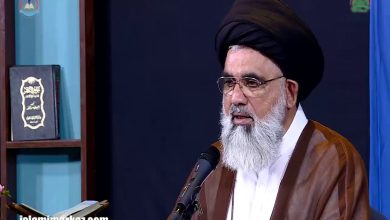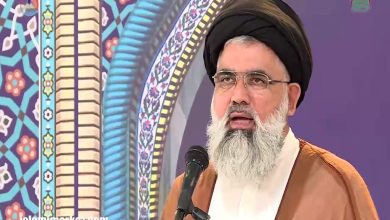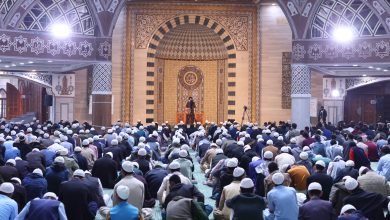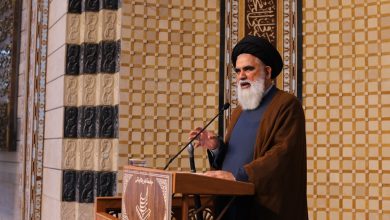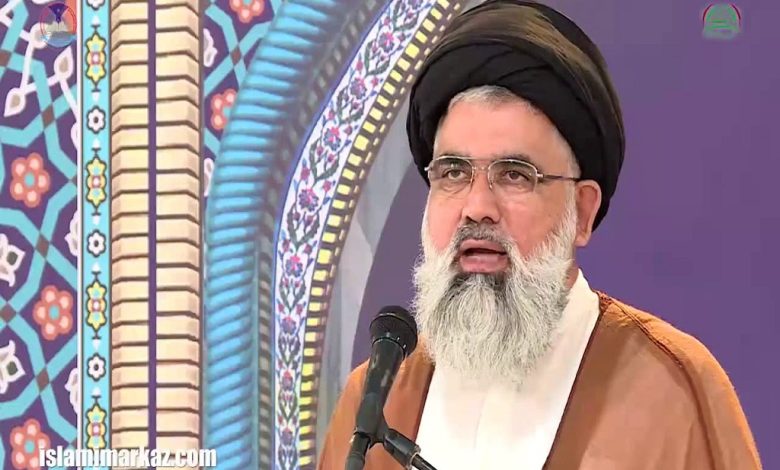
Hujjatul Islam Ustad Syed Jawad Naqvi
(Principal Jamia Orwatul Wuthqa – Lahore)
Delivered at: Masjid Baitul ul Ateeq
Lahore – Pakistan
Friday Sermon 22nd August – 2025
Sermon 1: Taqwa in Sexual Affairs – Part 3
Sermon 2: Betrayal of Muslim Rulers
Human life has many dimensions and arenas. Although man often limits his life to a few aspects, the majority of life’s domains become victims of his negligence. He gives attention only to those few dimensions that are tied to instincts or immediate pleasures, while neglecting other important aspects. Among the most significant of these dimensions—one that impacts many other areas of life—is the sexual aspect of human life.
Like other creatures, man also possesses this instinct. Just as Allah (سُبْحَانَهُ وَتَعَالَى) has provided guidance and systems of protection for the various dimensions of human existence, He has also given guidance for this dimension. He has instructed for its protection, and made Taqwa mandatory in this aspect of life. If man fails to protect his sexual life and does not safeguard himself, his destruction becomes inevitable.
In Surah Hud, Ayah 78, Allah (سُبْحَانَهُ وَتَعَالَى) narrates:
وَلَمَّا جَاءَتْ رُسُلُنَا لُوطًا سِيءَ بِهِمْ وَضَاقَ بِهِمْ ذَرْعًا وَقَالَ هَذَا يَوْمٌ عَصِيبٌ وَجَاءَهُ قَوْمُهُ يُهْرَعُونَ إِلَيْهِ وَمِن قَبْلُ كَانُوا يَعْمَلُونَ السَّيِّئَاتِ ۖ قَالَ يَا قَوْمِ هَؤُلَاءِ بَنَاتِي هُنَّ أَطْهَرُ لَكُمْ فَاتَّقُوا اللَّهَ وَلَا تُخْزُونِ فِي ضَيْفِي ۖ أَلَيْسَ مِنكُمْ رَجُلٌ رَّشِيدٌ
The people of Lut (عليه السلام) fell into sexual perversion; they did not adopt Taqwa in their sexual lives, and thus they faced destruction and annihilation. Allah (سُبْحَانَهُ وَتَعَالَى) sent the angels to Lut (عليه السلام), so they may punish his people but protect the pure ones who accompanied him. The angels came in the form of human guests. When the people heard of their arrival, they rushed to Lut’s house, driven by the same sexual sickness in which they were afflicted.
When Lut (عليه السلام) realized their intentions, he warned them: “These are my guests; do not dishonor me. If you wish for lawful fulfillment, here are my daughters for marriage. Fear Allah and do not disgrace me.” But they replied, “You know well what we desire.” At that moment, the angels disclosed their true identity to Lut (عليه السلام) and assured him: “Do not fear; we have come with the cure for this disease. Now is the time—leave this town with your family, for we shall annihilate this community.” And indeed, once Lut (عليه السلام) and his family departed, the punishment descended and the town was completely destroyed.
This is an example given by the Qur’an of a society that fell prey to sexual corruption. The result was collective annihilation, proving that sexual perversion leads to the downfall of entire communities.
The Qur’an explains that sexual desire itself is not a sin. It is not fisq, fujūr, or kufr. It is not a fault, nor is it something shameful. Rather, it is a natural instinct, a demand of human creation and nature. Just as hunger and thirst are natural needs, so too is sexual desire. It arises within man, it develops, it grows stronger, and it seeks fulfillment.
Just as Allah (سُبْحَانَهُ وَتَعَالَى) has provided a system for fulfilling hunger—where food must be both halāl and tayyib—He has likewise prescribed a system of discipline for fulfilling sexual needs. If a person eats harām or impure food, his hunger may be satisfied, but his being is corrupted. Similarly, sexual needs must also be fulfilled in the manner Allah has commanded, through halāl and pure means.
Allah (سُبْحَانَهُ وَتَعَالَى) has provided three measures for the proper direction and protection of sexual instinct:
1. Taqwa – Guarding oneself, creating an inner barrier against disobedience, and living under the protection of Allah’s commands.
2. Nikāh (Marriage) – The practical method of protection; the divinely ordained system for channeling sexual energy in a safe and constructive way.
3. ‘Iffah (Chastity) – If marriage is temporarily not possible due to circumstances, man must observe chastity, restraining himself and protecting his dignity until lawful means become available.
These three are not alternatives to each other, as if one can choose only one. Rather, they work together. The primary path is Nikāh, because it is the practical means of implementing Taqwa in sexual life. Through Nikāh, sexual instinct is not suppressed or destroyed, but directed in a healthy and balanced way.
Nikāh is therefore the shield and safeguard of human sexual life, just as locks, guards, and cameras protect physical property. For sexual life, Allah (سُبْحَانَهُ وَتَعَالَى) has ordained Nikāh as the protective system.
As soon as a person reaches bulūgh (puberty), when this energy awakens within him, the first responsibility placed upon him is Nikāh. The Qur’an prescribes that this energy must be directed immediately through lawful marriage. If marriage is delayed due to circumstances, then the emergency measure is ‘Iffah—but it is temporary, not permanent.
In truth, Taqwa in sexual life = Nikāh and ‘Iffah together. Nikāh fulfills the instinct lawfully, while ‘Iffah preserves dignity in times of necessity.
Unfortunately, people have not understood Religion as a complete system of life. Scholars and jurists extracted moral lessons and ritual rulings, but many failed to present Islam as a living constitution and manifesto of life. The Prophet ﷺ received religion from Allah as a system of life, and he implemented every aspect of it—including Nikāh. He himself contracted multiple marriages, arranged marriages for his companions, and commanded them to marry. He even rebuked those who avoided marriage, reminding them that abstaining from Nikāh is not piety, but deviation.
Why? Because sexual desire is among the most powerful forces in human existence. Hunger only affects a specific part of the body, but when sexual desire awakens, it seizes the entire being—the body, soul, intellect, emotions, and even spirituality. For this reason, Islam places such strong emphasis on Nikāh as the natural safeguard.
When a person’s sexual life is disciplined and directed properly through Nikāh and Taqwa, the results are positive in every aspect of life. Such a person studies better, works more productively, thinks more clearly, plans more wisely, and excels in all fields of life. His energy is channeled constructively, and he enjoys inner stability.
On the other hand, when one’s sexual life is disturbed and disorganized, the consequences are destructive. Such people often suffer from psychological pressure and physical illnesses. In our societies, people cannot openly share these struggles—not with parents, not with relatives—so they hide these disturbances inside themselves. Hidden within, these issues begin to harm both body and soul.
For example, when a student tries to study but is afflicted by inner sexual unrest, he cannot focus on what the teacher is teaching or what the book says. His mind is overwhelmed with unrelated thoughts. He is under immense pressure, unable to concentrate. In contrast, one who has organized his sexual life through Nikāh and Taqwa can study with clarity, absorb knowledge, and perform far better.
The same applies to worship (‘ibādah). Many people stand in prayer, in congregation or alone, but their minds wander restlessly. From the beginning to the end of the prayer, they remain distracted because their minds are dominated by inner sexual disturbances. Thus, they cannot taste the sweetness of worship, nor develop devotion and inclination toward it.
Why? Because sexual unrest absorbs all human energy. The energy that should be spent in worship, knowledge, reflection, and progress is instead consumed by uncontrolled desire. This explains why the Qur’an has emphasized organizing this dimension of life with such care.
The sexual instinct is powerful, stronger than hunger or thirst. Hunger may cause physical discomfort, but sexual desire, when aroused, overtakes the entire human being—body, soul, mind, intellect, and emotions. Its influence is overwhelming. This is why Allah (سُبْحَانَهُ وَتَعَالَى) prescribed such a firm, comprehensive, and constructive solution: Nikāh.
Nikāh directs this immense energy toward positive outcomes. A person with a disciplined sexual life achieves better results in learning, worship, social relations, and spiritual growth. In contrast, those who remain disorganized often suffer breakdowns in every field.
Yet, in our societies, we have ignored this Qur’anic guidance. Many continue to fulfill their desires in disorganized, unlawful ways—through lustful gazes, friendships with non-mahram, indecent films, and other harām avenues—while neglecting marriage. The Prophet ﷺ warned that even a lustful gaze at a non-mahram counts as a form of zina. Such habits destroy both chastity and society.
Thus, Qur’an and Islam present Nikāh as the divinely ordained system of protection, just as they have prescribed systems for every other aspect of human life.
Unfortunately, we Muslims have not truly understood Dīn as a complete system of life. Instead of treating it as our constitution and way of life, many scholars and jurists reduced it to abstract discussions, moral exhortations, and matters of ritual reward (thawāb and ‘ajr). The practical, systemic nature of Islam—as a discipline to organize human life—was neglected.
For example, the Qur’an’s guidance on Nikāh is meant to be implemented as a system. The Prophet ﷺ himself established it, married multiple times, encouraged and even commanded his companions to marry, and rebuked those who avoided it. Yet, many of our so-called pious figures today avoid marriage under the illusion of Taqwa, while secretly satisfying their desires through disorganized and unlawful means. This hypocrisy has spread across society, leaving sexual life unprotected and chaotic.
As a result, the vacuum left by Muslim scholars in this field has been filled by non-Muslim intellectuals. The philosophies guiding our societies today are not derived from the Qur’an, the Ahl al-Bayt (‘a), or even Muslim thinkers like Iqbal or Imam Khomeini. Instead, the dominant ideas shaping our culture, education, and social life come from three Western figures of the 19th century:
1. Karl Marx – A German philosopher, who diagnosed the disease of economic injustice. He saw that the poor were becoming poorer and the rich richer. His solution was class struggle and socialist revolution, leading to the rise of communism in the 20th century.
2. Charles Darwin – The English naturalist, who introduced the theory of evolution. His ideas about human origins and natural selection became the foundation of modern biology and are taught in every school and university, often without critique—despite the weaknesses in his theory.
3. Sigmund Freud (Zigmund Freud) – An Austrian psychologist, who diagnosed the psychological crises of his time. He concluded—through studying patients under hypnosis and therapy—that behind most psychological disorders, personality conflicts, and social dysfunctions lay sexual disorganization. According to him, around 90% of mental disturbances had roots in unresolved sexual issues.
These three men belonged to the 19th century (al-qarn al-tāsi‘ ‘ashar)—a century that reshaped the modern world. In this period, global crises emerged: wars, revolutions, the fall of empires, and the rise of new powers. The current world order, with its ideological, political, and social structure, is largely a product of the 19th century.
Just as the 2nd and 3rd centuries of Hijrah were decisive in shaping the Islam we have today—when the Umayyads and Abbasids engineered much of the intellectual and sectarian framework—the 19th century played the same role in shaping modern secular civilization.
Our tragedy is that instead of being shaped by the teachings of the Qur’an and Ahl al-Bayt (‘a), our societies, schools, and even our personal lives are shaped by Marx, Darwin, and Freud. These men diagnosed real problems, but their solutions were flawed—yet the world adopted them because they appeared to offer immediate remedies. Meanwhile, the Qur’anic system—perfect and comprehensive—was neglected.
SERMON 2
Without Taqwa, nothing remains safe—humanity, religion, land, honor, wealth, even one’s very personality. Just as others are unsafe from a person who has abandoned Taqwa, likewise he too is unsafe from the harm of others. A life without Taqwa is insecure, and under the hands of such people, the lives of others also become insecure.
The greatest evidence of this in our times is the condition of today’s humanity. Look at Gaza: before the eyes of the world, mass slaughter is taking place. Innocent men, women, and children are being starved, denied water, bombed, and buried alive. And the world, including the Muslim Ummah, watches in silence.
Criticism of Muslim Ritualism:
It is astonishing that when religious occasions arrive—like Muharram or Rabi‘ al-Awwal—Muslims perform rituals with such zeal that one would think they are the most God-conscious people, ready to sacrifice everything for faith. Yet, in these very gatherings, no meaningful word is spoken against the oppressors, nor is any practical support offered to the oppressed. Religion has been reduced to customs and ceremonies, while the Qur’an demands Taqwa expressed through action, justice, and resistance against tyranny.
Now, with the coming Mawlid of Rasul Allah ﷺ, Muslims prepare to spend millions on celebrations, lights, and ceremonies. This year is especially significant, for it marks 1,500 years since the blessed birth of Rasul Allah ﷺ. But despite the grandeur of celebration, Gaza will remain in blood, and Palestine under betrayal.
Betrayal of Muslim Rulers:
The speaker exposes that:
• Muslim rulers—including Saudi Arabia, UAE, Qatar, Bahrain, Turkey, and Pakistan—are all partners in betrayal of Palestine.
• Their silence in the face of Israel’s crimes is part of their political bargain with America. Pakistan’s renewed alliance with the U.S. is built upon this silence.
• Genuine protests in support of Palestine are suppressed. Those who raise their voices against Israel and America are branded as “terrorists,” while the real betrayers are honored as allies.
Only Iran and Yemen are excluded from this betrayal. All others—including the Taliban in Afghanistan—have chosen silence.
Israel, with this support, has begun annexing Gaza and the West Bank. Mahmoud Abbas and his collaborators have long paved the way. This is nothing short of the burial of Palestine—and Muslim rulers are participants in its funeral.
Divine Promise:
But Allah (سُبْحَانَهُ وَتَعَالَى) declares:
وَمَكَرُوا وَمَكَرَ اللَّهُ وَاللَّهُ خَيْرُ الْمَاكِرِينَ
“They plan, and Allah plans. And Allah is the best of planners.”
Though oppressors scheme to erase Palestine, Allah’s plan shall prevail. He has promised that the mustad‘afīn (oppressed) will inherit the earth, and the mustakbirīn (arrogant oppressors) will be vanquished.
Through the struggles of the Mujāhidīn of Hamas, Palestine, Yemen, and Iran, Allah will, insha’Allah, destroy the seed of corruption—Israel and its backers.