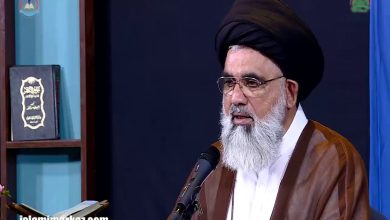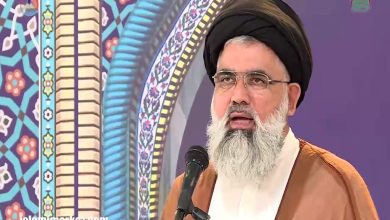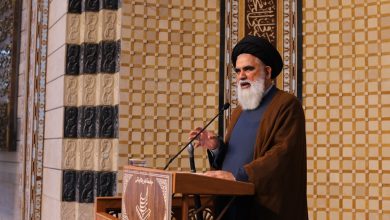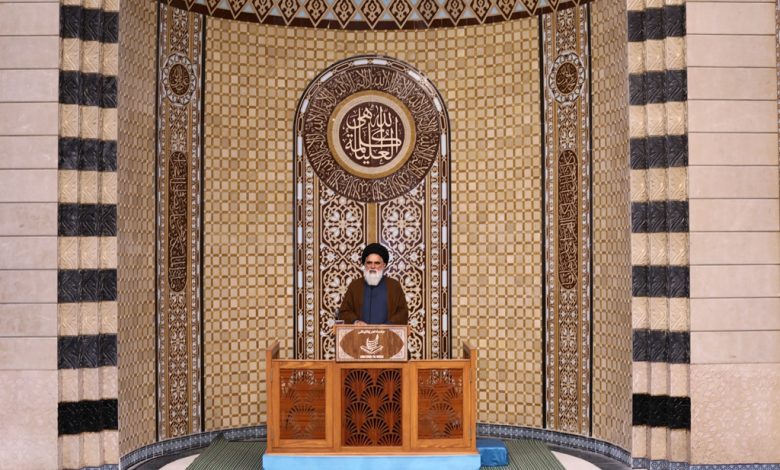
Hujjatul Islam Ustad Syed Jawad Naqvi
(Principal Jamia Orwatul Wuthqa – Lahore)
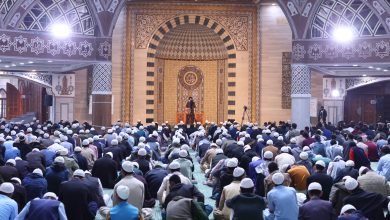
Delivered at: Masjid Baitul ul Ateeq
Lahore – Pakistan
Friday Sermon 20th June – 2025
Sermon 1: Living with the Truthful: Divine Guidance for a Protected (Taqwa) Social Life
Sermon 2: Iran’s war is a battle of survival for Pakistan
1. Social Life as the Basis of Human Existence
Social life is the foundation of human existence, through which both the world and the hereafter are developed for man. Therefore, the maximum focus of Quranic guidance is on social life, and likewise, the arrangement for the protection of human life—known as Taqwa—is more relevant to social life.
2. The Concept of Maiyat (معیت) in the Qur’an
One important dimension of social life, as described by the Qur’an, is “Maiyat.” It means “to be with,” as in the verse “Indeed, Allah is with the patient” (Inna Allah Ma’a As-Sabireen). Maiyat refers to the relationship that is established when people come together. Social life is built upon this foundation of living together and progressing towards common objectives. Every person is under someone’s Maiyat, while others are under his. Within the family, those you live with are part of your Maiyat and you are part of theirs. Some aspects of your life are shared with them due to cohabitation, and this shared experience is referred to as “Ma’a.” Your friends, companions, and social groups whom you interact with are also part of your “Ma’a.” Likewise, the leaders and guides whom you follow are in your Ma’iyat, and you are in theirs. Those with whom you are estranged or have enmity are not part of your Ma’a, even if they are physically close.
3. The Need for Protection in Companionship
The Qur’an links Taqwa to this concept of Maiyat, indicating the need for protection within the field of companionship. When you enter family relationships, form friendships, become part of a community or system, you inherently require Maiyat. You live with people with whom you have commercial, cooperative, or other forms of relationships. These include your social, religious, political, community, and business companions, who become essential parts of your life. Major life decisions are made within these circles. Some people complain about being born to certain parents, and vice versa—some parents feel irritated with their children or spouses. Despite living together, they may dislike each other. Sociologists have argued, with evidence, that these companions play a significant role in the development of human personality. Even traditions state that a person is recognized by his friends, and that one is upon the religion of his companions. A person’s friends determine whether he is corrupt or righteous. Companions exert both direct and indirect influence on a person.
4. The Influence of Companionship on Human Nature
When you travel with someone for a while, you may start speaking in their manner or using their expressions. Children who mix with other children adopt certain behaviors from them. When the environment changes, they emerge from the effects of the previous one. However, continuous companionship leaves a more lasting impact and plays a significant role in shaping personality. Thus, companionship brings both benefits and dangers. Since man is inherently social and must live among others, he is inevitably influenced by them. This requires no further proof—it is obvious that we affect and are affected by those with whom we share our lives. For instance, COVID-19 spread among people who were close to those infected. The proposed treatment was social distancing and isolation. If someone was infected, it was necessary to distance and isolate them to prevent further spread. Similarly, spiritual and social dangers arise from wrong companionships, which is why protection in this area is crucial. But this cannot mean complete detachment, as social life itself is indispensable.
5. Qur’anic Command to Join the Truthful
Allah has provided a beautiful system of protection in the form of Taqwa. In Surah Tawbah, there is a verse that many have heard frequently from orators:
يَا أَيُّهَا الَّذِينَ آمَنُوا اتَّقُوا اللَّهَ وَكُونُوا مَعَ الصَّادِقِينَ
“O you who believe! Be conscious of Allah and be with the truthful” (9:119).
This verse addresses a society of believers (Aamanu), and the concept of faith (Emaan) here is according to the Qur’anic standard, not simply verbal declarations. According to the Qur’an, Emaan means to have trust, reliance, and inner satisfaction in certain principles, adopting them practically for life’s affairs. For instance, one may claim to believe in Imamat, but if he relies on democracy for political matters, then his real faith is in democracy, not Imamat.
The Qur’an is addressing those who have real trust and dependence on Allah, the Messenger, and the divine constitution that governs their lives. Such people are commanded to acquire Taqwa. Unfortunately, some scholars, despite their deep knowledge of Arabic, forget the language when reading the Qur’an and blindly follow predecessors. They translate “Ittaqu” as “fear,” while the grammar actually instructs to “acquire protection.” The Qur’an is telling us to seek protection through Allah and to be with the truthful (Saadiqeen).
6. Ahlulbayt (a) as Exemplary Models of Saadiqeen
In Shia traditions, Imam Sadiq (a) explains that the “truthful ones” (Saadiqeen) refers to Ali (a) and the Ahlulbayt (a). When interpreting the Qur’an, we believe traditions serve as Tafsir (interpretation) of verses. Scholars note that most traditions serve as Tatbiq (application), where they provide practical examples rather than confining the meaning of the verse. If we claim a tradition as Tafsir alone, then the verse would only apply in that limited context. For example, if one points to a person and says “this is a human being,” it doesn’t mean others are not. Rather, it’s a reference or application of the general category. Thus, the Ahlulbayt are undoubtedly the most eminent and pure reference for Saadiqeen, but it doesn’t mean no one else in the Prophet’s Ummah can be considered among the truthful.
7. The Definition and Standard of Truthfulness
A Saadiq is one whose words align with what is in his heart, and whose inner self aligns with reality. If a person’s speech, actions, and heart are all in harmony with truth, then he is a Saadiq. The Qur’an commands believers to live with such people. To be with the truthful is to live a life of Taqwa—of spiritual protection. Truthfulness (Sidq) is a central theme of the Qur’an, but unfortunately, we deceive ourselves by claiming truthfulness despite lying all day. If our hearts, words, and actions are grounded in reality, only then can we call ourselves truthful.
8. The Obligation to Associate Only with the Truthful
This Qur’anic command to be with the truthful is obligatory (wajib), not merely recommended. However, it is often not listed in books of Islamic law. Still, the Qur’an makes it clear—it is not optional. There are levels and categories of truthfulness among the people around us: rulers, leaders, politicians, friends, business partners, organizational peers, and relatives. Either they must be truthful, or we must limit our companionship only to the truthful. We cannot treat truthful and untruthful people equally. You must live with the truthful and end relationships with those who are not. It is a flaw for a believer to associate with such individuals. The Qur’an says: “Is the believer like the transgressor?” Yet today, believers make no distinction. The Qur’an instructs us to avoid companionship with such people.
9. The Consequences of Wrong Companionship
Your friends and companions should be among the truthful. Hypocrites and liars should not be part of your social circle. You cannot eliminate all liars from the world, but your Taqwa lies in choosing the truthful. Unfortunately, many believers today are friends with both the allies and enemies of Allah. This must stop. We are not allowed to create our own standards of companionship. If you want to live and die as a believer, you must live with the truthful. If you live among liars, you will not be protected. Your end will be like theirs. If a bus is about to fall off a cliff and both a believer and a hypocrite are sitting together, both will perish. The wise action is to step off the bus.
10. The Call to Action: Purify Your Circle
“Koonoo Ma’as Saadiqeen” is a divine formula. If you understand it, you should commit to it. Make a list of all your companions, identify those who are not truthful, and remove them from your inner circle. You may still exchange greetings, but they should not be counted among your companions. Many people who once were companions deceived you in business or personal matters. They are no longer your companions, even if you still say hello. The downfall of today’s Muslim society is a result of neglecting this divine law. Muslims have befriended hypocrites, and mixed companionship has only led to harm. They have not aligned themselves with the truthful and have instead partnered with liars, leading to collective disgrace and decline.
SERMON 2
The Command of Qur’an and the Test of Truthfulness in Our Times
The current conflicts in Gaza and the aggression against Iran are, in essence, a divine test for the humanity of every individual. As emphasized in Surah Tauba, verse 119, Allah commands believers to be with the truthful—not with oppressors, tyrants, liars, or those driven by personal interests. This is not a recommendation but a clear and obligatory directive from the Qur’an.
A scholarly debate surrounds the application of this verse—whether it only applied to those who were with the Prophet (S) during his lifetime or continues to be relevant beyond that era. If one adheres strictly to sectarian interpretations, each group claims to be the only truthful ones. However, this is the battle of 72 sects that the Qur’an urges us to transcend. The Qur’an is not a book limited to the Prophet’s time; it is timeless, as Imam Baqir (a) stated, it rises like the sun for every age, offering renewed guidance to every generation. It is always fresh and ever-relevant. The verse addresses “believers,” and if believers exist until the Day of Judgment, this command remains applicable throughout time. A true believer, at every stage of life, must stand with the truthful and never with the liars.
The Crisis in Gaza and Iran: A Measure of Who Stands with Truth
Today, Israel—a brutal monster—has committed genocide against the Palestinians while many so-called believers have remained silent. In contrast, American university students and even corporate employees have raised their voices. Imam Ali (a) instructed to stand with the oppressed, and this moment is a test to see how many truly do. If one believes in the Qur’an and the Sunnah of the Prophet and the Ahlulbayt (a), then he must align his heart, speech, and actions with them. Evaluate the global situation based on these criteria and you will see clearly where truth stands.
Pakistan, until recently, had not stepped into the fray for Palestine, but now, after Israel’s attack on Iran, its politicians and leadership have declared their support for the truthful ones. The Palestinians are the truthful; Al-Aqsa is their right. The Jews do not belong in Palestine. It was Britain that seeded this corruption, aided by Arab complicity in dismantling the Ottoman Empire. Israel is not on the side of truth.
The Iran-Israel Conflict and the Hypocrisy of Global Powers
The recent attack on Iran was orchestrated by the U.S. through its Zionist ally, Israel. Their motive was to halt a Muslim nation from becoming a nuclear power. International law allows nations to develop technology for peaceful purposes, yet while Israel possesses nuclear arms and is not a signatory to the NPT, Muslim countries are denied this right. Iran was negotiating, not attacking—yet they were struck and their commanders were killed. Who then is truthful? Iran, its leadership, its people, and the resistance fighters. The Qur’an calls believers to stand with the truthful. This ongoing war is separating the true believers from pretenders.
At this very time, Pakistan’s army chief visited the U.S. While diplomacy is not inherently wrong, it is important to recognize the regional context. This is not just my concern—political figures like Maulana Fazlur Rahman, Siraj ul Haq, Hafiz Naeem, and others have declared that this attack on Iran is, in fact, an attack on the entire Islamic world. The next target could be Pakistan. Iran was about to become nuclear; Pakistan already is. If the aggressors cannot tolerate Iran reaching that point, how will they accept a nuclear Pakistan?
Pakistan’s Historical Role and Lessons from Zia ul Haqq
The U.S. has historically exploited Pakistan. From Zia ul Haqq to Musharraf, Pakistani rulers have been lured into American wars, especially in Afghanistan, only to be discarded and insulted once they were no longer useful. On his first day as President, a U.S. leader used vulgar language against Pakistan, despite having taken billions from the country. Now, Pakistan is once again being wined and dined—with no free lunch intended. These gestures are not favors but attempts to extract silence or complicity in war.
Remaining neutral in such a war is tantamount to supporting the tyrants. The Pakistan government has, however, taken a commendable stand—declaring that they stand with Iran. Fazlur Rahman clearly stated that it’s not enough to condemn Israel; we must stand with Iran. To not do so would be to stand with Trump, and on the Day of Judgment, you will be raised with Trump, Yazid, Shaddad, and Pharaoh. It is not Pakistan’s honor to stand with liars; it must stand with the truthful.
An Unseen Chapter in History: Zia ul Haqq’s Support for Iran
Despite coming to power illegitimately, Zia ul Haqq played a major role during the Iran-Iraq war—a role hidden from the Pakistani public. An elderly religious leader admitted he was unaware until it was explained. While many Muslim nations, under American pressure, supported Saddam, Zia ul Haqq sent a battalion of 5,000 troops to Iraq, instructing them to avoid the frontline and only provide training and logistics. On the other hand, Iran was under complete boycott and severely outmatched. Despite this, Zia ul Haqq supported Iran quietly and fully—handing over airbases and ports to them. He even visited Imam Khomeini multiple times as head of the peace committee between two Muslim nations. The Iranian ambassador confirmed that the Supreme Leader reminded Shahbaz Sharif of how much Pakistan, under Zia, had done for Iran.
The Battle of Today and the Responsibility of Pakistan
Today’s war is not just Iran’s—it is a war against the Qur’an, against Islam, and against all Muslim nations. If Pakistani generals do not stand with Iran now, they do not deserve their ranks. If you want to protect Pakistan, you must help defend it from Tehran. You must strike Israel before its dream of a Greater Israel destroys the Muslim world—including Pakistan. Modi, an ally of Israel, was sent by the U.S. to crush Pakistan but failed. Netanyahu has openly threatened Pakistan’s nuclear capability. Their plan was to finish Iran first, then move on to Pakistan, but they underestimated the followers of Haidar.
Standing with the truthful is essential for the survival of Pakistan. As Maulana Fazlur Rahman and others have said, the government must decide how to support Iran practically. What matters is that the people stand with Iran. For the first time, Israel is facing collapse. As Imam Khomeini said, Israel must be destroyed—and it is happening. Leader Khamenei wished that Hezbollah or Hamas would destroy Israel, but Allah seems to have chosen Iran for this purpose.
The Qur’anic Obligation and the People’s Role
Pakistan must not remain a spectator. Today is Friday, and it is a day to come out in solidarity with Iran. The entire nation should rise daily in support. It is Qur’anic obligation to be with the truthful. If not, you will be counted among the oppressors—Modi, Netanyahu, and Trump. The people of Pakistan have already shown solidarity; the next step is simpler. Israel has reached a critical stage where its survival is at risk. The very powers that pushed it into war are now scrambling to save it. They have already proposed negotiations in Geneva. They thought Israel would destroy Iran in one day, but they forgot Iran’s warriors are the followers of Haidar—who uprooted the gates of Khyber after 39 days.
Victory is not measured by the first strike. As the Leader has said, Iran will deliver such a blow to Israel that it will never forget. Iran is not sitting idle; the setbacks it faced were due to hypocrites. But now, Iran’s true face has emerged, and Allah is with Iran, the oppressed, the Palestinians, and the steadfast. And Allah will surely destroy the oppressors. In these very days, we will witness Allah erasing Israel from the earth through the hands of these warriors. May Allah protect Iran, its Leader, its fighters, and the people of Palestine.